

Axiology in research refers to the role of values, ethics, and researcher judgement in the research process. It examines how a researcher’s beliefs, assumptions, and ethical considerations influence the design, conduct, and interpretation of a study. On this page: What is Axiology? Axiology in Research Philosophy When to Use Axiology Axiology in the Age of AI and Digital Research Philosophy Role of Values Researcher Position Methods Positivism Value-free Independent Quantitative, structured Realism Value-influenced Aware of bias Mixed methods Interpretivism Value-bound Part of research Qualitative, in-depth Pragmatism Value-driven Flexible Mixed methods Axiology across research philosophies What is Axiology? Axiology is a branch of philosophy that studies judgements about the value[1]. The term axiology is derived from the Greek and means ‘value’ or ‘worth’. Axiology is engaged with assessment of the role of researcher’s own value on all stages of the research process.[2]. It is a relatively recent addition to the area of research philosophy. Axiology primarily refers to the ‘aims’ of the research. This branch of the research philosophy attempts to clarify if you are trying to explain or predict the world, or are you only seeking to understand it.[3] Axiology focuses on how researcher values influence the research process and findings. Not sure about axiology and research methodology for your dissertation? Get a clear, justified methodology for your research topic in minutes See how it works In simple terms, axiology focuses on what do you value in your research. This is important because your values affect how you conduct your research and what do you value in your research findings. Moreover, axiology relates to a dissertation or any research for that matter in the following ways: 1. Ethical Considerations. Axiology guides the researcher in addressing ethical issues that may arise during the research process. It…
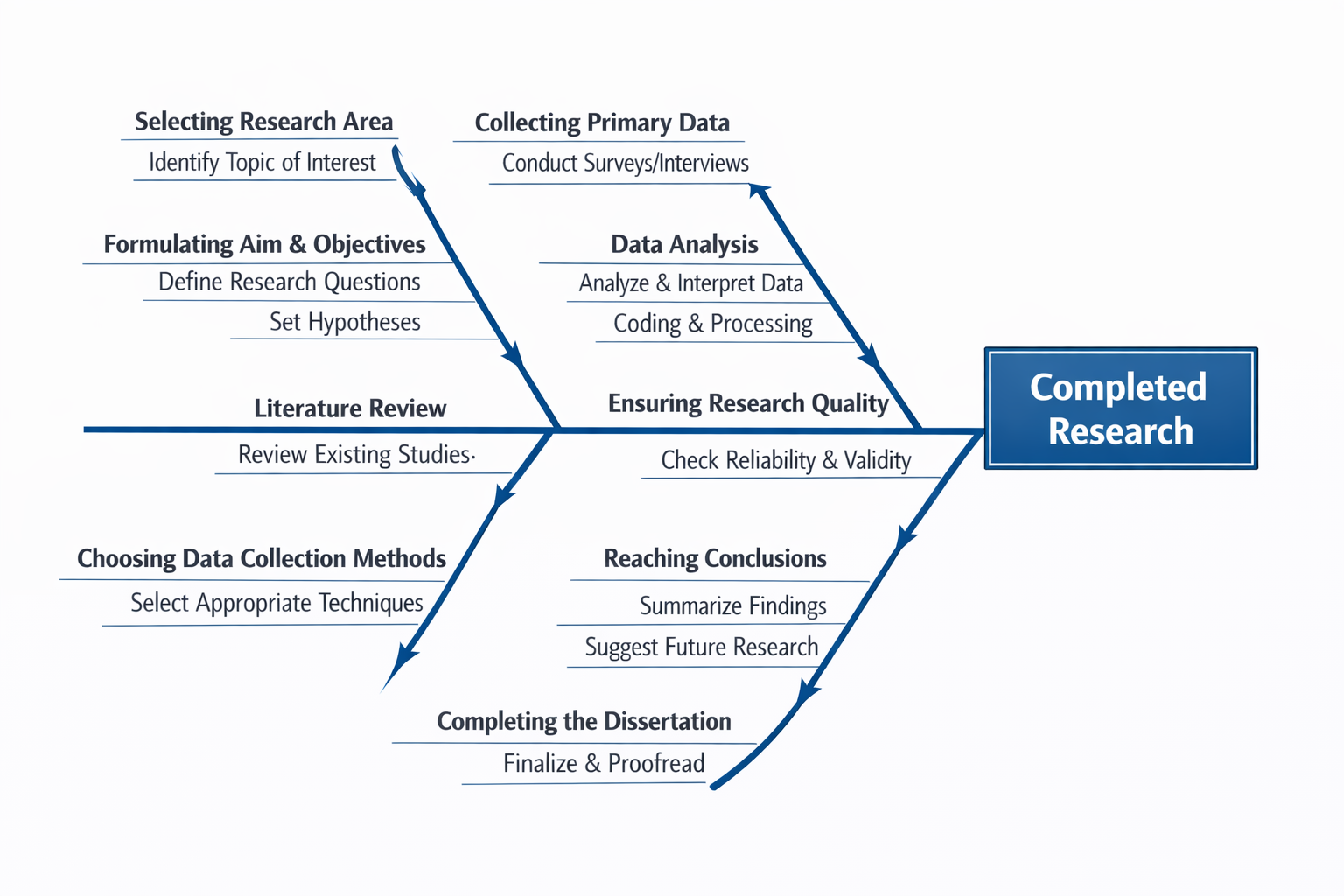
The research process refers to a structured sequence of steps that guide how a study is conducted, from selecting a research topic to reaching conclusions. The research process guides researchers from selecting a topic to reaching conclusions and presenting findings. On this page: What is Research Process? Stages of Research Process Research Process in the Age of AI and Contemporary Research Stage Main Purpose Typical Output Topic selection Identify research area Research topic Aim and objectives Define research direction Research questions or hypotheses Literature review Analyse existing knowledge Theoretical foundation Data collection Gather relevant data Dataset Data analysis Interpret findings Research findings Research quality Ensure validity and reliability Credible results Conclusion Answer research question Final conclusions Research process at a glance What is Research Process? Research process is a step-by-step approach used to conduct academic research properly. Instead of collecting information randomly, researchers follow a logical structure that helps them: define the research problem collect relevant data analyse findings reach reliable conclusions Each stage of the process supports the next stage, making the research more organised, credible, and academically valid. For example, researchers cannot analyse data properly before selecting appropriate data collection methods, and they cannot choose suitable methods before defining research objectives clearly. Not sure about research methodology for your dissertation? Get a clear, justified methodology for your research topic in minutes Learn More About the Tool Stages of Research Process Dissertation markers expect you to include the explanation of research process in methodology chapter. A typical research process consists of the following stages: 1. Selecting the research area. The research process begins with the selection of a research area. Your dissertation marker expects you to state that you have selected the research area due to professional and personal interests in the area and this statement must…

Sources for literature review can be divided into three categories as illustrated in table below. In your dissertation you will need to use all three categories of literature review sources: Sources of literature Characteristics Examples Primary sources for the literature High level of detail Little time needed to publish Reports Theses Emails Conference proceedings Company reports Unpublished manuscript sources Some government publications Secondary sources for the literature Medium level of detail Medium time needed to publish Journals Books Newspapers Some government publications Articles by professional associations Tertiary sources for the literature Low level of detail Considereable amount of time needed to publish Indexes Databases Catalogues Encyclopaedias Dictionaries Bibliographies Citation indexes Statistical data from government websites Sources for literature review and examples Generally, your literature review should integrate a wide range of sources such as: Books. Textbooks remain as the most important source to find models and theories related to the research area. Research the most respected authorities in your selected research area and find the latest editions of books authored by them. For example, in the area of marketing the most notable authors include Philip Kotler, Seth Godin, Malcolm Gladwell, Emanuel Rosen and others. Peer-reviewed academic journals. Peer-reviewed journal articles represent the most important source of literature for most dissertations. These articles present original research findings, theoretical developments, and empirical studies that have been evaluated by experts in the field before publication. Because of this rigorous review process, journal articles are considered more reliable and academically credible than many other sources. In business and management studies, influential journals include sources such as the Harvard Business Review, Journal of Business Research, Academy of Management Journal, and Strategic Management Journal. Access to these articles is typically obtained through academic databases such as Scopus, Web of Science, Emerald Insight,…
Sometimes you are required to explain your literature search strategy used in your research. Even when you are not officially required to do so, including the explanation of literature search strategy in the literature review chapter is going to boost your marks considerably. Keeping a literature search diary to write your search activities is a good way of keeping track of your literature review progress. The diary can be in the paper format, a Microsoft Word file or an Excel spreadsheet and include the following Names of sources Search terms used The numbers of search results generated from each source. Generally, you can conduct your literature search strategy in the following stages: 1. Identification of search terms. For example, for a study entitled “An investigation into the impacts of management practices on the levels of employee motivation at Coca-Cola USA” search terms can be specified as management, management style, motivation, employee morale, leadership, satisfaction, work-life balance, and others. Your search strategy for the relevant literature should also consider synonyms of key words. For example above, the search term of employee motivation might be referred to elsewhere as employee morale or employee willingness. 2. Identification of databases and search platforms. It is useful to explain which academic databases and search platforms were used during the literature search process. Different databases specialize in different subject areas and contain different collections of academic journals. For business and management studies, commonly used databases include Scopus, Web of Science, Emerald Insight, ScienceDirect, and Google Scholar. Explaining the choice of databases demonstrates that the literature search was conducted systematically using reliable academic sources that index peer-reviewed journals. 3. Finding an initial pool of online and offline resources according to the search term. Equipped with search terms, a vast pool of relevant literature can…

Research background is a context for your research and is a brief outline of the most important studies that have been conducted up-to-date presented in a chronological order. It is the outline of historical developments in the research area that led to your specific research problem. Research background part in introduction chapter can be also headed ‘Background of the Study.” Research background should also include a brief discussion of major theories and models related to the research problem. Specifically, when writing research background you can discuss major theories and models related to your research problem in a chronological order to outline historical developments in the research area. In discussing the background of your study, you also need to demonstrate how your research relates to what has been done so far in the research area. Research background is written after the literature review. Therefore, literature review has to be the first and the longest stage in the research process, even before the formulation of research aims and objectives, right after the selection of the research area. Once the research area is selected, the literature review is commenced in order to identify gaps in the research area. Research aims and objectives need to be closely associated with the elimination of this gap in the literature. Literature review has to be the first and the longest stage in the research process The main difference between background of the study and literature review is that the former only provides general information about what has been done so far in the research area, whereas the latter elaborates and critically reviews previous works. The table below illustrates differences between research background and literature review: Feature Research Background Literature Review Purpose Provides context and establishes significance of research question Critically evaluates and synthesizes existing knowledge Scope General…
Types of literature review refer to different approaches used to collect, analyse and synthesise existing research on a topic. The choice of literature review type depends on the research objectives, research design, and the level of depth and structure required in the study. On this page: Types of Literature Review Explained Simply How to Choose the Right Literature Review Type Literature Reviews in the Age of AI and Digital Research Type Purpose Approach Typical Use Narrative Summarise and critique literature Flexible Most dissertations Systematic Comprehensive and structured review Rigorous Evidence-based studies Scoping Map existing literature Exploratory New or broad topics Argumentative Support or refute a position Selective Theoretical debates Integrative Develop new frameworks Mixed Conceptual studies Theoretical Analyse existing theories Conceptual Theory development Types of literature review at a glance Types of Literature Review Explained Simply A literature review is not simply a summary of books and articles. Different types of literature reviews are designed for different research goals and levels of analysis. Some literature reviews mainly focus on summarising existing knowledge, whereas others aim to identify research gaps, compare theories, evaluate evidence systematically, or develop new conceptual understanding. Therefore, the type of literature review selected should always align with the research aims, research design, and overall objectives of the study. Not sure about right methodology for your research? Get a clear, justified methodology for your research topic in minutes See how it works There are many types of literature review. The choice of a specific type depends on your research approach and design. The following types of literature review are the most popular in business studies: Narrative literature review, also referred to as traditional literature review, critiques literature and summarizes the body of a literature. Narrative review also draws conclusions about the topic and identifies…
It is important for you to be able to explain the importance of the research you are conducting by providing valid arguments. Rationale for the study, also referred to as justification for the study, or purpose of the study is reason why you have conducted your study in the first place. This part in your paper needs to explain uniqueness and importance of your research. A strong rationale addresses a fundamental academic question: Why does this research matter? The rationale must be specific and grounded in scholarly reasoning. Vague statements about personal interest or general importance are insufficient. Instead, the justification should demonstrate contribution, relevance, and coherence. Ideally, rationale for the study should relate to the following points: 1. The research needs to contribute to the elimination of a gap in the literature. Elimination of gap in the present literature is one of the compulsory requirements for your study. In other words, you don’t need to ‘re-invent the wheel’ and your research aims and objectives need to focus on new topics. For example, you can choose to conduct an empirical study asessing the impact of artificial intelligence–powered travel recommendation systems on tourist decision-making in emerging markets.. This might be previously undressed topic, taking into account that artificial intelligence–powered travel recommendation systems are a relatively recent phenomenon. Alternatively, if you cannot find a new topic to research, you can attempt to offer fresh perspectives on existing management, business or economic issues. For example, while thousands of studies have been previously conducted to study various aspects of leadership, this topic as far from being exhausted as a research area. For instance, leadership practices may be re-examined in the context of AI-mediated communication environments, where managerial decisions, internal messaging, and performance evaluations are increasingly supported by algorithmic systems. You can also discuss the…
Research structure is basically an outline of your paper. In your dissertation you are expected to provide the research structure towards the end of introduction chapter. The components of research structure are illustrated in table below: Chapter Components Introduction Introduction of research problem Discussion of research background Research aims and objectives Rationale for the study Research structure Literature review Definitions of main terms Explanation of secondary data search strategy Critical analysis of major models, theoretical frameworks and thoughts Methodology Research process Research philosophy Research design Data collection methods and their application Sampling Findings Primary data presentation Brief discussions Discussions and analysis In-depth discussions and analysis of primary data Comparisons of primary data to secondary data findings Conclusions Discussion of achievement of research aim and objectives Limitations of research Scope for future studies Components of each chapter in research structure The following is a sample of a research structure: Chapter One establishes the foundation of the study. It communicates the purpose and focus of the study and explains the outline of the research. This chapter includes a brief explanation of the research background, and provides rationale for the selection of the research area. Moreover, the first chapter contains explanation of the research aim and objectives, and explains research structure. Chapter Two constitutes a literature review, and accordingly, contains analysis of models and theoretical frameworks that have been previously introduced to the research area by others. This chapter contains definitions of main terms and explains search strategy for the secondary data. Viewpoints of other authors regarding the research area in general and research problem in particular have been presented in a logical manner in this chapter. Chapter Three addresses methodology. The chapter explains the research process and addresses the issues of…
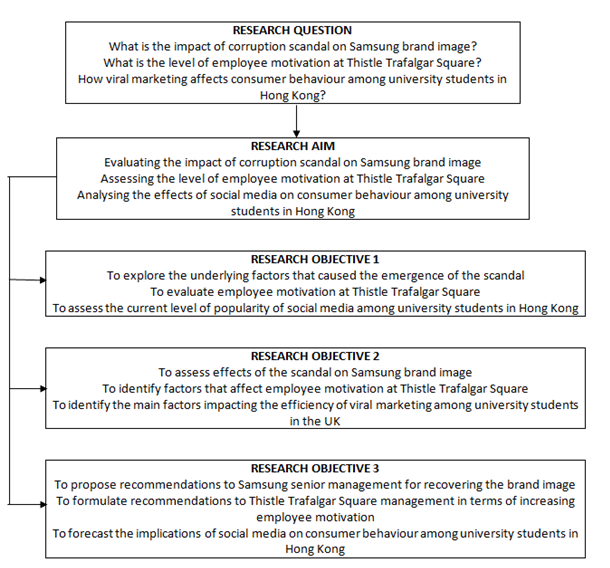
Research aim defines the overall purpose of the study — what you, as a researcher intend to achieve. Research objectives break this aim into specific, actionable steps that guide how you will conduct the research. Together, they provide a clear direction and structure for the entire research project. On this page: Difference between research question, aim and objectives Mistakes in formulating research aim SMART principle for research objectives Research Question, Aim, and Objectives: Understanding the Difference Formulating research aim and objectives in an appropriate manner is one of the most important aspects of your thesis. This is because research aim and objectives determine the scope, depth and the overall direction of the research. Research aims and objectives provide a roadmap for your research, guiding your methodology, data collection, and analysis. Research question is the central question your study seeks to answer. It represents the intellectual problem driving the investigation. Research aim emphasizes what needs to be achieved within the scope of the research, by the end of the research process. Achievement of research aim provides answer to the research question. Research objectives divide research aim into several parts and address each part separately. Research aim specifies WHAT needs to be studied and research objectives comprise a number of steps that address HOW research aim will be achieved. Still unsure about aims and objectives for your research? Get a clear, justified methodology for your research topic in minutes See how it works As a rule of dumb, there would be one research aim and several research objectives. Achievement of each research objective will lead to the achievement of the research aim. Consider the following as an example: Research title: Effects of organizational culture on business profitability: a case study of Virgin Atlantic. Research aim: To assess the effects…

A dissertation proposal is a structured plan that outlines your research topic, objectives, methodology, and expected contribution. It is submitted for approval before starting the full dissertation and serves as a blueprint for the entire research project. On this page: Purpose for a Dissertation Proposal Dissertation Proposal Format Dissertation Proposals in the Age of AI and Digital Research How to Write a Strong Dissertation Proposal Component Main Purpose Title Define research focus Introduction Provide background and context Research problem Identify issue to be investigated Aims and objectives Define direction of the study Literature review Demonstrate academic grounding Methodology Explain how research will be conducted Ethical considerations Ensure responsible research Research schedule Plan timing and stages References Support academic credibility Dissertation Proposal at a Glance Purpose for a Dissertation Proposal Writing dissertation proposal gives you a chance to find out if research aims and objectives are valid. Also, it helps to understand if the methods you are planning to use are suitable and feasible. Your dissertation proposal is a blueprint for the entire work. The purpose for writing dissertation proposal is to get it approved by your supervisor to get the green light start the actual research. Furthermore, writing dissertation proposal helps you to clarify the direction of your study. A dissertation proposal helps you: Clarify your research direction Test feasibility of your methods Get approval from your supervisor It answers three key questions:What will you study? Why? How? Not sure about the right research methodology for your dissertation? Get a clear, justified methodology for your research topic in minutes See how it works Your dissertation proposal needs to be able to communicate the following three critical points to the supervisor: a) You already did your homework in terms of reading a large amount of relevant secondary data in your research…