
Inductive Approach (Inductive Reasoning)
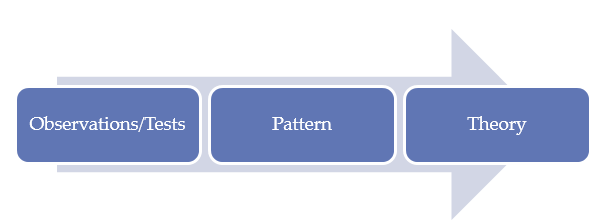
Inductive approach, also known in inductive reasoning, starts with the observations and theories are proposed towards the end of the research process as a result of observations[1]. Inductive research “involves the search for pattern from observation and the development of explanations – theories – for those patterns through series of hypotheses”[2]. No theories or hypotheses would apply in inductive studies at the beginning of the research and the researcher is free in terms of altering the direction for the study after the research process had commenced.
On this page:
- What is inductive approach?
- Types of inductive reasoning
- Application of inductive approach in business research
- Advantages and Limitations
- Inductive Approach in the Age of AI and Digital Research
- When to use inductive approach
| Feature | Inductive Approach | Deductive Approach |
|---|---|---|
| Starting point | Observations and empirical data | Existing theory |
| Purpose | Generate new theory | Test existing theory |
| Direction of reasoning | Specific → general | General → specific |
| Research methods | Often qualitative | Often quantitative |
| Outcome | Development of concepts and theories | Confirmation or rejection of hypotheses |
Inductive vs deductive approach (comparison table)
What is Inductive Approach?
Inductive reasoning starts with observations, experiences, or collected data. Researchers examine patterns, themes, and relationships within the data and then develop broader explanations or theories based on those findings.
For example, a researcher may conduct interviews with employees about remote work experiences. After analysing the interviews, the researcher may identify common themes related to flexibility, motivation, communication, or work-life balance and then develop broader conclusions about remote work culture.
Inductive approach therefore moves from specific observations to broader concepts and theory development.
It is important to stress that inductive approach does not imply disregarding theories when formulating research questions and objectives. This approach aims to generate meanings from the data set collected in order to identify patterns and relationships to build a theory; however, inductive approach does not prevent the researcher from using existing theory to formulate the research question to be explored.[3] Inductive reasoning is based on learning from experience. Patterns, resemblances and regularities in experience (premises) are observed in order to reach conclusions (or to generate theory).
Types of Inductive Reasoining
The following are the five main types of inductive reasoning:
1. Inductive generalization. This is the most common type of inductive reasoning, where a general conclusion is drawn based on a pattern observed in specific instances. For example, if you observe that the level of customer satisfaction of telecom companies you know is low, you might conclude that all telecom companies have customer service issues.
2. Statistical generalization. This type of inductive reasoning uses probabilities and statistics to make general conclusions about a population. For example, a poll that shows 60% of members of target customer segments like the new product idea might lead to the conclusion that the new product will be successful.
3. Causal reasoning. This type of inductive reasoning involves identifying the cause-and-effect relationships between events. For example, if you notice that the revenues of a grocery store declined during a local festival, you might conclude that the festival caused the revenues to decline.
4. Sign reasoning. This type of inductive reasoning involves drawing conclusions about a phenomenon based on signs or indicators that precede or accompany it. For example, seeing rising inflation rate, worsening unemployment and decline of property sales might lead you to conclude that an economic crisis is going to happen.
5. Analogical reasoning. This type of inductive reasoning involves drawing conclusions about something unknown by comparing it to something similar that is known. For example, observing that application of a new manufacturing principles increases efficiency in smartphone manufacturing might lead you to conclude that it will also be effective in producing TV sets.
Application of Inductive Approach (Inductive Reasoning) in Business Research
Inductive reasoning begins with detailed observations of the world, which moves towards more abstract generalisations and ideas[4]. When following an inductive approach, beginning with a topic, a researcher tends to develop empirical generalisations and identify preliminary relationships as he progresses through his research. No hypotheses can be found at the initial stages of the research and the researcher is not sure about the type and nature of the research findings until the study is completed.
As it is illustrated in figure below, “inductive reasoning is often referred to as a “bottom-up” approach to knowing, in which the researcher uses observations to build an abstraction or to describe a picture of the phenomenon that is being studied”[5]
Here is an example:
My nephew borrowed $100 last June but he did not pay back until September as he had promised (PREMISE). Then he assured me that he will pay back until Christmas but he didn’t (PREMISE). He also failed in to keep his promise to pay back in March (PREMISE). I reckon I have to face the facts. My nephew is never going to pay me back (CONCLUSION).
Generally, the application of inductive approach is associated with qualitative methods of data collection and data analysis, whereas deductive approach is perceived to be related to quantitative methods. The following table illustrates such a classification from a broad perspective:
| Concepts associated with quantitative methods | Concepts associated with qualitative methods | |
| Type of reasoning | Deduction
Objectivity Causation |
Induction
Subjectivity Meaning |
| Type of question | Pre-specified
Outcome-oriented |
Open-ended
Process-oriented |
| Type of analysis | Numerical estimation
Statistical inference |
Narrative description
Constant comparison |
However, the statement above is not absolute, and in some instances inductive approach can be adopted to conduct a quantitative research as well. The following table illustrates patterns of data analysis according to type of research and research approach.
| Qualitative | Quantitative | |
| Inductive | Grounded theory | Exploratory data analysis |
| Deductive | Qualitative comparative analysis | Structural equation modeling |
When writing a dissertation in business studies it is compulsory to specify the approach of are adopting. It is good to include a table comparing inductive and deductive approaches similar to one below[6] and discuss the impacts of your choice of inductive approach on selection of primary data collection methods and research process.
| Attribute | Deductive | Inductive |
| Direction | “Top-Down” | “Bottom-Up” |
| Focus | Prediction changes, validating theoretical construct, focus in “mean” behaviour, testing assumptions and hypotheses, constructing most likely future | Understanding dynamics, robustness, emergence, resilience, focus on individual behaviour, constructing alterative futures |
| Spatial scales | Single
(one landscape, one resolution) |
Multiple
(multiple landscape, one resolution) |
| Temporal scales | Multiple
(deterministic) |
Multiple
(stochastic) |
| Cognitive scales | Single
(homogenous preferences) |
Multiple
(heterogeneous preferences) |
| Aggregation scales | Single
(core aggregation scale) |
Single or multiple
(one or more aggregation scales) |
| Predictive vs. Stochastic accuracy | High – Low
(one likely future) |
Low-High
(many likely futures) |
| Data intensity | Low
(group or partial attributes) |
High
(individual or group attributes) |
Advantages and Limitations
Flexibility is one of the biggest advantages inductive approach offers. Researchers can adapt the direction of the study as new findings, themes, and relationships emerge during the research process. Unlike deductive studies, inductive research is not restricted by rigid hypotheses established at the beginning of the study.
Moreover, the ability of deductive approach to generate new theories and insights instead of relying only on existing theoretical models has to be mentioned in this context. This makes the approach highly valuable for exploratory research and for studying emerging business phenomena where previous research may be limited.
Inductive approach also allows researchers to examine complex social and organisational issues in greater depth. Researchers can develop richer contextual understanding of employee experiences, organisational culture, consumer behaviour, workplace relationships, and technological change, because the approach is commonly associated with qualitative methods.
Additional advantage is openness to unexpected findings. Researchers can identify new patterns, themes, or explanations that may not have been anticipated at the beginning of the study. This flexibility often leads to deeper and more nuanced understanding of research phenomena. Furthermore, inductive studies are particularly effective when the objective is to understand meanings, experiences, behaviours, and processes that cannot easily be reduced into measurable quantitative variables alone.
Inductive approach also has a number of limitations. The popular criticism is lower generalisability. Inductive studies often rely on relatively small qualitative samples, and for this reason findings may not always be applied confidently to larger populations or different organisational contexts.
Inductive Approach in the Age of AI and Digital Research
AI technologies and digital research environments are significantly transforming inductive research practices. Researchers increasingly use AI-assisted transcription tools, thematic analysis software, digital ethnography, online behavioural analysis, and social media data to identify patterns and generate insights from large volumes of qualitative information.
Digital platforms now provide researchers with access to enormous amounts of textual, visual, and behavioural data generated through online communities, digital workplaces, customer reviews, social media interactions, and virtual collaboration systems. This creates new opportunities for inductive exploration of emerging business and social phenomena.
AI-powered tools can assist researchers by identifying recurring themes, patterns, and relationships within qualitative datasets much faster than traditional manual coding methods. At the same time, AI-assisted inductive research introduces important methodological concerns related to algorithmic bias, contextual misunderstanding, loss of nuance, and overreliance on automated interpretation.
Inductive reasoning depends heavily on contextual understanding, human judgement, and interpretation of meaning. AI systems may recognise patterns efficiently, but they cannot fully understand emotional nuance, organisational culture, or complex human experiences in the same way human researchers can.
Researchers must therefore critically evaluate AI-generated thematic patterns and maintain strong human involvement throughout interpretation and theory development processes.
When to Use Inductive Approach
You can use inductive approach if the aim of your research is to explore a phenomenon and develop new theoretical insights rather than test existing theories. This approach is commonly used when the research area is relatively new, when existing theories are limited, or when you want to analyze complex social or organizational phenomena in greater depth.
You should use inductive approach if:
- your research aims to explore new or poorly understood phenomena
- existing theories are limited or insufficient
- your study focuses on meanings, experiences, or processes
- qualitative data collection methods are central to the research
- flexibility during the research process is important
- you aim to generate new theoretical insights
- your study examines rapidly changing business or technological environments
Still unsure whether inductive approach is the right choice for your research?
Get a clear, justified methodology for your research topic in minutes
John Dudovskiy
[1] Goddard, W. & Melville, S. (2004) “Research Methodology: An Introduction” 2nd edition, Blackwell Publishing
[2] Bernard, H.R. (2011) “Research Methods in Anthropology” 5th edition, AltaMira Press, p.7
[3] Saunders, M., Lewis, P. & Thornhill, A. (2012) “Research Methods for Business Students” 6th edition, Pearson Education Limited
[4] Neuman, W.L. (2003) “Social Research Methods: Qualitative and Quantitative Approaches” Allyn and Bacon
[5] Lodico, M.G., Spaulding, D.T & Voegtle, K.H. (2010) “Methods in Educational Research: From Theory to Practice” John Wiley & Sons, p.10
[6] Source: Alexandiris, K.T. (2006) “Exploring Complex Dynamics in Multi Agent-Based Intelligent Systems” Pro Quest