
Convenience sampling
Convenience sampling is a non-probability sampling method in which participants are selected primarily because they are easy to access, readily available, or willing to participate. It is one of the simplest and most widely used sampling techniques, particularly in exploratory research, pilot studies, and situations where access to the full target population is limited.
On this page:
- Convenience Sampling Explained Simply
- What is Convenience Sampling?
- Convenience Sampling vs Probability Sampling
- How Convenience Sampling Works
- Examples of Convenience Sampling
- Convenience Sampling in Business Research
- Common Mistakes
- Advantages and Disadvantages of Convenience Sampling
- Convenience Sampling in the Age of AI and Digital Research
- When to Use Convenience Sampling
- Exam Tip
| Aspect | Convenience Sampling | Probability Sampling |
|---|---|---|
| Selection method | Based on availability and accessibility | Based on random selection |
| Sampling type | Non-probability | Probability |
| Bias level | High | Lower |
| Representativeness | Usually limited | Usually stronger |
| Cost and time | Low | Higher |
| Generalisability | Often limited | Usually stronger |
| Ease of implementation | Very easy | More complex |
Convenience sampling vs probability sampling
Convenience Sampling Explained Simply
Imagine that you need to collect survey responses for your dissertation within two weeks.
Rather than obtaining a complete list of the target population and selecting participants randomly, you distribute your questionnaire to classmates, colleagues, LinkedIn connections, and people you already know.
This is convenience sampling.
For example, a student investigating customer attitudes towards sustainable products may share a questionnaire through university groups, WhatsApp contacts, LinkedIn networks, and social media platforms. Participants are selected because they are easy to reach rather than because they statistically represent the wider population.
In simple terms, convenience sampling means collecting data from the people who are most readily available.
What is Convenience Sampling?
Convenience sampling, sometimes referred to as availability sampling, is a non-probability sampling technique in which participants are selected primarily because of their accessibility and willingness to participate.
Unlike probability sampling methods, convenience sampling does not require every member of the population to have an equal chance of selection. Instead, researchers recruit participants who are easiest to reach.
This makes convenience sampling one of the simplest and fastest methods of collecting primary data.
Researchers often use convenience sampling when time, financial resources, or access to the target population are limited. As a result, it is particularly popular among undergraduate and postgraduate students conducting dissertations under tight deadlines.
Although convenience sampling is easy to implement, researchers must recognise that the sample may not accurately represent the wider population. Consequently, findings generated through convenience sampling should be interpreted carefully.
Despite its limitations, convenience sampling remains widely used in exploratory research and pilot studies because it allows researchers to gather preliminary insights quickly and efficiently.
How Convenience Sampling Works
The process of convenience sampling is straightforward.
Researchers identify a group of participants who are easily accessible and invite them to participate in the study. No random selection procedure is used, and participants are not selected according to predefined probabilities.
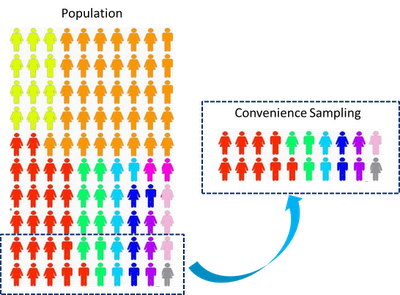
Historically, convenience sampling often involved approaching people in shopping centres, public places, universities, or workplaces.
A classic example is the famous Pepsi Challenge marketing campaign. Participants in busy public locations were invited to taste different soft drinks and express their preferences. Individuals were selected because they happened to be present and willing to participate.
Today, convenience sampling frequently occurs online. Researchers distribute questionnaires through social media, email lists, online communities, LinkedIn networks, and university platforms.
Because recruitment is based on convenience rather than statistical representativeness, convenience sampling can be implemented quickly and with minimal resources.
Examples of Convenience Sampling
Convenience sampling appears in many business and academic research settings.
For example, a researcher studying customer perceptions of a new mobile banking application may distribute a survey through personal LinkedIn connections and university contacts.
A student investigating consumer attitudes towards sustainable fashion may recruit participants through Instagram followers and campus networks.
Similarly, researchers exploring workplace wellbeing may collect responses from colleagues working within their own organisation because access to those participants is readily available.
Companies also use convenience sampling in market research. For example, Starbucks may gather customer feedback from visitors leaving selected stores, while IKEA may ask customers to complete short surveys immediately after making purchases.
Although these samples are unlikely to be fully representative, they can provide valuable initial insights.
Convenience Sampling in Business Research
Convenience sampling is particularly common in business research because researchers often face practical constraints when accessing broader populations. For example, studies examining employee engagement, customer satisfaction, brand perception, or consumer behaviour frequently rely on participants who are readily available through existing networks.
A researcher investigating employee attitudes towards remote work may distribute surveys within their own organisation. Similarly, a study examining customer experiences with digital banking may recruit participants through online professional networks.
Convenience sampling is especially useful during exploratory phases of research when the objective is to identify themes, generate ideas, or refine research instruments rather than produce highly generalisable findings. It is also widely used in pilot studies to test questionnaires, interview protocols, and data collection procedures before conducting larger studies.
Common Mistakes
One common mistake is claiming that convenience sampling produces representative samples. Because participants are selected based on accessibility rather than random selection, representativeness is often limited. Another frequent error is failing to acknowledge sampling bias. Researchers should clearly explain how convenience sampling may have influenced the findings and discuss any resulting limitations.
Students also sometimes confuse convenience sampling with simple random sampling. The two methods are fundamentally different because convenience sampling does not involve any random selection process. A further mistake is making broad generalisations about entire populations based on convenience samples. Researchers should ensure that conclusions remain consistent with the limitations of the sampling method.
Finally, some researchers fail to describe exactly how participants were recruited, making it difficult for readers to assess the quality of the sample.
Advantages and Disadvantages of Convenience Sampling
One of the strongest advantages of convenience sampling is its practicality. Researchers can recruit participants quickly without requiring extensive planning, complex sampling procedures, or access to complete population lists.
Another important benefit is cost-effectiveness. Data collection can often be conducted using existing personal, academic, or professional networks, reducing both time and financial requirements. Convenience sampling is also highly suitable for exploratory studies, pilot testing, questionnaire development, and early-stage investigations where generating preliminary insights is more important than statistical representativeness.
Its flexibility makes it particularly attractive for student dissertations and small-scale business studies operating under strict deadlines.
Despite these benefits, convenience sampling carries significant limitations. Selection bias represents one of the most important concerns because participants are chosen based on availability rather than probability. The method also limits generalisability. Findings generated from a convenience sample may not accurately represent the wider population, particularly when participants share similar demographic, social, or professional characteristics.
Another challenge involves self-selection bias. Individuals who choose to participate may differ systematically from those who decline, potentially influencing the results. Consequently, researchers using convenience sampling should acknowledge these limitations openly and avoid making overly broad claims based on their findings.
Convenience Sampling in the Age of AI and Digital Research
Digital technologies have dramatically expanded opportunities for convenience sampling.
Researchers now recruit participants through LinkedIn, Facebook, Instagram, Reddit communities, online forums, email databases, mobile applications, and online survey platforms. AI-powered survey tools can automate participant recruitment, questionnaire distribution, response monitoring, and preliminary analysis, making convenience sampling even faster and more efficient.
For example, a researcher examining consumer attitudes towards AI-powered customer service may distribute a survey through LinkedIn groups focused on technology and innovation. Similarly, businesses such as Spotify may collect user feedback directly through digital platforms and mobile applications.
However, digital convenience sampling introduces new challenges. Social media algorithms may expose surveys to particular groups of users, creating hidden sampling biases. Online datasets may also contain fake accounts, duplicate responses, automated activity, or highly homogeneous participant groups.
Researchers must therefore evaluate sample diversity carefully and recognise that technological convenience does not automatically improve representativeness. As online research continues to expand, convenience sampling remains highly relevant, but its limitations remain fundamentally unchanged.
When to Use Convenience Sampling
Convenience sampling may be appropriate when:
- the research is exploratory in nature
- a pilot study is being conducted
- access to the target population is limited
- time or financial resources are constrained
- preliminary insights are required
- participants can be accessed through existing networks
- statistical generalisation is not the primary objective
For example, a researcher studying early user reactions to a new mobile application may recruit participants through university groups, LinkedIn contacts, and social media communities to obtain quick feedback.
Convenience sampling is generally less suitable when research requires highly representative samples or strong statistical generalisation to wider populations.
Exam Tip
Students often apologise for using convenience sampling in their dissertations. This is usually unnecessary. Convenience sampling is a legitimate sampling technique when used appropriately and justified clearly. Rather than pretending the sample is representative, explain why convenience sampling was the most practical option, acknowledge its limitations, and discuss how those limitations may influence the findings.
Still not sure if convenience sampling is the right choice for your dissertation?
Get a clear, justified methodology for your research topic in minutes
John Dudovskiy
[1] Saunders, M., Lewis, P. & Thornhill, A. (2012) “Research Methods for Business Students” 6th edition, Pearson Education Limited