
Ontology
Ontology refers to the study of the nature of reality. In research, ontology is concerned with what exists, what can be considered real, and how reality should be understood. Ontological assumptions influence the way researchers view the world and ultimately shape their research design, methodology, and choice of data collection methods.
On this page:
- What is Ontology?
- Ontology in Business Studies
- Ontology in the Age of AI and Digital Research
- How to Address Ontology in Your Dissertation
| Ontological Position | View of Reality | Key Idea |
|---|---|---|
| Objectivism | Reality is objective and independent | Reality exists regardless of human perception |
| Subjectivism (Constructivism) | Reality is subjective and socially constructed | Reality is created through human interaction |
| Pragmatism | Reality is practical and context-dependent | Choose the view that best answers the research question |
Ontology at a glance (comparison table)
What is Ontology?
Ontology can seem abstract at first, but the underlying question is straightforward:
What is reality?
Researchers may answer this question differently.
Some researchers believe reality exists independently of people and can be studied objectively. Others believe reality is shaped by human experiences, interpretations, and social interactions. These different assumptions influence how researchers collect data, analyse findings, and interpret results.
In simple terms, ontology is about deciding what you believe exists in the world and how that reality should be understood within the context of your research.
Ontology and epistemology are two different ways of viewing the research philosophy. Ontology in business research can be defined as “the science or study of being”[1] and it deals with the nature of reality. Ontology is a system of belief that reflects an interpretation of an individual about what constitutes a fact. In simple terms, ontology is associated with what we consider as reality.
The table below illustrates main questions that key philosophical concepts attempt to answer:
| Philosophical concept | Main question |
| Ontology | What is the nature of reality? |
| Epistemology | What can be accepted as knowledge? |
| Methodology | How knowledge regarding given question can be produced? |
| Methods | What specific ways of data collection and data analysis can be used? |
| Paradigm | What are the conceptual and/or methodological models that relate to a specific discipline during a particular period of time? |
Key philosophical concepts and questions
Ontology relates to a central question of whether social entities need to be perceived as objective or subjective. In other words, within the scope of your research you need to decide whether the world is external to social world or the perceptions and actions of social actors create social phenomena.[2]
Accordingly, objectivism (or positivism) and subjectivism can be specified as two important aspects of ontology.
Objectivism “portrays the position that social entities exist in reality external to social actors concerned with their existence”[3]. Alternatively, objectivism “is an ontological position that asserts that social phenomena and their meanings have an existence that is independent of social actors”[4].
Subjectivism (also known as constructionism or interpretivism) on the contrary, perceives that social phenomena are created from perceptions and consequent actions of those social actors concerned with their existence. Formally, constructionism can be defined as “ontological position which asserts that social phenomena and their meanings are continually being accomplished by social actors”.[5]
The following illustrates the ontology of four major research philosophies related to business studies:
| Research philosophy | Ontology: the researcher’s view of the nature of reality or being |
| Pragmatism | External, multiple, view chosen to best enable answering of research question |
| Positivism | External, objective and independent of social actors |
| Realism | Objective. Exists independently of human thoughts and beliefs or knowledge of their existence (realist), but is interpreted through social conditioning (critical realist) |
| Interpretivism | Socially constructed, subjective, may change, multiple |
Ontology of research philosophies
Identification of ontology at the start of the research process is critically important as it determines the choice of the research design. The figure below illustrates the consequent impact of ontology on the choice of research methods via epistemology, research approach, research strategy and methods of data collection and data analysis.
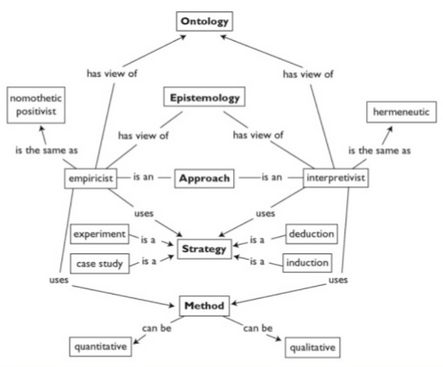
Impact of research philosophy on the choice of research method
Ontology in business studies
In business and management research, reality may not be singular or fixed. Different individuals may perceive the same organizational situation in different ways depending on their experiences, cultural backgrounds, professional roles etc. For this reason, some researchers argue that multiple realities may exist simultaneously. Recognizing this possibility is particularly important in qualitative research, where understanding subjective experiences and interpretations becomes central to the investigation. This perspective relates to ontology because it reflects the assumption that reality may be socially constructed and interpreted differently by individuals rather than existing as a single objective entity independent of human perception.
Ontology in the Age of AI and Digital Research
The growing use of artificial intelligence, digital platforms, and big data has introduced new ontological questions into business research. Researchers increasingly analyse digital behaviours, online interactions, virtual communities, AI-generated content, and algorithmic decision-making systems.
These developments challenge traditional assumptions about reality because many contemporary business phenomena now exist simultaneously in both physical and digital environments. For example, organisational culture may be shaped not only through face-to-face interactions but also through digital communication platforms, virtual collaboration tools, and AI-assisted workflows.
AI technologies also raise questions about the nature of knowledge and reality. Researchers must consider whether AI-generated outputs represent objective observations, interpretations of existing data, or entirely new forms of digital reality created through algorithmic processes.
At the same time, AI systems can analyse vast amounts of data and identify patterns that may not be immediately visible to human researchers. However, determining whether these patterns represent meaningful realities still requires human judgement and theoretical understanding.
As digital technologies continue to transform organisations, researchers must increasingly reflect on how technological systems influence both the reality being studied and the methods used to study it.
How to Address Ontology in Your Dissertation
You don’t have to discuss ontology in great depth when writing a dissertation in business studies. Several paragraphs to one page will suffice for a dissertation on Bachelor’s or Master’s level, whereas you can devote about two pages to ontology on a research at a PhD level.
You can address ontology part of methodology chapter of your dissertation in the following manner:
Firstly, you can provide a formal definition of ontology with proper referencing. When providing definitions, it is better to use and reference books rather than internet web pages. This can be followed by explanation of ontology in simple terms, in your own words.
Secondly, you have to specify whether you are adopting objectivism or constructivism view. This should be followed by explanation of rationale for your choice by referring to your research aims and objectives.
Thirdly, you have to discuss implications of your ontological choice on the choice of epistemology, research approach, and research strategy and data collection methods.
Clarifying ontological assumptions helps ensure that the research design remains logically consistent. When you clearly state your assumptions about the nature of reality, you are better able to justify your methodological choices and demonstrate coherence between research philosophy, epistemology, and data collection methods.
Still unsure about ontological position of your research?
Get a clear, justified methodology for your research topic in minutes
John Dudovskiy
[1] Blaikie, N. (2010) “Designing Social Research” Polity Press
[2] Wilson, J. (2010) “Essentials of Business Research: A Guide to Doing Your Research Project” SAGE
[3] Saunders, M., Lewis, P. & Thornhill, A. (2012) “Research Methods for Business Students” 6th edition, Pearson Education Limited
[4] Bryman, A. (2012) “Social Research Methods” 4th edition, Oxford University Press
[5] Bryman, A. (2012) “Social Research Methods” 4th edition, Oxford University Press
John Dudovskiy