Stratified Sampling

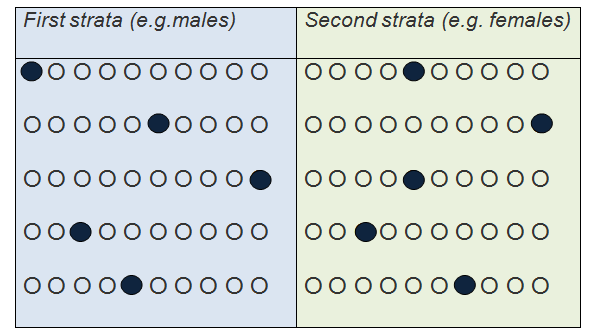
Stratified sampling is a probability sampling method in which the population is divided into distinct subgroups, known as strata, based on shared characteristics such as age, gender, education level, income, or job role. Researchers then select participants randomly from each stratum to ensure that important subgroups are adequately represented in the sample.

On This Page:

  • Stratified Sampling Explained Simply
  • What is Stratified Sampling?
  • Stratified Sampling vs Simple Random Sampling
  • Types of Stratified Sampling
  • How Stratified Sampling Works
  • Stratified Sampling in Business Research
  • Common Mistakes
  • Advantages and Disadvantages of Stratified Sampling
  • Stratified Sampling in the Age of AI and Digital Research
  • When to Use Stratified Sampling
  • Exam Tip


Aspect Stratified Sampling Simple Random Sampling
Population division Divided into strata before sampling No division
Representation of subgroups Explicitly ensured May occur by chance
Sampling error Usually lower Usually higher
Complexity More complex Simpler
Population knowledge required Yes Limited
Best used when Important subgroups exist Population is relatively homogeneous

Stratified sampling vs simple random sampling (comparison table)

Stratified Sampling Explained Simply

Imagine a company wants to understand employee satisfaction across its workforce. If researchers randomly select 100 employees, they may accidentally recruit too many employees from one department and too few from another. Instead, they divide employees into departments such as Marketing, Finance, Operations, and Human Resources. They then randomly select participants from each department.

This is stratified sampling.

For example, if Unilever wants to assess employee engagement across different business units, stratified sampling ensures that all major divisions are represented fairly within the study.

In simple terms, stratified sampling ensures that important subgroups are not overlooked during participant selection.

Unsure whether your dissertation should use stratified, simple random, cluster, or convenience sampling?

The Dudovskiy AI Research Assistant can recommend the most appropriate sampling strategy and generate a complete academic justification for your methodology chapter.

What is Stratified Sampling?

Stratified sampling is a probability sampling technique that divides a population into two or more distinct groups known as strata before selecting participants. The strata are created using characteristics that are relevant to the research objectives.

Common stratification variables may include:

  • gender
  • age
  • income level
  • education level
  • nationality
  • job position
  • business division


Stratified Sampling

Once the strata have been identified, participants are selected randomly from each group. The primary objective is to ensure that all important subgroups are represented appropriately within the sample.

Stratified sampling is particularly useful when the population contains meaningful differences between groups and researchers wish to capture those differences accurately.

Types of Stratified Sampling

Stratified sampling can be divided into the following two groups: proportionate and disproportionate.

In proportionate stratified sampling, the proportion of participants selected from each stratum reflects the proportion of that stratum within the overall population.

For example, suppose a company employs:

  • 60% operational staff
  • 25% administrative staff
  • 15% management staff

A sample of 200 employees would contain:

  • 120 operational staff
  • 50 administrative staff
  • 30 management staff

This approach preserves the actual structure of the population.

In disproportionate stratified sampling, on the other hand, researchers deliberately select different numbers of participants from each stratum regardless of their actual size within the population. For example, a study may intentionally recruit equal numbers of managers and non-managers even if managers represent only a small proportion of the workforce.

This approach is useful when smaller subgroups require more detailed analysis. Contrary to a common misconception, disproportionate sampling is not automatically less accurate. It simply serves different analytical purposes and often requires statistical weighting during analysis.

How Stratified Sampling Works

The process of stratified sampling typically involves four stages.

Stage 1: Identify Relevant Strata. Researchers first identify meaningful categories relevant to the study. For example, a study examining leadership practices at HSBC may divide employees into:

  • Retail Banking
  • Commercial Banking
  • Wealth Management
  • Corporate Functions

The choice of strata should align directly with the research objectives.

Stage 2: Create the Sampling Frame. Researchers compile lists of population members within each stratum. Each individual receives a unique identifier.

Stage 3: Determine Sample Size. Researchers decide how many participants will be selected from each stratum. The allocation depends on whether proportionate or disproportionate stratification is being used.

Stage 4: Select Participants Randomly. Participants are selected randomly within each stratum using methods such as:

  • random number generators
  • random selection software
  • lottery methods

Random selection within each stratum helps minimise selection bias.

Stratified Sampling in Business Research

Stratified sampling is widely used in business and management studies because organisations often consist of diverse employee groups.

For example:

  • Microsoft may divide employees according to business functions.
  • Coca-Cola may stratify participants by geographical region.
  • Deloitte may create strata based on management level.
  • Emirates Airlines may divide employees into pilots, cabin crew, ground staff, and management.

Suppose a researcher wishes to examine leadership styles among middle managers at BMW. BMW operates across several major business segments, including:

  • Automotive
  • Motorcycles
  • Financial Services
  • Other Business Activities

A simple random sample could unintentionally overrepresent one division. Stratified sampling ensures that managers from each business segment are included proportionately, producing a more representative sample and reducing sampling error.

Common Mistakes

Researchers occasionally create strata that have little relevance to the research objectives. Stratification should always be based on characteristics that are likely to influence the phenomenon being studied. A misunderstanding often encountered among students is that dividing participants into groups automatically creates stratified sampling. In reality, participants must still be selected randomly within each stratum for the technique to remain a probability sampling method.

Difficulties may also arise when strata overlap. If participants could reasonably belong to multiple categories simultaneously, classification becomes complicated and representativeness may be weakened. Another issue involves allocating insufficient participants to certain strata, making meaningful comparisons between groups difficult.

Finally, some researchers choose stratified sampling because it appears more sophisticated than simple random sampling, even when the population is relatively homogeneous and stratification provides little practical benefit.

Advantages and Disadvantages of Stratified Sampling

One major advantage of stratified sampling is improved representativeness. Important population subgroups are deliberately included rather than relying on chance. Another strength is reduced sampling error. When strata are internally similar but different from one another, estimates often become more precise than those obtained through simple random sampling.

Stratified sampling also enables meaningful comparisons between groups. Researchers can compare responses across different departments, regions, age groups, or organisational levels. Furthermore, the method is particularly effective when researchers wish to ensure adequate representation of smaller but important subgroups.

Despite these strengths, stratified sampling has limitations. Researchers must possess accurate information about population characteristics before strata can be created. The technique can also be more time-consuming and expensive than simple random sampling because of the additional stage of population classification.

Another challenge involves determining appropriate stratification variables. Poorly chosen strata may increase complexity without improving research quality. Finally, data analysis may become more complicated, especially when disproportionate stratification is used.

Stratified Sampling in the Age of AI and Digital Research

Digital technologies and AI-powered analytical systems are making stratified sampling easier to implement than ever before. Modern organisations often maintain extensive employee, customer, and operational databases that allow researchers to identify and classify population members rapidly. Automated sampling software can generate random samples within strata almost instantly, reducing administrative effort and improving accuracy.

Large organisations such as Amazon, Google, and Tesco increasingly use data-driven segmentation systems that can support sophisticated stratification based on demographics, behavioural characteristics, geographic regions, purchasing patterns, or organisational roles. AI-assisted systems can also help researchers identify meaningful stratification variables by analysing large datasets and detecting population differences that might otherwise remain unnoticed.

At the same time, researchers must remain cautious. AI-generated classifications may contain biases or inaccuracies if underlying datasets are incomplete or skewed. The quality of stratified sampling continues to depend on appropriate human judgement regarding the selection of strata and the interpretation of results.

Need help justifying stratified sampling for your dissertation methodology chapter?

The Dudovskiy AI Research Assistant can explain when stratified sampling is appropriate, calculate sample allocation, and provide a dissertation-ready justification.

When to Use Stratified Sampling

Stratified sampling is most appropriate when:

  • the population contains distinct subgroups
  • representation of all major groups is important
  • comparisons between groups are required
  • sampling error needs to be reduced
  • population information is available
  • the study aims to improve representativeness

For example, stratified sampling is particularly useful when studying employees across departments, customers across regions, consumers across age groups, or organisations across industries.

Use stratified sampling when important population differences exist and those differences need to be reflected accurately within the sample.

Exam Tip

Many students describe stratified sampling simply as “dividing the population into groups.” This explanation is incomplete. Examiners usually expect you to explain why the chosen strata are relevant to the research objectives and how random selection will be performed within each stratum. A strong justification demonstrates how stratification improves representativeness and helps answer the research question more effectively than alternative sampling methods.

Still not sure if stratified sampling is the right choice for your dissertation?

Get a clear, justified methodology for your research topic in minutes


My e-book, How to Write a Dissertation: A Step-by-Step System to Plan, Write and Defend Your Dissertation in the age of AI contains discussions of theory and application of research philosophy. The e-book also explains all stages of the research process starting from the selection of the research area to writing personal reflection. Important elements of dissertations such as research philosophyresearch approachresearch designmethods of data collection and data analysis are explained in this e-book in simple words.

How to Write a Dissertation: A Step-by-Step System to Plan, Write and Defend Your Dissertation in the age of AI

Download the e-book and start making progress today


Preparing to Defend Your Methodology?

Understanding research design is one thing. Defending it under examination is another.

If you would like structured guidance on how to justify your methodological choices, respond to challenging viva questions, address limitations confidently, and navigate academic integrity in the AI era, you may find the following resource helpful:

The Dissertation Methodology Defense Manual in the AI Era: Examiner-Proof Justification & Academic Integrity Framework

The manual provides a structured system for aligning your research design, strengthening your justifications, and preparing for defense scenarios with clarity and confidence.

The Dissertation Methodology Defense Manual in the AI Era

Download the manual and prepare to defend your methodology with confidence

John Dudovskiy

[]