
Abductive reasoning (abductive approach)
Abductive approach is a research reasoning process that begins with surprising observations or unexplained phenomena and seeks the most plausible explanation by moving back and forth between theory and data.
On this page:
- Abductive Approach Explained Simply
- Abductive vs Deductive vs Inductive Reasoning
- Advantages and Limitations
- When to Use Abductive Approach
- Abductive Research in the Age of AI
| Feature | Deductive Approach | Inductive Approach | Abductive Approach |
|---|---|---|---|
| Starting point | Existing theory | Observations | Unexpected observation or puzzle |
| Purpose | Test theory | Develop theory | Explain surprising phenomena |
| Direction of reasoning | General → specific | Specific → general | Interaction between theory and data |
| Research methods | Often quantitative | Often qualitative | Mixed methods often used |
| Outcome | Confirmation or rejection of theory | Generation of theory | Development of best possible explanation |
Comparison of research approaches
Abductive Approach Explained Simply
Abductive reasoning means:
- starting with something unexpected
- exploring possible explanations
- moving between theory and evidence until the best explanation is identified
It answers the question:
“What is the most likely explanation for this phenomenon?”
Still unsure whether abductive approach is the right choice for your research?
Get a clear, justified methodology for your research topic in minutes
Abductive vs Deductive vs Inductive Reasoning
Abductive reasoning, also referred to as abductive approach is set to address weaknesses associated with deductive and inductive approaches. Specifically, deductive reasoning is criticized for the lack of clarity in terms of how to select theory to be tested via formulating hypotheses. Inductive reasoning, on other hand, criticized because “no amount of empirical data will necessarily enable theory-building”[1]. Abductive reasoning, as a third alternative, overcomes these weaknesses via adopting a pragmatist perspective.
The figure below illustrates the main differences between abductive, deductive and inductive reasoning:
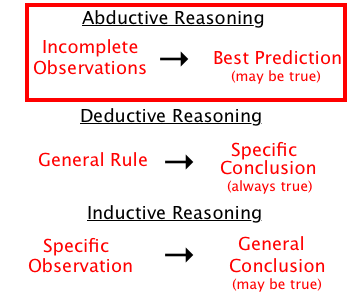
At the same time, it has to be clarified that abductive reasoning is similar to deductive and inductive approaches in a way that it is applied to make logical inferences and construct theories.
In abductive approach, the research process starts with ‘surprising facts’ or ‘puzzles’ and the research process is devoted their explanation[2]. ‘Surprising facts’ or ‘puzzles’ may emerge when a researchers encounters with an empirical phenomena that cannot be explained by the existing range of theories.
When following an abductive approach, researcher seeks to choose the ‘best’ explanation among many alternative in order to explain ‘surprising facts’ or ‘puzzles’ identified at the start of the research process. In the course of explaining ‘surprising facts’ or ‘puzzles’, the researcher can combine both, numerical and cognitive reasoning.
Despite its increasing popularity in business studies, application of abductive reasoning in practice is challenging and you are advised to stick with traditional deductive or inductive approaches when writing your dissertation if it is the first time you are writing a dissertation.
Advantages and Limitations
One of the main advantages of abductive reasoning is its flexibility. Unlike strictly deductive or inductive approaches, abductive research allows researchers to move continuously between theory and empirical observations in order to develop the most plausible explanation for a phenomenon. This flexibility makes the approach particularly valuable when studying complex or rapidly evolving business environments where existing theories may not fully explain observed realities.
Abductive reasoning is also highly useful for exploring emerging phenomena such as artificial intelligence adoption, digital transformation, platform economies, and changing consumer behaviour. In these contexts, researchers often encounter unexpected findings that cannot be adequately explained using traditional theoretical frameworks alone.
Another important advantage of abductive approach is its compatibility with mixed methods research. Researchers can combine quantitative evidence with qualitative insights in order to achieve a deeper and more comprehensive understanding of the research problem. This enables abductive studies to generate both practical and theoretical contributions.
In addition, abductive reasoning encourages creativity and critical thinking because researchers are not restricted to confirming or rejecting existing theories. Instead, they actively search for new interpretations and explanations that better reflect empirical reality.
When to Use Abductive Approach
You can use abductive research when you encounter unexpected or puzzling findings that cannot be fully explained by existing theories. In such situations, abductive reasoning allows you to explore alternative explanations and develop new theoretical insights.
This approach is often used in studies involving complex organizational phenomena, emerging technologies, or rapidly changing business environments where existing theoretical frameworks may be insufficient.
For example, if you are analyzing the impact of artificial intelligence on employee appraisal you may observe unexpected behavioral patterns among managers that are not fully explained by existing management theories. In such cases, abductive reasoning can help you to develop new explanations by integrating empirical observations with theoretical concepts.
Abductive approach is also commonly adopted in mixed-method research, where researchers combine qualitative and quantitative data in order to develop more comprehensive explanations of complex phenomena.
Abductive Research in the Age of AI and Digital Transformation
Abductive reasoning has become increasingly important in modern business research because digital transformation and AI adoption frequently generate unexpected organisational and behavioural outcomes that existing theories struggle to explain fully.
For example, organisations implementing AI systems may observe surprising employee behaviours, decision-making patterns, or customer responses that are not adequately explained by traditional management theories. In such situations, researchers may combine empirical observations with multiple theoretical perspectives to develop new explanations. As business environments become more dynamic and data-rich, abductive reasoning is increasingly used in research involving AI, digital platforms, innovation, and rapidly evolving technologies.
Still unsure whether abductive approach is the right choice for your research?
Get a clear, justified methodology for your research topic in minutes
My e-book, How to Write a Dissertation: A Step-by-Step System to Plan, Write and Defend Your Dissertation in the age of AI contains discussions of theory and application of research philosophy. The e-book also explains all stages of the research process starting from the selection of the research area to writing personal reflection. Important elements of dissertations such as research philosophy, research approach, research design, methods of data collection and data analysis are explained in this e-book in simple words.
 Download the e-book and start making progress today
Preparing to Defend Your Methodology?
Understanding research design is one thing. Defending it under examination is another.
If you would like structured guidance on how to justify your methodological choices, respond to challenging viva questions, address limitations confidently, and navigate academic integrity in the AI era, you may find the following resource helpful:
The manual provides a structured system for aligning your research design, strengthening your justifications, and preparing for defense scenarios with clarity and confidence.
 Download the manual and prepare to defend your methodology with confidence
John Dudovskiy
[1] Source: Saunders, M., Lewis, P. & Thornhill, A. (2012) “Research Methods for Business Students” 6th edition, Pearson Education Limited
[2] Bryman A. & Bell, E. (2015) “Business Research Methods” 4th edition, Oxford University Press, p.27