
Deductive Approach (Deductive Reasoning)
Deductive research approach refers to a method of reasoning in which researchers begin with an existing theory and develop hypotheses that are tested through empirical data collection and analysis. In deductive studies, conclusions are drawn by moving from general theoretical propositions to specific observations. This approach is commonly used in business and management research when the objective is to test whether existing theories apply in particular contexts.
On this page:
- Meaning of deductive research approach
- Advantages and disadvantages
- Stages of deductive research process
- Deductive Approach in the Age of AI and Digital Research
- When to use deductive approach
- Exam Tip
| Feature | Deductive Approach | Inductive Approach |
|---|---|---|
| Starting point | Existing theory | Observations or data |
| Main purpose | Test hypotheses | Develop theory |
| Direction of reasoning | General → specific | Specific → general |
| Typical methods | Often quantitative | Often qualitative |
| Main outcome | Confirmation or rejection of theory | Development of new insights |
Deductive vs inductive approach (comparison table)
Meaning of Deductive Approach
A deductive approach is concerned with “developing a hypothesis (or hypotheses) based on existing theory, and then designing a research strategy to test the hypothesis”[1]
It has been stated that “deductive means reasoning from the particular to the general. If a causal relationship or link seems to be implied by a particular theory or case example, it might be true in many cases. A deductive design might test to see if this relationship or link did obtain on more general circumstances”[2].
Deductive approach can be explained by the means of hypotheses, which can be derived from the propositions of the theory. In other words, deductive approach is concerned with deducting conclusions from premises or propositions. Deduction begins with an expected pattern “that is tested against observations, whereas induction begins with observations and seeks to find a pattern within them”[3].
Deductive research approach is commonly associated with positivism research philosophy. Positivism studies emphasize objectivity, measurement, and hypothesis testing, which align closely with the deductive logic of testing theoretical propositions through empirical observations. However, deductive reasoning may also be used in other philosophical perspectives when researchers aim to test specific theoretical propositions.
Using the wrong research approach can weaken the logic of your entire dissertation.
The Dudovskiy AI Research Assistant helps you align your research approach, methodology, and research objectives in academically defensible way.
Advantages and Disadvantages of Deductive Approach
The ability to test existing theories systematically is one of the main reasons researchers choose deductive approach. You can examine whether theoretical relationships remain valid within different industries, countries, organisations, or business conditions.
Another important strength is possibility of identifying causal relationships between variables. Deductive studies often focus on:
- cause-and-effect relationships
- statistical correlations
- measurable impacts
Deductive approach also allows concepts to be measured quantitatively through structured data collection methods such as surveys and experiments. Deductive studies often rely on larger samples and standardised procedures, findings may be generalised more confidently to wider populations.
Efficiency also belongs to the list of advantages of deductive approach . When substantial existing literature already exists, deductive approach allows researchers to build directly upon previous theoretical knowledge instead of starting entirely from exploratory investigation.
As it is the case with any approach, deductive approach also has some noteworthy limitations. Reliance on existing theories tops the list of the weaknesses. This may limit discovery of entirely new insights or unexpected explanations.
Deductive studies may also oversimplify complex social and organisational phenomena by reducing them into measurable variables and statistical relationships only. Human behaviour, organisational culture, emotions, ethics, and social interactions are sometimes too complex to be explained fully through hypothesis testing alone.
Another limitation is reduced flexibility. Because hypotheses and research design are usually determined early in the study, researchers may find it difficult to adapt to unexpected findings emerging during data collection. Deductive models may also fail to capture contextual factors influencing behaviour within specific organisational environments.
Additionally, if existing theories themselves contain weaknesses or outdated assumptions, deductive studies built upon those theories may also inherit similar limitations. For these reasons, some researchers prefer inductive or mixed-method approaches when exploring newer or more complex research problems.
Stages in Deductive Approach (Deductive Reasoning)
In studies with deductive approach, the researcher formulates a set of hypotheses at the start of the research. Then, relevant research methods are chosen and applied to test the hypotheses to prove them right or wrong.
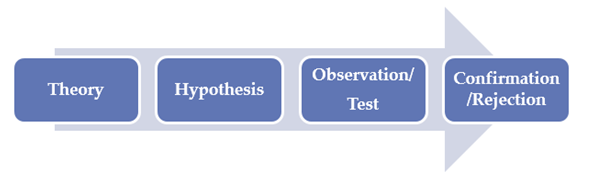
Generally, studies using deductive approach follow the following stages:
- Deducing hypothesis from theory.
- Formulating hypothesis in operational terms and proposing relationships between two specific variables
- Testing hypothesis with the application of relevant method(s). These are quantitative methods such as regression and correlation analysis, mean, mode and median and others.
- Examining the outcome of the test, and thus confirming or rejecting the theory. When analysing the outcome of tests, it is important to compare research findings with the literature review findings.
- Modifying theory in instances when hypothesis is not confirmed.
Deductive Approach in the Age of AI and Digital Research
AI technologies, big data analytics, and digital research systems are significantly increasing the importance and capabilities of deductive research approaches. Modern businesses generate large amounts of measurable digital data through online platforms, AI systems, customer analytics, financial databases, and digital business operations.
Researchers can now test hypotheses using large datasets processed through AI-assisted statistical analysis and machine learning systems. These tools can identify patterns, correlations, and predictive relationships much faster than traditional manual analysis methods.
For example, deductive studies may examine the effect of AI adoption on employee productivity, the impact of digital marketing algorithms on customer behaviour, or the influence of remote work technologies on organisational performance using large-scale digital datasets.
At the same time, AI-assisted deductive research introduces important methodological concerns related to algorithmic bias, data quality, overreliance on automated analysis, and incorrect interpretation of statistical relationships. AI systems can identify measurable patterns efficiently, but they cannot always explain deeper contextual or human factors behind those relationships.
Researchers must therefore critically evaluate AI-generated outputs rather than assuming that every statistical relationship represents meaningful causality. Despite rapid advances in AI-powered analytics, human judgement remains essential for selecting appropriate theories, formulating valid hypotheses, interpreting findings critically, and evaluating methodological limitations.
Using AI-generated statistical outputs or AI-assisted analysis in your dissertation?
The Dudovskiy AI Research Assistant can help you evaluate whether your deductive methodology and hypothesis testing remain academically defensible.
When to Use Deductive Reasoning
Deductive approach is most appropriate when your research aims to test existing theories, examine relationships between variables, and produce generalisable findings.
You should use a deductive approach if:
- you are working with existing theory or models
- your study involves hypothesis testing
- you aim to examine relationships between variables
- quantitative analysis plays central role in the study
- your objective is to produce generalisable findings
- substantial literature already exists in your research area
- your study focuses on measurable and structured data
Here are a few examples of studies with deductive approach
- Testing if AI-powered customer service improves customer satisfaction using survey data
- Examining the relationship between employee training and development and organisational performance
- Analysing the impact of changes of pricing strategy on sales volumes
Exam Tip
When discussing deductive approach in your dissertation:
- explain clearly which theory your hypotheses are based on
- justify why hypothesis testing suits your objectives
- explain how variables were measured
- discuss how findings support or challenge existing theory
- distinguish deductive approach clearly from inductive reasoning
Still unsure whether deductive approach is the right choice for your research?
Get a clear, justified methodology for your research topic in minutes
My e-book, How to Write a Dissertation: A Step-by-Step System to Plan, Write and Defend Your Dissertation in the age of AI contains discussions of theory and application of research philosophy. The e-book also explains all stages of the research process starting from the selection of the research area to writing personal reflection. Important elements of dissertations such as research philosophy, research approach, research design, methods of data collection and data analysis are explained in this e-book in simple words.
 Download the e-book and start making progress today
Preparing to Defend Your Methodology?
Understanding research design is one thing. Defending it under examination is another.
If you would like structured guidance on how to justify your methodological choices, respond to challenging viva questions, address limitations confidently, and navigate academic integrity in the AI era, you may find the following resource helpful:
The manual provides a structured system for aligning your research design, strengthening your justifications, and preparing for defense scenarios with clarity and confidence
 Download the manual and prepare to defend your methodology with confidence
John Dudovskiy
[1] Wilson, J. (2010) “Essentials of Business Research: A Guide to Doing Your Research Project” SAGE Publications, p.7
[2] Gulati, PM, 2009, Research Management: Fundamental and Applied Research, Global India Publications, p.42
[3] Babbie, E. R. (2010) “The Practice of Social Research” Cengage Learning, p.52
[4] Snieder, R. & Larner, K. (2009) “The Art of Being a Scientist: A Guide for Graduate Students and their Mentors”, Cambridge University Press, p.16
[5] Pelissier, R. (2008) “Business Research Made Easy” Juta & Co., p.3