
Action Research
Action research is a a type of research where the researcher collaborates with participants or organisations to identify problems, implement changes, and evaluate outcomes in order to improve real-world practices.
On this page:
- What is Action Research?
- Types of Action Research
- Action Research Spiral
- Action Research in the Age of AI and Digital Research
- Advantages and Disadvantages
- When to use Action Research
| Feature | Action Research | Traditional Research |
|---|---|---|
| Researcher role | Active participant | Independent observer |
| Main purpose | Solve practical problems | Generate theoretical knowledge |
| Research process | Cyclical and iterative | Usually linear |
| Research setting | Real organisational environment | Often controlled or theoretical |
| Main outcome | Practical improvements and insights | Generalisable knowledge |
Action research at a glance
What is Action Research?
Most research studies aim to understand a problem. Action research goes one step further by attempting to solve the problem while simultaneously studying it.
Instead of remaining detached from the research setting, the researcher works collaboratively with participants to identify issues, implement improvements, evaluate results, and refine solutions over time. This creates a continuous cycle of learning and improvement.
Bryman, and Bell (2011) define action research as “an approach in which the action researcher and a client collaborate in the diagnosis of the problem and in the development of a solution based on the diagnosis”[1]. In other words, one of the main characteristic traits of this type of research relates to collaboration between researcher and member of organisation in order to solve organizational problems.
Action study assumes social world to be constantly changing, both, researcher and research being one part of that change.[2] Action research is closely associated with applied research and is particularly suitable for studies aiming to solve real organisational problems. Unlike purely fundamental research, action research directly links knowledge generation with practical change within a specific context. Action research combines research and practical problem-solving within a real organisational setting.
It is important to make a clear distinction between action research and consulting. Specifically, the former is greater than the latter in a way that action research includes both action and research, whereas business activities of consulting are limited action without the research.
Not every research project requires action research.
The Dudovskiy AI Research Assistant can help you determine whether action research, case study, survey research, or another methodology is most appropriate for your dissertation.
Types of Action Research
Generally, action researches can be divided into three categories: positivist, interpretive and critical.
Positivist approach to action research, also known as ‘classical action research’ perceives research as a social experiment. Accordingly, action research is accepted as a method to test hypotheses in a real world environment.
Interpretive action research, also known as ‘contemporary action research’ perceives business reality as socially constructed and focuses on specifications of local and organisational factors when conducting the action research.
Critical action research is a specific type of action research that adopts critical approach towards business processes and aims for improvements.
The following features of action research need to be taken into account when considering its suitability for any given study:
- It is applied in order to improve specific practices. Action research is based on action, evaluation and critical analysis of practices based on collected data in order to introduce improvements in relevant practices.
- This type of research is facilitated by participation and collaboration of number of individuals with a common purpose
- Such a research focuses on specific situations and their context
Action Research Spiral
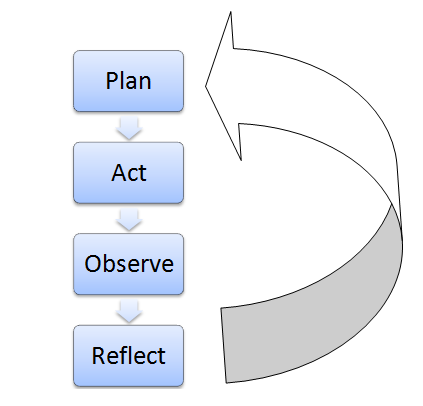
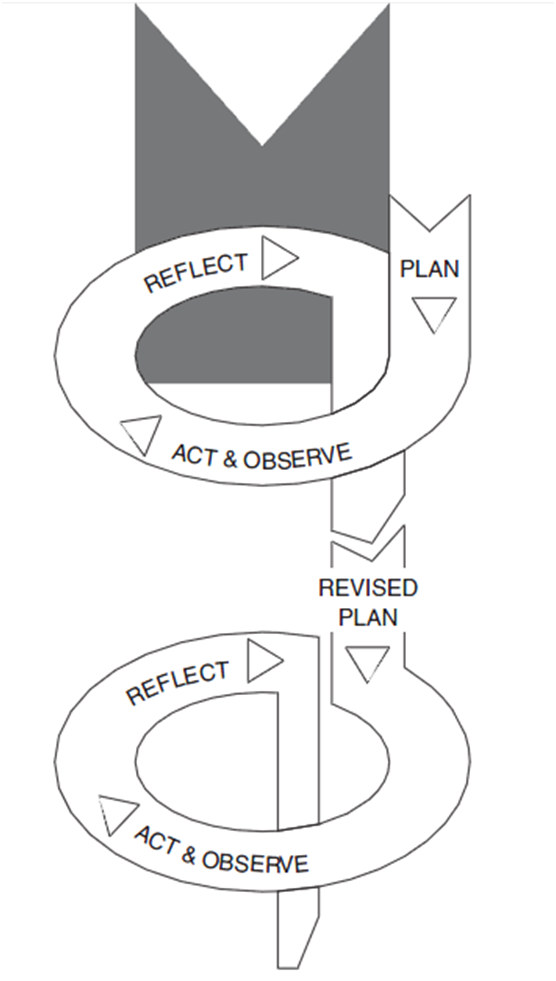
Action study is a participatory study consisting of spiral of following self-reflective cycles:
- Planning in order to initiate change
- Implementing the change (acting) and observing the process of implementation and consequences
- Reflecting on processes of change and re-planning
- Acting and observing
- Reflecting
Action Research Spiral
It is important to note that individual stages specified in Action Research Spiral model may overlap, and initial plan developed for the research may become obsolete in short duration of time due to a range of factors.
The main advantage of Action Research Spiral model relates to the opportunity of analysing the phenomenon in a greater depth each time, consequently resulting in greater level of understanding of the problem. Disadvantages of Action Research Spiral model include its assumption each process takes long time to be completed which may not always be the case.
Action Research in the Age of AI and Digital Research
Action research has become increasingly relevant as organisations navigate rapid technological change, digital transformation, artificial intelligence adoption, remote working arrangements, and evolving business models.
Many organisations now face challenges that cannot be solved through one-off interventions. Instead, they require ongoing experimentation, evaluation, and refinement. The cyclical nature of action research makes it particularly well suited to these dynamic environments.
For example, an organisation introducing AI-powered decision-support systems may use action research to monitor employee reactions, identify implementation challenges, evaluate performance outcomes, and continuously improve adoption strategies. Researchers can work alongside managers and employees to understand how technological changes influence organisational behaviour and performance over time.
Digital technologies also create new opportunities for data collection and analysis within action research. Researchers may utilise digital collaboration platforms, organisational analytics, employee feedback systems, and AI-assisted analytical tools to support decision-making throughout the research process.
At the same time, these developments introduce important ethical challenges. Issues such as employee monitoring, algorithmic bias, data privacy, transparency, and informed consent require careful consideration. Researchers must ensure that technological innovation does not compromise participant rights or organisational trust.
As organisations continue to adapt to AI and digital transformation, action research is likely to become an increasingly valuable methodology for supporting evidence-based organisational change.
Planning a dissertation on AI implementation, organisational change, or digital transformation?
The Dudovskiy AI Research Assistant can help you determine whether action research is suitable for your study and guide you in justifying your methodological choices.
Advantages and Disadvantages
Perhaps the greatest strength of action research is its practical relevance. The research is directly connected to real organisational challenges, meaning that findings often lead to immediate and tangible improvements.
A further benefit is the opportunity to develop a deep understanding of organisational processes. Because researchers work closely with participants and observe change as it occurs, they often gain insights that would be difficult to obtain through more detached research methods.
Another reason researchers value action research is its methodological flexibility. Both qualitative and quantitative methods can be incorporated depending on the nature of the problem, organisational context, and research objectives.
Despite these advantages, action research presents several challenges. One limitation frequently associated with the approach is the difficulty of maintaining objectivity. Close collaboration with participants may increase the risk of researcher bias and make it harder to remain neutral throughout the study.
Researchers should also recognise that action research can be time-intensive. Multiple cycles of planning, implementation, observation, and reflection often require sustained engagement over extended periods.
A further drawback relates to generalisability. Because action research is typically conducted within a specific organisational context, findings may not be easily transferable to other organisations or environments.
Nevertheless, action research remains one of the most effective approaches when the objective is both to understand and improve organisational practice.
When to Use Action Research
You should use action research if:
- your objective is to improve organisational practices while studying them
- you have direct access to an organisation and can collaborate with participants
- the research involves implementing and evaluating change
- continuous learning and improvement are important to the study
- the problem requires practical solutions rather than purely theoretical explanations
- you are studying organisational development, process improvement, cultural change, or technology implementation
Action research is particularly suitable for projects involving employee performance improvement, organisational transformation, leadership development, digital innovation, AI adoption, customer service enhancement, or business process optimisation.
Because action research involves close collaboration with participants, ethical considerations should receive special attention. Researchers must ensure informed consent, protect confidentiality, manage power relationships responsibly, and remain transparent throughout the research process.
Still not sure if action research is the right choice for your dissertation?
Get a clear, justified methodology for your research topic in minutes
My e-book, How to Write a Dissertation: A Step-by-Step System to Plan, Write and Defend Your Dissertation in the age of AI contains discussions of theory and application of research philosophy. The e-book also explains all stages of the research process starting from the selection of the research area to writing personal reflection. Important elements of dissertations such as research philosophy, research approach, research design, methods of data collection and data analysis are explained in this e-book in simple words.

Download the e-book and start making progress today
Preparing to Defend Your Methodology?
Understanding research design is one thing. Defending it under examination is another.
If you would like structured guidance on how to justify your methodological choices, respond to challenging viva questions, address limitations confidently, and navigate academic integrity in the AI era, you may find the following resource helpful:
The manual provides a structured system for aligning your research design, strengthening your justifications, and preparing for defense scenarios with clarity and confidence.
 Download the manual and prepare to defend your methodology with confidence
John Dudovskiy
References
[1] Bryman, A. & Bell, E. (2011) “Business Research Methods” 3rd edition, Oxford University Press
[2] Collis, J. & Hussey, R. (2003) “Business Research. A Practical Guide for Undergraduate and Graduate Students” 2nd edition, Palgrave Macmillan