
Research Philosophy
Research philosophy refers to the set of beliefs and assumptions about how knowledge is created, what is valid knowledge, and how research should be done. It guides the choice of research methods, data collection, and analysis by defining how a researcher understands reality and knowledge.
On this page:
- What is Research Philosophy?
- Why it Research Philoshophy Matters?
- The Choice of Research Philosophy
- Research Philosophy in the Age of AI and Digital Research
- How to use Research Philosophy
| Philosophy | Main Focus | Data Type | Typical Methods |
|---|---|---|---|
| Positivism | Objective facts and causality | Quantitative | Surveys, experiments, statistical analysis |
| Interpretivism | Meanings and experiences | Qualitative | Interviews, observations |
| Realism | Objective reality with interpretation | Mixed | Qualitative and quantitative |
| Pragmatism | Practical solutions | Mixed | Flexible mixed methods |
Main research philosophies (comparison table)
What is Research Philosophy?
Many students initially find research philosophy difficult to understand because it deals with abstract concepts about knowledge and reality. However, it is not necessary to become a philosopher in order to apply philosophical ideas in research. The key objective is simply to understand the basic assumptions underlying the research approach and to demonstrate that the chosen methodology is logically consistent with those assumptions.
Research philosophy is a vast topic and here we will not be discussing this topic in great details. Research philosophy is associated with assumption, knowledge and nature of the study. It deals with the specific way of developing knowledge. This matter needs to be addressed because researchers may have different assumptions about the nature of truth and knowledge and philosophy helps us to understand their assumptions.
In business and economics dissertations at Bachelor’s level, you are not expected to discuss this topic in a great level of depth, and about one page in methodology chapter devoted to research philosophy usually suffices. For a business dissertation at Master’s level, on the other hand, you may need to provide more discussion of the philosophy of your study. But even there, about two pages of discussions are usually accepted as sufficient by supervisors.
Research philosophy is about the way researchers view knowledge and reality.
Different researchers may have different beliefs about:
- what counts as reliable knowledge
- how reality should be studied
- which methods are most appropriate
- how findings should be interpreted
For example, some researchers believe research should focus mainly on measurable facts and statistical analysis. Others believe understanding human experiences and meanings is more important.
Your research philosophy therefore influences:
- your methodology
- your data collection methods
- your data analysis approach
- interpretation of findings
In simple terms, research philosophy acts as the foundation of your entire dissertation.
Choosing the wrong research philosophy can weaken your entire dissertation.
The Dudovskiy AI Research Assistant helps you align your research philosophy, methodology, and objectives in academically defensible way.
Why Research Philosophy Matters
Research philosophy deals with the source, nature and development of knowledge[1]. In simple terms, research philosophy is belief about the ways in which data about a phenomenon should be collected, analysed and used.
Although the idea of knowledge creation may appear to be profound, you are engaged in knowledge creation as part of completing your dissertation. You will collect secondary and primary data and engage in data analysis to answer the research question and this answer marks the creation of new knowledge.
In respect to business and economics philosophy has the following important three functions[2]:
- Demystifying: Exposing, criticising and explaining the unsustainable assumptions, inconsistencies and confusions these may contain.
- Informing: Helping researchers to understand where they stand in the wider field of knowledge-producing activities, and helping to make them aware of potentialities they might explore.
- Method-facilitating: Dissecting and better understanding the methods which economists or, more generally, scientists do, or could, use, and thereby to refine the methods on offer and/or to clarify their conditions of usage.
In essence, addressing research philosophy in your dissertation involves being aware and formulating your beliefs and assumptions. As illustrated in figure below, the identification of research philosophy is positioned at the outer layer of the ‘research onion’. Accordingly it is the first topic to be clarified in research methodology chapter of your dissertation.
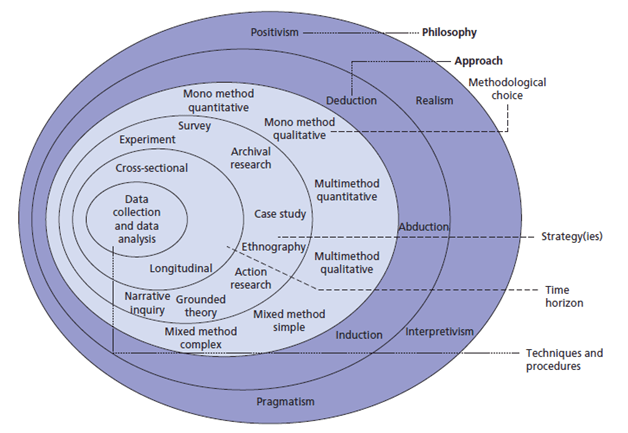
Research philosophy in the ‘research onion’[2]
Each stage of the research process is based on assumptions about the sources and the nature of knowledge. Research philosophy will reflect the author’s important assumptions and these assumptions serve as base for the research strategy. Generally, research philosophy has many branches related to a wide range of disciplines.
Different research philosophies reflect different assumptions about how knowledge should be generated and interpreted. Each philosophical perspective influences the research design, the type of data collected, and the methods used for analysis. While no single philosophy can be considered universally superior, the choice of philosophy should align with the research objectives and the nature of the research problem.
Within the scope of business studies in particular there are four main research philosophies:
- Pragmatism
- Positivism
- Realism
- Interpretivism (Interpretivist)
The Choice of Research Philosophy
The choice of a specific research philosophy is impacted by practical implications. There are important philosophical differences between studies that focus on facts and numbers such as an analysis of the impact of foreign direct investment on the level of GDP growth and qualitative studies such as an analysis of leadership style on employee motivation in organizations.
The choice between positivist and interpretivist research philosophies or between quantitative and qualitative research methods has traditionally represented a major point of debate. However, the latest developments in the practice of conducting studies have increased the popularity of pragmatism and realism philosophies as well.
Moreover, as it is illustrated in table below, there are popular data collection methods associated with each research philosophy.
| Pragmatism | Positivism | Realism | Interpretivism | |
| Popular data collection method | Mixed or multiple
method designs, quantitative and qualitative |
Highly structured,
large samples, measurement, quantitative, but can use qualitative |
Methods chosen must fit the subject matter, quantitative or qualitative | Small samples, in-depth
investigations, qualitative |
Research philosophies and data collection methods[3]
Research Philosophy in the Age of AI and Digital Research
AI technologies and digital research environments are changing how research philosophy is applied in modern business studies. AI-assisted analytics, big data systems, machine learning, digital ethnography, online behavioural analysis, and automated data processing are increasing both opportunities and methodological complexity within academic research.
Positivist approaches are becoming increasingly important because AI systems can process extremely large numerical datasets and identify measurable patterns much faster than traditional methods. At the same time, interpretivist approaches remain highly relevant because human experiences, meanings, emotions, ethics, and social interactions still require contextual understanding beyond automated analysis.
Digital research environments are also blurring traditional boundaries between qualitative and quantitative research. Researchers increasingly combine statistical analysis, textual analysis, behavioural analytics, social media data, digital observation, and AI-assisted thematic analysis within mixed-method research designs.
At the same time, AI-assisted research introduces important philosophical and ethical concerns related to the validity of AI-generated knowledge, algorithmic bias, transparency of automated analysis, and the role of human judgement in the research process. Researchers must therefore critically evaluate not only the data itself, but also how AI technologies influence production, interpretation, and reliability of knowledge.
Despite rapid advances in AI-assisted research tools, human reasoning, methodological understanding, and critical thinking remain essential for producing academically credible and defensible research.
Using AI tools to help design your methodology or analyse data?
The Dudovskiy AI Research Assistant can help you choose and justify research philosophy and methodology choices that remain academically defensible.
How to Use Research Philosophy
The choice of research philosophy depends on your research aim, research questions, and the nature of the problem you are investigating.
You should:
- Use positivism when your study focuses on measuring relationships between variables and testing hypotheses
- Use interpretivism when your aim is to understand meanings, experiences, or perceptions
- Use realism when you want to combine objective analysis with contextual interpretation
- Use pragmatism when your research requires practical solutions and mixed methods
For example:
- A study analysing the impact of an acquisition on company’s performance → Positivism
- A study exploring how employees experience organisational change in the workplace → Interpretivism
Choose your research philosophy based on whether your study aims to measure, understand, or solve a problem.
Discussion of research philosophy in your dissertation should include the following:
- You need to specify the research philosophy of your study. Your research philosophy can be pragmatism, positivism, realism or interpretivism as discussed below in more details.
- You are expected to discuss the reasons behind philosophical classifications of the study.
- You need to discuss the implications of your research philosophy on the research strategy in general and the choice of primary data collection methods in particular.
Still unsure about the right research philosophy for your research?
Get a clear, justified methodology for your research topic in minutes
My e-book, How to Write a Dissertation: A Step-by-Step System to Plan, Write and Defend Your Dissertation in the age of AI contains discussions of theory and application of research philosophy. The e-book also explains all stages of the research process starting from the selection of the research area to writing personal reflection. Important elements of dissertations such as research philosophy, research approach, research design, methods of data collection and data analysis are explained in this e-book in simple words.

Download the e-book and start making progress today
Preparing to Defend Your Methodology?
Understanding research design is one thing. Defending it under examination is another.
If you would like structured guidance on how to justify your methodological choices, respond to challenging viva questions, address limitations confidently, and navigate academic integrity in the AI era, you may find the following resource helpful:
The manual provides a structured system for aligning your research design, strengthening your justifications, and preparing for defense scenarios with clarity and confidence.

Download the manual and prepare to defend your methodology with confidence
John Dudovskiy
[1] Bajpai, N. (2011) “Business Research Methods” Pearson Education India
[2] Tsung, E.W.K. (2016) “The Philosophy of Management Research” Routledge
[3] Table adapted from Saunders, M., Lewis, P. & Thornhill, A. (2012) “Research Methods for Business Students” 6th edition, Pearson Education Limited
John Dudovskiy