
Simple Random Sampling
Simple random sampling is a probability sampling method in which every member of a population has an equal and independent chance of being selected for the sample. Because selection is entirely random, this method helps minimise sampling bias and increases the likelihood that the sample will accurately represent the wider population.
On this page:
- Simple Random Sampling Explained Simply
- What is Simple Random Sampling?
- Simple Random Sampling vs Other Sampling
- Minimising Sampling Bias
- How to Use Simple Random Sampling
- Simple Random Sampling in Business Research
- Advantages and Limitations
- Simple Random Sampling in the Age of AI and Digital Research
- When to Use Simple Random Sampling
- Exam Tip
| Aspect | Simple Random Sampling | Stratified Sampling | Purposive Sampling |
|---|---|---|---|
| Selection method | Entirely random | Random within predefined groups | Researcher judgement |
| Sampling type | Probability | Probability | Non-probability |
| Risk of bias | Low | Low | Higher |
| Representativeness | High | Very high if strata are appropriate | Limited |
| Generalisation | Usually possible | Usually possible | Usually limited |
| Typical research | Quantitative | Quantitative | Qualitative |
Sampling methods at a glance (comparison table)
Simple random sampling aims to produce representative and unbiased samples through random selection.
Simple Random Sampling Explained Simply
Imagine a company wants to survey 200 employees from a workforce of 2,000 people.
Instead of choosing employees based on department, seniority, or convenience, the company assigns every employee a number and uses a random process to select participants.
Every employee has exactly the same chance of being chosen.
This is simple random sampling.
For example, HSBC may wish to measure employee engagement across its workforce. Rather than selecting only employees from particular offices, the bank could randomly select participants from its complete employee database. This helps ensure that the findings reflect the broader workforce rather than the views of a specific subgroup.
In simple terms, simple random sampling gives every member of the population an equal opportunity to be included in the study.
What is Simple Random Sampling?
Simple random sampling, sometimes referred to simply as random sampling, is one of the oldest and most widely used probability sampling techniques. It is often considered the purest form of probability sampling because the selection process relies entirely on chance.
The underlying principle is straightforward. Every member of the target population must have an equal and known probability of being selected. This reduces the influence of researcher bias and increases the likelihood that the sample accurately represents the wider population.
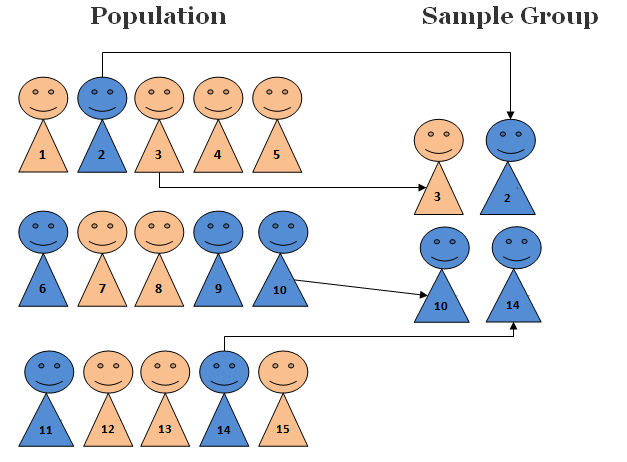
The logic behind simple random sampling is that random selection removes subjective judgement from the sampling process. As a result, researchers can make stronger claims about the representativeness of their sample and the generalisability of their findings.
Despite its conceptual simplicity, applying simple random sampling in practice can be challenging. Researchers must usually have access to a complete sampling frame, meaning a full list of all members of the population. Obtaining such a list can be difficult, expensive, or impossible in many research settings.
For this reason, although dissertation supervisors often encourage the use of probability sampling methods, many students ultimately adopt alternative sampling techniques because of practical constraints.
Simple Random Sampling vs Other Random Sampling Methods
Simple random sampling is only one type of probability sampling. Other common probability sampling methods include the following:
Stratified Sampling. The population is divided into relevant subgroups (strata), and random samples are drawn from each group. For example, a researcher studying employees at Toyota may divide employees into management, administrative, and production groups before selecting random participants from each category.
Systematic Sampling. Researchers select every nth member from a list after choosing a random starting point. For example, every 20th customer from a customer database may be selected.
Cluster Sampling. Researchers randomly select groups or clusters rather than individual participants. For example, a study involving schools may randomly select entire schools rather than individual students.
Multistage Sampling. Sampling occurs in multiple stages, often combining several probability sampling techniques.This approach is commonly used in large-scale national and international studies.
Minimising Sampling Bias
There are two popular approaches that are aimed to minimize the relevance of bias in the process of random sampling selection: method of lottery and the use of random numbers.
The method of lottery is the most primitive and mechanical example of random sampling. In this method you will have to number each member of population in a consequent manner, writing numbers in separate pieces of paper. These pieces of papers are to be folded and mixed into a box. Lastly, samples are to be taken randomly from the box by choosing folded pieces of papers in a random manner.
The use of random numbers, an alternative method also involves numbering of population members from 1 to N. Then, the sample size of N has to be determined by selecting numbers randomly. The use of random number table similar to one below can help greatly with the application of this sampling technique.
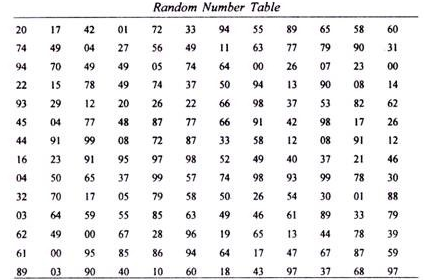 Random number table
How to Use Simple Random Sampling
Suppose you are conducting a dissertation examining leadership practices and work-life balance at a company with 600 employees.
The process would typically involve the following steps:
- Obtain a complete list of all 600 employees.
- Assign each employee a unique number.
- Determine the required sample size.
- Use a random number generator to select participants.
- Contact the selected employees and collect data.
For example, if your desired sample size is 150 participants, you would generate 150 random numbers corresponding to employees on the list. The employees assigned to those numbers would become members of your sample.
Modern tools such as spreadsheet software, statistical packages, and online random number generators make this process straightforward and transparent.
Simple Random Sampling in Business Research
Simple random sampling is widely used in business research because many studies seek findings that can be generalised to larger populations.
For example, marketing researchers may randomly select customers to measure satisfaction levels, purchasing behaviour, or brand awareness. Human resource researchers may randomly select employees to assess engagement, motivation, or organisational commitment.
A company such as Unilever might randomly select consumers from a customer database to evaluate perceptions of a new product. Similarly, Marriott International could randomly select guests from recent bookings to assess service quality across multiple locations.
Because random selection reduces bias, findings generated through simple random sampling are often viewed as more credible than those obtained through convenience or purposive sampling.
Advantages and Limitations
One of the strongest advantages of simple random sampling is its ability to minimise selection bias. Because every member of the population has an equal chance of being chosen, researchers can be more confident that the sample reflects the wider population.
Another important benefit is the relative simplicity of the method. Once a complete sampling frame is available, selecting participants can be straightforward and transparent. This makes the process easy to explain and justify within a dissertation methodology chapter.
Researchers also value simple random sampling because it supports statistical analysis and increases the potential for generalising findings to the broader population.
Despite these strengths, practical limitations often arise. The most significant challenge is obtaining a complete and accurate sampling frame. Many populations do not have readily available lists of members, making true random sampling difficult to implement.
A further limitation concerns sample size. Random sampling generally performs best when relatively large samples are available. Small samples may not adequately represent the population despite the random selection process.
Researchers should also recognise that random sampling can become costly and time-consuming when participants are geographically dispersed or difficult to contact.
For these reasons, simple random sampling is often theoretically ideal but practically challenging.
Simple Random Sampling in the Age of AI and Digital Research
Advances in artificial intelligence, cloud computing, digital platforms, and big data technologies are transforming how researchers conduct random sampling.
Many organisations now maintain large digital databases containing customer records, employee information, transaction histories, and online user profiles. These databases allow researchers to generate random samples much more efficiently than traditional manual approaches.
For example, Spotify can randomly select users from millions of accounts to evaluate customer feedback regarding the latest track, while DHL can use digital employee databases to select participants for workforce surveys.
AI-powered research platforms increasingly automate participant selection, survey distribution, response tracking, and data validation. This significantly reduces administrative effort and improves sampling efficiency.
However, digital environments also introduce new challenges. Online databases may contain duplicate accounts, inactive users, automated bots, outdated records, or algorithmic biases that affect representativeness. Consequently, researchers must carefully assess the quality of digital sampling frames before assuming that a randomly selected sample is genuinely representative.
As organisations become increasingly data-driven, simple random sampling remains highly relevant. Technology has made random selection easier than ever, but ensuring the quality and accuracy of the sampling frame remains a critical responsibility for researchers.
When to Use Simple Random Sampling
You should use simple random sampling if:
- you have access to a complete sampling frame
- your research requires statistical analysis
- generalisation of findings is important
- you are conducting quantitative research
- the population is relatively homogeneous
- sufficient time and resources are available to contact participants
Simple random sampling is particularly suitable for surveys and quantitative studies where minimising sampling bias is a priority.
Exam Tip
Students often claim they used simple random sampling even though they selected participants based on convenience or accessibility.
To justify simple random sampling in your dissertation, you must demonstrate that every member of the population had an equal chance of selection and explain exactly how the random selection process was carried out. If participants were selected based on availability, the sampling method is not simple random sampling.
Still not sure if simple random sampling is the right choice for your research?
Get a clear, justified methodology for your research topic in minutes
John Dudovskiy
[1] Gravetter, F.J & Forzano, L.B. (2011) “Research Methods for the Behavioural Sciences” Cengage Learning p.146
[2] Saunders, M., Lewis, P. & Thornhill, A. (2012) “Research Methods for Business Students” 6th edition, Pearson Education Limited