

Interviews are a qualitative data collection method where the researcher asks participants questions to explore their experiences, opinions, or behaviours in depth. Interviews are widely used in business research to gain detailed and context-rich insights that cannot be captured through quantitative methods. On this page: What are Interviews in Research Types of Interview When to Use Interviews Advantages and Disadvantages How to Conduct Interviews Interviews in the Age of AI and Digital Research Type Structure Flexibility Typical Use Structured Pre-defined questions Low Comparability, large samples Semi-structured Core questions + follow-ups Medium Most business research Unstructured No fixed questions High Exploratory studies Types of interviews at a glance Semi-structured interviews are the most commonly used interview format in business research because they balance consistency with flexibility. What are Interviews in Research? Interviews can be defined as a qualitative research technique which involves “conducting intensive individual interviews with a small number of respondents to explore their perspectives on a particular idea, program or situation.”[1] Interviews enable researchers to explore not only what participants think, but also why they think that way. This makes interviews particularly valuable for gaining in-depth insights into complex or context-specific business issues. Still unsure if interview is the right data collection method for your research? Get a clear, justified methodology for your research topic in minutes See how it works Types of Interviews There are three different formats of interviews: structured, semi-structured and unstructured. Structured interviews consist of a series of pre-determined questions that all interviewees answer in the same order. Data analysis usually tends to be more straightforward because researcher can compare and contrast different answers given to the same questions. Structured interviews are more commonly used in quantitative or highly standardised research. Unstructured interviews are usually the least reliable from research viewpoint,…

The term experiment may seem to be associated with the image of a chemist surrounded by bubbling tubes and other related items. Traditionally, experiments have been used by physical and behavioural researchers to a greater extent compared to business scientists. Nevertheless, experiments research can be effectively used in businesses in order to analyse cause and affect relationships. Deductive approach is mainly used for experiments research in order to test hypotheses. Experiments are usually used in causal studies. Specifically, experiment researches involve manipulation with an independent variable in order to assess its impacts on dependent variables. Changes in price levels on volume of sales can be mentioned as a basic example for experiment. In this specific example, price can be specified as independent variable, whereas sales would be dependent variable. The nature of relationships between two variables in causal experimental researches may be divided into three categories: symmetrical, reciprocal and asymmetrical. Symmetrical relationship can be observed when two variables fluctuate at the same time. However, in symmetrical relationship change in one variable is not caused by change in another variable. In other words, symmetrical relationships of two individual variables usually would be the cause of another factor. For example, decrease in the levels of consumption of luxury products and decrease on the levels of consumer trust on financial institutions may occur at the same time as a result of a third factor – increasing level of uncertainty of perspectives of national economy. Reciprocal relationship between two variables occurs when there is a mutual influence and reinforcement between two variables. For example, impacted by a marketing message a consumer purchases a car from a particular brand for the first time. Consequently, the consumer becomes loyal to the brand considering more purchases from the same brand in the future. Hence, the mutual influence between…
Surveys are a data collection method that involves asking a group of individuals structured questions in order to gather information about their opinions, behaviours, or characteristics. They are widely used in business research for both quantitative and qualitative studies. On this page: What are Surveys? Types of Surveys Advantages and Disadvantages When to Use Surveys Method Description Typical Use Online survey Self-administered via internet Large-scale data collection Telephone survey Questions asked via phone Quick responses Face-to-face survey Conducted in person Higher response quality Mail survey Sent via post Low-cost but slow Survey methods at a glance Modern research primarily relies on online surveys due to speed and cost efficiency. Surveys involve: Asking the same questions to many people Collecting responses in a structured format Analysing results to identify patterns They help answer questions like:“What do people think?”, “How satisfied are customers?”, “What are common behaviours?” What are Surveys? The essence of survey method can be explained as “questioning individuals on a topic or topics and then describing their responses”[1]. In business studies survey method of primary data collection is used in order to test concepts, reflect attitude of people, establish the level of customer satisfaction, conduct segmentation research and a set of other purposes. Survey method can be used in both, quantitative, as well as, qualitative studies. Survey method pursues two main purposes: Describing certain aspects or characteristics of population and/or Testing hypotheses about nature of relationships within a population. Types of Surveys Survey method can be broadly divided into three categories: mail survey, telephone survey and personal interview. The descriptions of each of these methods are briefly explained on the following table [2]: Survey method Description Mail survey A written survey that is self-administered Telephone survey A survey conducted by telephone in which the questions are read to the…
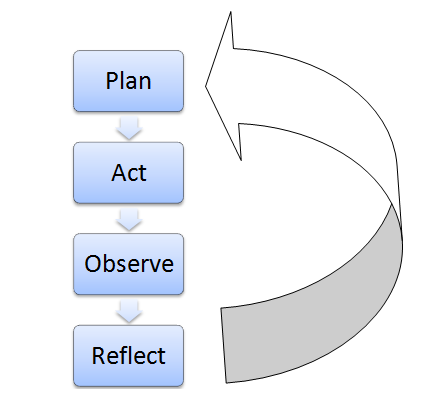
Action research is a a type of research where the researcher collaborates with participants or organisations to identify problems, implement changes, and evaluate outcomes in order to improve real-world practices. On this page: What is Action Research? Types of Action Research Action Research Spiral Advantages and Disadvantages Action Research in the Age of AI When to use Action Research Feature Action Research Traditional Research Researcher role Active participant Independent observer Main purpose Solve practical problems Generate theoretical knowledge Research process Cyclical and iterative Usually linear Research setting Real organisational environment Often controlled or theoretical Main outcome Practical improvements and insights Generalisable knowledge Action research at a glance What is Action Research? Action research can be defined as “an approach in which the action researcher and a client collaborate in the diagnosis of the problem and in the development of a solution based on the diagnosis”[1]. In other words, one of the main characteristic traits of this type of research relates to collaboration between researcher and member of organisation in order to solve organizational problems. Action study assumes social world to be constantly changing, both, researcher and research being one part of that change.[2] Action research is closely associated with applied research and is particularly suitable for studies aiming to solve real organisational problems. Unlike purely fundamental research, action research directly links knowledge generation with practical change within a specific context. Action research combines research and practical problem-solving within a real organisational setting. It is important to make a clear distinction between action research and consulting. Specifically, the former is greater than the latter in a way that action research includes both action and research, whereas business activities of consulting are limited action without the research. Not sure if action research is the right choice for your dissertation?…

Samsung marketing communication mix utilises a number of marketing communication channels such as print and media advertising, sales promotion, events and experiences and public relations. Samsung Electronics uses these channels in an integrated manner as discussed below in more details. Advertising Print and media advertising is one of the core elements of the marketing mix extensively utilized by Samsung Electronics. One of the important key features of Samsung advertising strategy is that the multinational electronics company usually advertises its specific products such as Galaxy S and Note smartphones, but it does not advertise much Samsung brand in general . The most noteworthy media advertising campaigns include live commercials for Samsung Galaxy S 3 device on popular Jimmy Kimmel Live show in June 2012 and on Late Night With Jimmy Fallon on July and August of the same year. Moreover, partnership with Fox channel in the US to run four 30-second advertising clips during the National Football League, college football and World Series games in 2012 have been praised as efficient marketing campaigns.[1] Samsung print advertising in popular newspapers, magazines and journals have previously included direct attacks on its major competitors, notably Apple. For example, a print ad campaign titled ‘It doesn’t take a genius’ is a clever play of words on Apple’s emphasize on genius branding. The print ad compares major functionalities of iPhone5 and Galaxy S III and illustrating the superiority of Samsung’s product on several fronts.[2] Viral marketing is also extensively used by Samsung as one of the most effective advertising methods. For example, the latest 60-second viral marketing video titled “Anticipation” is a successful attempt to associate Samsung Galaxy S6 with excitement and a sense of achievement and recognition.[3] Sales Promotion Samsung uses sales promotions as a marketing tool more extensively compared to the majority of…
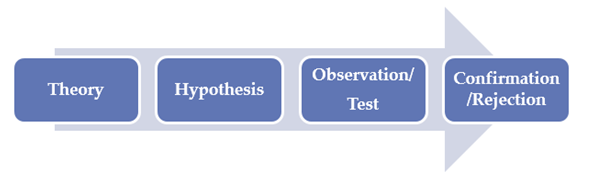
Deductive research approach refers to a method of reasoning in which researchers begin with an existing theory and develop hypotheses that are tested through empirical data collection and analysis. In deductive studies, conclusions are drawn by moving from general theoretical propositions to specific observations. This approach is commonly used in business and management research when the objective is to test whether existing theories apply in particular contexts. On this page: Meaning of deductive research approach Advantages and disadvantages Stages of deductive research process Deductive Approach in the Age of AI and Digital Research When to use deductive approach Exam Tip Feature Deductive Approach Inductive Approach Starting point Existing theory Observations or data Main purpose Test hypotheses Develop theory Direction of reasoning General → specific Specific → general Typical methods Often quantitative Often qualitative Main outcome Confirmation or rejection of theory Development of new insights Deductive vs inductive approach (comparison table) Meaning of Deductive Approach A deductive approach is concerned with “developing a hypothesis (or hypotheses) based on existing theory, and then designing a research strategy to test the hypothesis”[1] It has been stated that “deductive means reasoning from the particular to the general. If a causal relationship or link seems to be implied by a particular theory or case example, it might be true in many cases. A deductive design might test to see if this relationship or link did obtain on more general circumstances”[2]. Deductive approach can be explained by the means of hypotheses, which can be derived from the propositions of the theory. In other words, deductive approach is concerned with deducting conclusions from premises or propositions. Deduction begins with an expected pattern “that is tested against observations, whereas induction begins with observations and seeks to find a pattern within them”[3]. Deductive research approach is commonly…
Fundamental research, also known as basic research or pure research, refers to research conducted to expand knowledge and improve understanding of theoretical concepts without aiming for immediate practical application. Unlike applied research, which focuses on solving specific real-world problems, fundamental research seeks to develop general principles, theories, and conceptual frameworks that contribute to the overall body of knowledge in a discipline. On this page: Characteristics of fundamental research Differences between fundamental and applied research Examples of fundamental research in business Advantages and disadvantages of fundamental research Fundamental Research in the Age of AI and Digital Business When to Use Fundamental Research The following table highlights the main differences between fundamental and applied research: Feature Fundamental Research Applied Research Main objective Expand theoretical knowledge Solve practical problems Focus Concepts, theories, and general principles Real-world organizational issues Context Often conducted in universities Often conducted within organizations Time horizon Long-term knowledge development Short- to medium-term solutions Outcomes Conceptual insights and theoretical contributions Practical recommendations Characteristics of Fundamental Research Fundamental research is driven by curiosity and the desire to expand knowledge in specific research area. This type of research makes a specific contribution to the academic body of knowledge in the research area. Fundamental studies tend to make generalizations about the phenomenon, and the philosophy of this type of studies can be explained as ‘gathering knowledge for the sake of knowledge’. Fundamental researches mainly aim to answer the questions of why, what or how and they tend to contribute the pool of fundamental knowledge in the research area. Opposite to fundamental research is applied research that aims to solve specific problems, thus findings of applied research do have immediate practical implications. Not sure if fundamental research is the right choice for your dissertation? Get a clear, justified methodology for your research topic in minutes…
Causal research, also known as explanatory research, is a type of research that aims to identify and explain cause-and-effect relationships between variables On this page: Meaning of causal research and its components Causal research methods Examples of causal research methods Advantages and disadvantages Causal research in the age of AI and digital business When to use causal research Feature Causal Research Exploratory Research Descriptive Research Main purpose Explain cause-and-effect relationships Explore unclear problems Describe characteristics or situations Main research statement Hypothesis Research question Research question Level of structure Highly structured Flexible and unstructured Structured Typical stage Later stages of research Early stages of research Later stages of research Typical methods Experiments, quasi-experiments Interviews, observations Surveys, case studies Research designs at a glance Causal research explains why something happens, whereas descriptive research explains what is happening. Meaning of Causal Research and Its Components Causal studies focus on an analysis of a situation or a specific problem to explain the patterns of relationships between variables. Causal research can be conducted in order to assess impacts of specific changes on existing norms, various processes etc. Experiments are the most popular primary data collection methods in studies with causal research design. Not sure if causal research is the right choice for your dissertation? Get a clear, justified methodology for your research topic in minutes See how it works The presence of cause cause-and-effect relationships can be confirmed only if specific causal evidence exists. Causal evidence has three important components: 1. Temporal sequence. The cause must occur before the effect. For example, it would not be appropriate to credit the increase in sales to rebranding efforts if the increase had started before the rebranding. 2. Concomitant variation. The variation must be systematic between the two variables. For example, if a company doesn’t change its…

Conclusive research design, as the name implies, is applied to generate findings that are practically useful in reaching conclusions or decision-making. In this type of studies research objectives and data requirements need to be clearly defined. Findings of conclusive studies usually have specific uses. Conclusive research design provides a way to verify and quantify findings of exploratory studies. Conclusive research design usually involves the application of quantitative methods of data collection and data analysis. Moreover, conclusive studies tend to be deductive in nature and research objectives in these types of studies are achieved via testing hypotheses. The table below illustrates the main differences between conclusive and exploratory research design: Factor Conclusive Exploratory Objectives To test hypothesis and relationships To get insights and understanding Characteristics Information needs a clearly defined Research process is formal and structured Large representative sample Data analysis is quantitative Information needs are loosely defined Research process is unstructured and flexible Small, non-representative sample Primary data analysis is qualitative Findings Conclusive Only tentative Outcome Findings used as input to decision making Generally followed by further exploratory conclusive research Main differences between conclusive and exploratory research design It has to be noted that “conclusive research is more likely to use statistical tests, advanced analytical techniques, and larger sample sizes, compared with exploratory studies. Conclusive research is more likely to use quantitative, rather than qualitative techniques”[1]. Conclusive research is helpful in providing a reliable or representative picture of the population through the application of valid research instrument. The following are the main benefits of conclusive studies: Provides Definitive Answers. Offers clear and conclusive evidence to support or refute hypotheses. Establishes Causal Relationships. Identifies the factors that influence or cause specific outcomes. Generalizable Findings. Facilitates the application of research findings to real-world settings and broader contexts. Advances Scientific Knowledge. Contributes…
Pragmatism research philosophy is a philosophical approach that focuses on practical solutions and real-world outcomes. It allows researchers to use both qualitative and quantitative methods depending on what best addresses the research question. On this page: What is Pragmatism Research Philosophy? Core Principles of Pragmatism Pragmatism vs Positivism vs Interpretivism Research Methods in Pragmatism Advantages and Limitations Pragmatism in the Age of AI When to Use Pragmatism Research Philosophy Philosophy Research Approach View of Reality Role of Values Typical Methods Positivism Deductive Objective Value-free Quantitative Interpretivism Inductive Subjective Value-laden Qualitative Pragmatism Deductive and/or inductive Objective and subjective Practical and flexible Mixed methods Research phisolophies at a glance What is Pragmatism Research Philosophy? Pragmatism research philosophy is a research approach that focuses on practical outcomes and problem-solving, allowing researchers to combine qualitative and quantitative methods based on what works best for the research question. Pragmatism research philosophy accepts concepts to be relevant only if they support action. Pragmatics “recognise that there are many different ways of interpreting the world and undertaking research, that no single point of view can ever give the entire picture and that there may be multiple realities”[1] Pragmatism is a philosophical approach that emphasizes the practical consequences of ideas. In the context of research, it suggests that the best research methods are those that are most useful and effective in solving particular research problems. Pragmatic researchers are flexible and open to using a variety of methods, both quantitative and qualitative, depending on the specifics of the research question. Pragmatism focuses on what works best to answer the research question. Pragmatists ask:“Which method will best solve this research problem?” Still unsure whether pragmatism is the right choice for your research? Get a clear, justified methodology for your research topic in minutes See how it works…