
Mixed Methods Research
Mixed methods research is a research design in which the researcher collects and analyses both quantitative and qualitative data within a single study and deliberately integrates the two, so that the combined findings answer the research question better than either type of data could alone.
The defining feature is integration, not simply the presence of numbers and words. A dissertation that runs a survey and then a few interviews, and reports them in separate chapters that never refer to each other, has used two methods but has not really done mixed methods research.
For a dissertation, the important questions are:
Why does my research question need both types of data, in what order should I collect them, where will they be integrated, and how do I justify this philosophically?
This page answers each of these, with a decision path for choosing a design and template wording for a methodology chapter.
On this page:
- Mixed methods research explained simply
- What mixed methods research is
- Why researchers combine methods
- The three core mixed methods designs
- How to choose a mixed methods design
- Integration: where the data meet
- Philosophical justification for mixed methods
- Sampling in mixed methods research
- When not to use mixed methods
- Application example
- Advantages and limitations
- Common mistakes
- Mixed methods research in the age of AI and digital research
- Dissertation example
- Exam tip
Mixed Methods Research Explained Simply
Suppose you are studying why so many staff in a chain of hotels say they intend to leave. A questionnaire to 400 employees shows that turnover intention is strongly associated with shift patterns, but much less with pay. That is useful, but it leaves an obvious question: what is it about shift patterns that makes people think about leaving?
You then interview 15 employees selected from the questionnaire respondents, some with high and some with low turnover intention. The interviews suggest that the problem is not long shifts as such, but rotas published at short notice that make childcare difficult to arrange.
The survey told you what was related to turnover intention and how strongly. The interviews suggested why, although they cannot by themselves establish cause and effect. Because the interview sample was chosen using the survey results, and the interview findings were used to interpret those results, the two strands are integrated. That is mixed methods research.
What Is Mixed Methods Research?
Mixed methods research combines elements of quantitative and qualitative research, such as their viewpoints, data collection, analysis and inference techniques, for the purposes of breadth and depth of understanding and corroboration (Johnson, Onwuegbuzie and Turner, 2007). Creswell and Plano Clark (2018) add that the two forms of data must be integrated and that the study should be organised into a recognisable design.
Three features distinguish a mixed methods study from a study that happens to use two methods:
- Both strands answer the same overall research question. The quantitative and qualitative parts are not two separate projects.
- The relationship between the strands is deliberate. The researcher decides whether the strands run at the same time or one after the other, and which, if either, has priority. This is usually planned in advance, although in emergent designs the second strand is added during the study when a need for it appears.
- The strands are integrated. At one or more stages (design, data collection, analysis or interpretation), one strand informs or is compared with the other.
Mixed methods research is a research design choice, which sits alongside decisions about research philosophy and research approach. It draws on the separate traditions of quantitative and qualitative data collection.
Why Researchers Combine Methods
Researchers combine quantitative and qualitative methods for five main purposes: to corroborate findings (triangulation), to elaborate one set of results with another (complementarity), to use one method to develop the other (development), to uncover contradictions that prompt new questions (initiation), and to extend the breadth of a study (expansion). This classification comes from Greene, Caracelli and Graham (1989).
| Purpose | What it means | Dissertation example |
|---|---|---|
| Triangulation | Seeking agreement between results from different methods on the same question | Comparing survey scores of customer trust with themes from customer interviews |
| Complementarity | Using one method to elaborate, illustrate or clarify the results of the other | Interviews explaining an unexpected correlation found in a survey |
| Development | Using the results of one method to build the other | Focus groups used to design questionnaire items |
| Initiation | Looking for contradictions that lead to new perspectives | Investigating why managers rate a policy highly in a survey but criticise it in interviews |
| Expansion | Using different methods for different parts of the inquiry | Measuring programme outcomes with a survey and studying implementation through observation |
Stating your purpose in these terms is one of the simplest ways to make a mixed methods justification precise. “To gain a fuller picture” is vague; “to explain the survey results (complementarity)” is a defensible reason.
The Three Core Mixed Methods Designs
Creswell and Plano Clark (2018) identify three core mixed methods designs: the convergent design, the explanatory sequential design and the exploratory sequential design. They differ mainly in the purpose of mixing and the timing of the two strands; priority (which strand carries more weight) and the point of integration are separate decisions within each design.
| Feature | Convergent design | Explanatory sequential design | Exploratory sequential design |
|---|---|---|---|
| Order | Quantitative and qualitative collected in the same phase | Quantitative first, then qualitative | Qualitative first, then quantitative |
| Main purpose | Compare or combine two perspectives on the same question | Explain or elaborate quantitative results | Explore a topic, then build and test a measure or intervention |
| Illustrative notation (priority can vary) | QUAN + QUAL | QUAN → qual or quan → QUAL | QUAL → quan or qual → QUAN |
| Point of integration | Merging results in analysis and interpretation | Connecting (quantitative results select participants) and often building (results shape interview questions) | Building: qualitative findings generate items, variables or a tool |
| Best when | Time is limited and both data types can be collected together | Quantitative results (from a survey, experiment, secondary data or other source) need explaining or elaborating | A topic needs exploring before it can be measured, or qualitative findings are needed to develop an instrument, intervention or set of variables |
| Main challenge for students | Deciding what to do when the results disagree | Allowing enough time for a second phase after analysis | Developing and testing a new instrument within a dissertation timeline |
In the notation, capital letters indicate the strand with priority and lower-case letters a supporting strand; “+” means the strands run at the same time and “→” means one follows the other. Priority is not fixed by the design: an explanatory sequential study can give the qualitative phase more weight (quan → QUAL), for example. Interviews conducted after a survey do not by themselves make a study explanatory sequential; what matters is that the second phase depends on the results of the first.
Older textbooks and many websites also list embedded, transformative and multiphase designs. In the third edition of their text, Creswell and Plano Clark (2018) treat such studies as complex applications that build on the three core designs, such as mixed methods intervention trials, case studies, participatory and social justice studies, and programme evaluations. For most dissertations, choosing one of the three core designs and describing it accurately is sufficient.
How to Choose a Mixed Methods Design
Choosing a mixed methods design starts with the purpose of mixing: whether quantitative results need explaining, whether something must be explored before it can be measured or developed, or whether two perspectives on the same question should be compared. The flowchart below is a guide to the three common core designs, not a decision rule. The questions are not exhaustive, more than one may apply, and timing, priority and the point of integration still need to be decided separately.
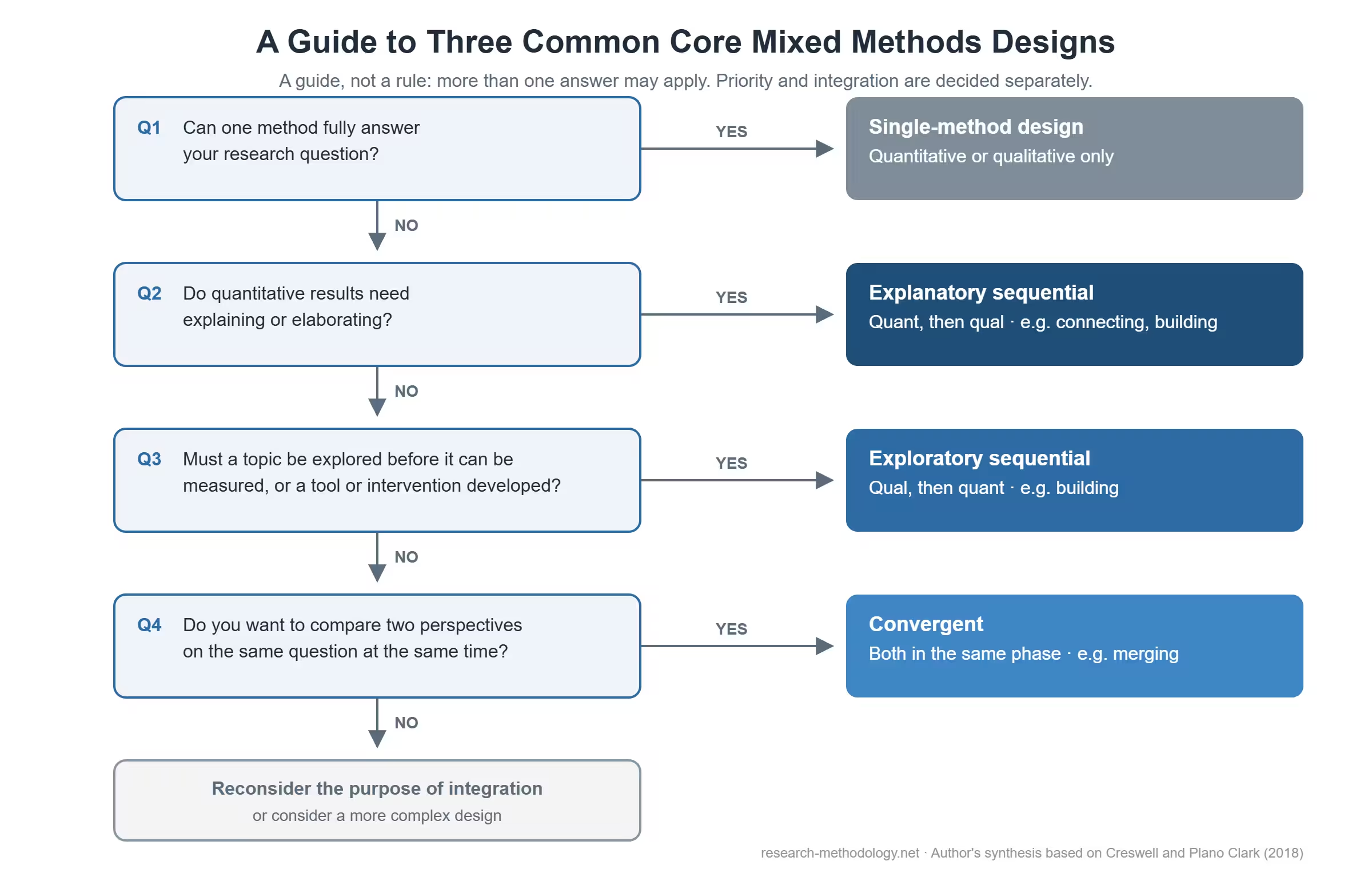
Figure: A guide to three common core mixed methods designs. Author’s synthesis based on Creswell and Plano Clark (2018); not an exhaustive decision rule.
Three practical checks should follow the decision path:
- Time. Sequential designs need the first phase to be analysed before the second can begin. Map both phases onto your submission deadline before committing.
- Skills. You will need to analyse quantitative data (for example, with SPSS or R) and qualitative data (for example, with thematic analysis) to a standard your examiners will accept.
- Access. Explanatory sequential designs that select interviewees from survey respondents need permission to re-contact survey respondents. Ask for consent to follow-up contact in the questionnaire.
Integration: Where the Data Meet
Integration is the point at which quantitative and qualitative strands are brought into relation with each other. Fetters, Curry and Creswell (2013) describe integration at three levels: the design level, the methods level and the level of interpretation and reporting.
At the methods level, they distinguish four approaches. These are not exclusive labels for different designs: a single study can use more than one.
| Integration approach | What happens | Typical design |
|---|---|---|
| Connecting | One strand is linked to the other through sampling, for example interviewees chosen from survey respondents | Explanatory sequential |
| Building | Results from one strand shape data collection in the other, for example interview themes becoming questionnaire items, or survey results shaping interview questions | Exploratory sequential; also explanatory sequential |
| Merging | The two datasets are brought together for analysis and comparison | Convergent |
| Embedding | Data collection and analysis are linked at several points, often within a larger design such as an intervention trial | Complex applications |
At the interpretation and reporting level, a joint display is one of the most effective tools available to a dissertation student. A joint display is a table or figure that places quantitative and qualitative results side by side so that the reader can see where they agree, where one expands on the other and where they disagree (Fetters, Curry and Creswell, 2013).
| Survey finding | Interview theme | Fit | Meta-inference |
|---|---|---|---|
| Turnover intention strongly associated with shift patterns | Rotas published at short notice prevent childcare arrangements | Expansion | Unpredictable scheduling, rather than shift length, may be what links shift patterns to turnover intention |
| Weak association between pay satisfaction and turnover intention | Pay described as “expected in hospitality” and not a reason to leave | Confirmation | Pay may be a weaker influence on turnover intention than scheduling in this setting; this would need testing before informing policy |
| Higher turnover intention among staff under 25 | Younger interviewees described the job as temporary from the start | Expansion | Some turnover intention may reflect planned short-term employment rather than dissatisfaction |
Hypothetical joint display based on the hotel example above. “Fit” describes how the two results relate: confirmation, expansion or discordance (disagreement). Meta-inferences are combined interpretations; here they remain tentative, because the study measures turnover intention rather than actual turnover and the interviews suggest explanations rather than establish causes.
Including one joint display in your findings or discussion chapter is direct evidence to examiners that your study is integrated, not just a survey with interviews attached.
Philosophical Justification for Mixed Methods
Mixed methods research is most often justified philosophically through pragmatism, which judges methods by how well they answer the research question rather than by loyalty to one view of knowledge. Critical realism, transformative and dialectical stances are also used.
This question matters because examiners often ask how a study can combine methods commonly associated with positivism and interpretivism, which make different assumptions about reality (ontology) and knowledge (epistemology). Methods are not tied one-to-one to philosophies: a questionnaire can serve interpretive aims, and interviews can be analysed from a realist position. The real question is whether the study’s assumptions about reality and knowledge are coherent. Claiming both positivism and interpretivism at once, without explaining how they fit together, does not answer it.
| Philosophical stance | How it justifies mixing methods | Suits a dissertation that… |
|---|---|---|
| Pragmatism | The research question drives the choice of methods; what matters is what works to answer it (Johnson and Onwuegbuzie, 2004; Morgan, 2007) | Addresses a practical problem, such as an organisational issue, and wants usable answers |
| Critical realism | Reality exists independently of our knowledge of it; quantitative data can show patterns, and qualitative data can reveal the mechanisms that produce them (Shannon-Baker, 2016) | Asks both whether something happens and why or how it happens |
| Transformative stance | Research should advance social justice; methods are chosen to give voice to marginalised groups (Shannon-Baker, 2016) | Studies inequality, discrimination or a disadvantaged group |
| Dialectical stance | Different paradigms are deliberately placed in dialogue; tensions between findings are treated as productive (Shannon-Baker, 2016) | Expects the two strands to produce different, even conflicting, insights |
Pragmatism is usually linked with an abductive approach, moving between induction and deduction. Morgan (2007) describes the pragmatic approach in terms of abduction, intersubjectivity and transferability, as an alternative to choosing between purely deductive, objective and generalisable research on one side and purely inductive, subjective and context-bound research on the other.
Whichever stance you choose, state it once and apply it consistently. The philosophy should explain your design, not be added to it as a label.
Sampling in Mixed Methods Research
Mixed methods studies usually need two samples with different logics: a larger sample suited to quantitative analysis, often selected through probability sampling or a well-described non-probability method, and a smaller sample suited to qualitative depth, typically selected through purposive sampling.
How the two samples relate depends on the design. In an explanatory sequential design, the qualitative sample is usually a subset of the quantitative sample chosen using its results, for example extreme cases, typical cases or groups that behaved unexpectedly. In a convergent design, the samples may be the same people, overlapping groups or different people from the same population. In an exploratory sequential design, the qualitative participants are often different from those who later complete the instrument, so that the instrument is not tested on the people who helped create it.
State the relationship between the two samples explicitly in your methodology chapter, and explain why it fits your design. The same applies to sampling decisions in general.
When Not to Use Mixed Methods
Mixed methods is not automatically stronger than a single-method design. It is the wrong choice when one method can answer the research question fully, when there is not enough time to do both strands properly, or when the second strand would be too small to contribute meaningfully.
Bryman (2006), in a content analysis of published articles combining quantitative and qualitative research, found that the reasons researchers give for mixing methods often differ from how the methods are actually combined in practice. A well-executed single-method study is better than a mixed methods study in name only.
Within dissertation word limits, mixed methods also means less space for each strand. Check whether your programme expects or permits it, and whether your supervisor is comfortable supervising both forms of analysis.
Application of Mixed Methods Research: an Example
Hypothetical example. A public health researcher wants to measure how confident older adults feel about using online GP booking systems. No validated questionnaire exists for this population and this type of service.
The researcher chooses an exploratory sequential design (QUAL → quan). In the first phase, she runs four focus groups with adults aged 70 and over, identifying five themes: fear of making mistakes, password difficulties, reliance on family members, distrust of automated systems and preference for telephone contact. In the second phase, she turns these themes into questionnaire items, pilots them, and distributes the questionnaire to 350 older adults registered at three GP practices. Piloting shows whether items are understood; it does not show that the questionnaire is a valid measure, so she also examines the questionnaire’s validity and reliability using the main sample. Where groups of items are intended to form scales or subscales, techniques such as factor analysis and Cronbach’s alpha can be appropriate; alpha assesses internal consistency, not validity. A checklist of distinct barriers is not a scale and need not show high internal consistency.
Integration happens through building: the qualitative findings define what the quantitative instrument measures. The final discussion can report not only how many older adults in these practices lack confidence, which a survey alone could show, but how widely each barrier identified in the focus groups is experienced, which the focus groups alone could not show.
Advantages and Limitations of Mixed Methods Research
The main strength of mixed methods research is that it can address questions neither approach answers well alone, such as how much and possibly why, or whether a new measure reflects how participants actually think about a topic. Combining methods can offset the weaknesses of each: statistical results gain context and meaning, while qualitative findings gain a sense of how widely they apply. Where the results agree, conclusions are better supported; where they disagree, the disagreement can itself become a finding.
Against this, mixed methods studies take longer, require competence in two forms of analysis and are harder to report within a word limit. Sequential designs carry the risk that a delay in the first phase leaves too little time for the second. Without genuine integration, the design produces two thin studies instead of one strong one. Philosophical justification is also more demanding, because the researcher must explain how different assumptions about knowledge are reconciled.
Common Mistakes When Using Mixed Methods Research
- No integration. Reporting survey and interview results in separate chapters without ever relating them.
- A second strand that cannot do its job. Adding a few interviews that are too brief or too disconnected from the survey to explain anything. The adequacy of a strand depends on its purpose, depth and integration, not on a fixed number of participants.
- Naming the wrong design. Calling a study explanatory sequential simply because interviews followed a survey, when the interviews did not depend on the survey results; describing a sequential study as convergent; or not naming the design at all.
- Contradictory philosophy. Declaring a study both positivist and interpretivist without explaining how the two are reconciled, instead of adopting pragmatism, critical realism or another stance that supports mixing.
- Ignoring disagreement. Discarding qualitative findings that contradict the survey, instead of discussing the discordance.
- Underestimating time. Planning a sequential design without allowing time to analyse phase one before starting phase two.
Mixed Methods Research in the Age of AI and Digital Research
AI tools change how the qualitative strand is analysed and digital sources change what counts as data, but they do not change what makes a study mixed methods: the deliberate integration of the two strands. A tool can speed up coding; it cannot decide what the quantitative and qualitative findings mean together.
Researchers increasingly use large language models to propose codes or themes from interview transcripts. In one comparison of human and ChatGPT-generated themes from interviews, the two approaches overlapped in some areas and diverged in others, with each identifying themes the other missed, and the authors suggested that AI-generated themes could be used in triangulation discussions to surface oversights and alternative interpretations (Hamilton et al., 2023). This is one study on one dataset, so it supports cautious, documented use rather than a general claim that AI coding is equivalent to human coding.
In a mixed methods dissertation, the safest role for AI is as a supporting check on a human analysis. The researcher remains responsible for reading the data, verifying that each theme is supported by extracts, and carrying out the integration step, for example when building a joint display. Automated summaries of survey and interview data placed side by side do not amount to integration.
Digital data also needs the same scrutiny as any sample. If one strand draws on social media text or platform data, remember that such data may reflect the platform and its algorithms rather than the wider population (Ruths and Pfeffer, 2014), which affects what the qualitative strand can say about the quantitative sample.
In the methodology chapter, state which tool and version were used, for what task, how outputs were checked against the original data, and how participant confidentiality was protected. Check your institution’s ethics approval and data protection requirements before uploading interview transcripts to an external AI service.
Dissertation Example
The following paragraph shows how a mixed methods design can be justified in a methodology chapter. The study is hypothetical.
“This study adopts an explanatory sequential mixed methods design (QUAN → qual) (Creswell and Plano Clark, 2018), underpinned by a pragmatist research philosophy. Pragmatism was chosen because the research question is practical, namely which workplace factors are associated with high turnover intention among employees of UK mid-market hotels and why, and because it permits methods to be selected according to what best answers that question rather than according to a single view of knowledge (Johnson and Onwuegbuzie, 2004). In the first phase, a questionnaire was distributed to 400 hotel employees to identify which workplace factors are associated with turnover intention. In the second phase, 15 respondents who had agreed to follow-up contact were purposively selected, including employees with high and low turnover intention scores, and interviewed to explore possible explanations for the associations found. The phases were integrated through connecting, as phase one results determined the interview sample, and through building, as they shaped the interview questions; they were also integrated in interpretation, through a joint display comparing survey findings with interview themes (Fetters, Curry and Creswell, 2013). The purpose of mixing methods was complementarity: using qualitative data to elaborate and explain the quantitative results (Greene, Caracelli and Graham, 1989).”
This wording names the design and its notation, states the philosophy and why it fits, explains how each strand was sampled, identifies where integration occurred, and states the purpose of mixing in recognised terms.
Exam Tip
When asked to evaluate a mixed methods study, look first for integration. Ask where the quantitative and qualitative strands meet (in sampling, in instrument development, in analysis or in interpretation) and whether the study would lose anything if one strand were removed. If nothing would be lost, the integration is weak. Naming the design correctly (convergent, explanatory sequential or exploratory sequential) and the purpose of mixing (for example, complementarity or development) will also distinguish your answer.
Does your research question really need both quantitative and qualitative data?
Dudovskiy Research Assistant can review your dissertation topic and research questions to suggest whether a mixed methods design fits, which design to choose and how to justify it in your methodology chapter.
John Dudovskiy
References
Bryman, A. (2006). Integrating quantitative and qualitative research: how is it done? Qualitative Research, 6(1), 97–113. https://doi.org/10.1177/1468794106058877
Creswell, J.W. and Plano Clark, V.L. (2018). Designing and Conducting Mixed Methods Research. 3rd ed. Thousand Oaks, CA: SAGE.
Fetters, M.D., Curry, L.A. and Creswell, J.W. (2013). Achieving integration in mixed methods designs: principles and practices. Health Services Research, 48(6 Pt 2), 2134–2156. https://doi.org/10.1111/1475-6773.12117
Greene, J.C., Caracelli, V.J. and Graham, W.F. (1989). Toward a conceptual framework for mixed-method evaluation designs. Educational Evaluation and Policy Analysis, 11(3), 255–274. https://doi.org/10.3102/01623737011003255
Hamilton, L., Elliott, D., Quick, A., Smith, S. and Choplin, V. (2023). Exploring the use of AI in qualitative analysis: a comparative study of guaranteed income data. International Journal of Qualitative Methods, 22. https://doi.org/10.1177/16094069231201504
Johnson, R.B. and Onwuegbuzie, A.J. (2004). Mixed methods research: a research paradigm whose time has come. Educational Researcher, 33(7), 14–26.
Johnson, R.B., Onwuegbuzie, A.J. and Turner, L.A. (2007). Toward a definition of mixed methods research. Journal of Mixed Methods Research, 1(2), 112–133. https://doi.org/10.1177/1558689806298224
Morgan, D.L. (2007). Paradigms lost and pragmatism regained: methodological implications of combining qualitative and quantitative methods. Journal of Mixed Methods Research, 1(1), 48–76. https://doi.org/10.1177/2345678906292462
Ruths, D. and Pfeffer, J. (2014). Social media for large studies of behavior. Science, 346(6213), 1063–1064.
Shannon-Baker, P. (2016). Making paradigms meaningful in mixed methods research. Journal of Mixed Methods Research, 10(4), 319–334. https://doi.org/10.1177/1558689815575861
Last reviewed: November 2026.