
Purposive sampling
Purposive sampling is a non-probability sampling technique where the researcher selects participants based on their knowledge, experience, or relevance to the research topic. Instead of random selection, participants are chosen deliberately to provide the most useful and relevant data.
On this page:
- What is purposive sampling?
- Categories of purposive sampling
- When to use purposive sampling
- Advantages and disadvantages
| Aspect | Purposive Sampling | Random Sampling |
|---|---|---|
| Selection method | Researcher’s judgment | Random selection |
| Type | Non-probability | Probability |
| Purpose | In-depth understanding | Generalisation |
| Bias level | Higher | Lower |
| Typical use | Qualitative studies | Quantitative studies |
Main differences between purposive and random sampling methods
What is Purposive Sampling?
Purposive sampling (also known as judgment, selective or subjective sampling) is a sampling technique in which researcher relies on his or her own judgment when choosing members of population to participate in the study.
Purposive sampling is a non-probability sampling method and it occurs when “elements selected for the sample are chosen by the judgment of the researcher. Researchers often believe that they can obtain a representative sample by using a sound judgment, which will result in saving time and money”.[1]
TV reporters stopping certain individuals on the street in order to ask their opinions about certain political changes constitutes the most popular example of this sampling method. However, it is important to specify that the TV reporter has to apply certain judgment when deciding who to stop on the street to ask questions; otherwise it would be the case of random sampling technique.
Alternatively, purposive sampling method may prove to be effective when only limited numbers of people can serve as primary data sources due to the nature of research design and aims and objectives. For example, for a research analysing effects of personal tragedy such as family bereavement on performance of senior level managers the researcher may use their own judgment in order to choose senior level managers who could participate in in-depth interviews
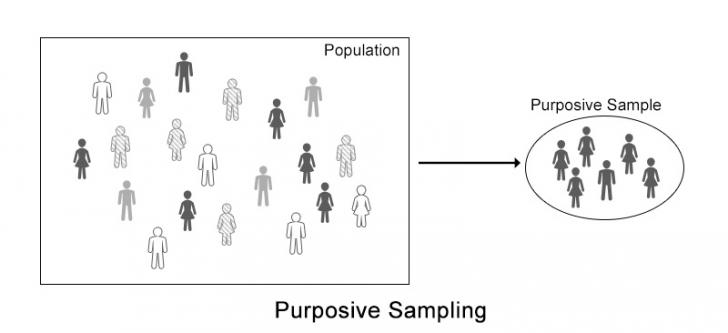
In purposive sampling personal judgment needs to be used to choose cases that help answer research questions or achieve research objectives. The quality of purposive sampling depends heavily on the researcher’s ability to make appropriate and justified selection decisions.
Categories of Purposive Sampling
According to the type of cases, purposive sampling can be divided into the following six categories[1]:
- Typical case. Explains cases that are average and normal.
- Extreme or deviant case. Deriving samples from cases that are perceived as unusual or rare such as exploring the reasons for corporate failure by interviewing executives that have been fired by shareholders.
- Critical case sampling focuses on specific cases that are dramatic or very important.
- Heterogeneous or maximum variation sampling relies on researcher’s judgment to select participants with diverse characteristics. This is done to ensure the presence of maximum variability within the primary data.
- Homogeneous sampling focuses on “focuses on one particular subgroup in which all the sample members are similar, such as a particular occupation or level in an organization’s hierarchy”[2]
- Theoretical sampling is a special case of purposive sampling that is based on an inductive method of Grounded Theory.
When to Use Purposive Sampling
Purposive sampling is most suitable when your research requires participants with specific knowledge, experience, or characteristics relevant to the study.
You should use purposive sampling if:
- Your study focuses on specific groups (e.g. managers, experts, or professionals)
- Only certain individuals can provide relevant and meaningful data
- Your research involves qualitative methods such as interviews or case studies
- The sample size is small and specialised
- You aim to gain in-depth insights rather than generalisable results
Suppose, your dissertation topic has been approved as the following:
A study into the impact of tax scandal on the brand image of Starbucks Coffee in the UK
If you decide to apply questionnaire primary data collection method with use of purposive sampling, you can go out to Oxford Street and stop what seems like a reasonable cross-section of people in the street to survey.
Another example. Your research objective is to determine the patterns of use of social media by global IT consulting companies based in the US. Rather than applying random sampling and choosing subjects who may not be available, you can use purposive sampling to choose IT companies whose availability and attitude are compatible with the study.
Use purposive sampling when you need the right people, not just random people.
Advantages and Disadvantages of Purposive Sampling (Judgment Sampling)
Purposive sampling offer the following advantages:
- It is one of the most cost-effective and time-effective sampling methods available
- Purposive sampling may be the only appropriate method available if there are only limited number of primary data sources who can contribute to the study
- This sampling technique can be effective in exploring anthropological situations where the discovery of meaning can benefit from an intuitive approach
At the same time, purposive sampling is associated with the following disadvantages
- Vulnerability to errors in judgment by researcher
- Low level of reliability and high levels of bias.
- Inability to generalize research findings
Because of these disadvantages purposive sampling (judgment sampling) method is not very popular in business studies, and the majority of dissertation supervisors usually do advice selecting alternative sampling methods with higher levels of reliability and low bias such as quota, cluster, and systematic sampling methods.
My e-book, How to Write a Dissertation: A Step-by-Step System to Plan, Write and Defend Your Dissertation in the age of AI contains discussions of theory and application of research philosophy. The e-bookalso explains all stages of the research process starting from the selection of the research area to writing personal reflection. Important elements of dissertations such as research philosophy, research approach, research design, methods of data collection and data analysis are explained in this e-book in simple words.
 Download the e-book and start making progress today
Preparing to Defend Your Methodology?
Understanding research design is one thing. Defending it under examination is another.
If you would like structured guidance on how to justify your methodological choices, respond to challenging viva questions, address limitations confidently, and navigate academic integrity in the AI era, you may find the following resource helpful:
The manual provides a structured system for aligning your research design, strengthening your justifications, and preparing for defense scenarios with clarity and confidence.
 Download the manual and prepare to defend your methodology with confidence
John Dudovskiy
[1] Black, K. (2010) “Business Statistics: Contemporary Decision Making” 6th edition, John Wiley & Sons
[2] Saunders, M., Lewis, P. & Thornhill, A. (2012) “Research Methods for Business Students” 6th edition, Pearson Education Limited
[3] Saunders, M., Lewis, P. & Thornhill, A. (2012) “Research Methods for Business Students” 6th edition, Pearson Education Limited p.288