
Amazon.com Inc. was founded in 1994 in Washington and Amazon.com as a website became first active in July 1995 to become the largest online retailer in the world to offer Earth’s Biggest Selection in less than two decades. The e-commerce and cloud computing company generated revenues of USD 386 billion and earned a net income of USD 21.3 billion in 2020 alone.[1]
The e-commerce giant employs approximately 1,3 million full-time and part-time employees referred to as Amazonians.[2] Amazon has declared its adherence to four principles: customer obsession rather than competitor focus, passion for invention, commitment to operational excellence and long-term thinking. These principles represent sources of Amazon’s competitive advantage.
Amazon business strategy is a hybrid of cost leadership and business diversification. The online retailer also benefits from encouraging communication between various elements within its ecosystem and promotion of its leadership principles consisting of 16 points discussed in this report. The founder and former CEO Jeff Bezos prefers to base business strategy on things that do not change. Specifically, consumers will always want low prices, variety and speedy delivery of their orders. Amazon focuses on these facts via effective integration of information technology into various business processes.
Combination of pragmatist, visionary and autocratic leadership styles are exercised at various levels at Amazon. The company has a hierarchical organizational structure. Nevertheless, it remains highly flexible to adapt to frequent changes in the external marketplace. Amazon organizational culture, on the other hand, is based on the principles of high level of cost-consciousness, constant reinvention and improvement of organizational culture and customer obsession.
Major weaknesses associated with Amazon include seasonality of the business, low profit margins and lack of focus on specific product or service categories. Moreover, a weak competitive position of Amazon’s Fire Phone and damage to the brand image due to tax avoidance scandal in the UK can be listed as weaknesses of Amazon. Furthermore, harsh working conditions for warehouse employees is a noteworthy weakness for the tech giant.
Amazon.com Inc. Report contains the application of the major analytical strategic frameworks in business studies such as SWOT, PESTEL, Porter’s Five Forces, Value Chain analysis, Ansoff Matrix and McKinsey 7S Model on Amazon. Moreover, the report contains analyses of Amazon business strategy, leadership and organizational structure and ecosystem. The report also analysis marketing strategy, ecosystem and discusses the issues of corporate social responsibility.
How to Write a Dissertation: A Step-by-Step System to Plan, Write and Defend Your Dissertation in the age of AI

Xiaomi does not publish annual CSR report. It has been noted that despite its branding effort to resemble the minimalist style of Apple, Xiaomi does not show similar commitment in environmental responsibility.[1] However, the mobile internet company may start publishing CSR reports after initial public offering (IPO) of its stocks that is expected to take place in the foreseeable future. Official Xiaomi website declares company’s pledge “to reduce the use of hazardous substances in products.”[2] However the website does not disclose any data at all regarding emissions or any other environmental impact of Xiaomi products and services. According to German Federal Office for Radiation Protection (Bundesamt für Strahlenschutz) Xiaomi smartphone Mi A1 has “Specific Absorption Rate” of 1,75 watts per kilogram, which is the highest level of radiation of smartphones worldwide.[3] In general, there is a lack of information related to Xiaomi CSR programs and initiatives, as it is illustrated in table below. CSR aspect of the business Xiaomi performance Supporting Local Communities No information available Educating and Empowering Workers No information available Labour and Human Rights No information available Employee Health and Safety No information available Gender Equality and Minorities It has been noted that Xiaomi uses “yanzhi,” or physical appearance metric when hiring, leading to discriminaton during employee recruitment and selection process.[4] Energy Consumption No information available Water Consumption No information available Waste Reduction and Recycling MI INDIA maintains PRODUCT TAKE-BACK & RECYCLING PROGRAM. Xiaomi Authorised e-waste recycler can collect e-waste from customer’s location, or customers can also drop e-waste at any of company’s service centers[5] Carbon Emissions No information available Sustainable Sourcing No information available other CSR Initiatives and Charitable Donations No information available Xiaomi CSR Programs and Initiatives Xiaomi Inc. Report contains a full analysis of Xiaomi corporate social responsibility including Xiaomi CSR issues. The report…
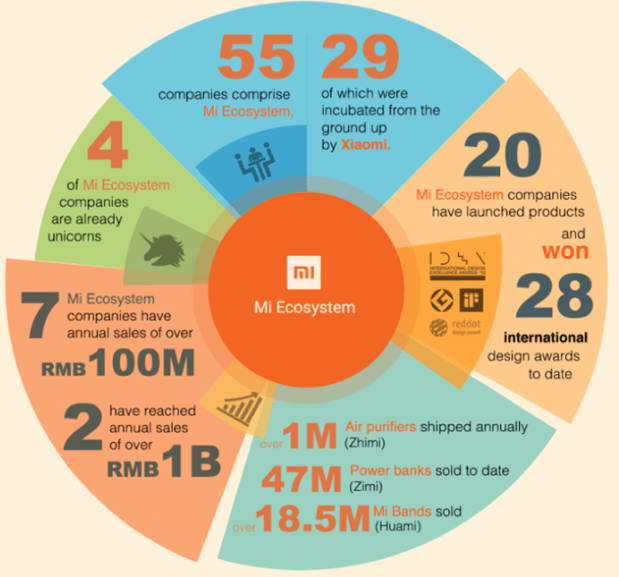
Xiaomi ecosystem is vast and comprises 55 companies including 29 companies that have been incubated from the beginning by Xiaomi. The company sells a wide range of products from smartphones to kettles and gloves. [1] Moreover, ever-expanding corporate ecosystem has been placed at the core of Xiaomi business strategy. Usually, producing a wide range of products and services threats to compromise the focus on core products and services. However, Xiaomi claims to have addressed this threat in a proactive manner. Specifically, according to its official website, while the company focuses on its core products – smartphones, smart TVs and smart routers, Xiaomi invests in companies that produce other types of products without being involved in operational management.[2] Xiaomi Ecosystem[3] Smartphones are placed at the core of Xiaomi ecosystem. Moreover, smartphones are used to facilitate the sales and use of many other products and services. Xiaomi smart devices include Mi Water Purifier, Mi Air Purifier, Mi Induction Heating Rice cooker and other products. All smart devices are connected to Xiaomi IoT platform and can be managed though Xiaomi smartphone. In 2013, the electronics and software company announced its plans to invest in 100 hardware startups.[4] The company also sells a range of “non-smart” products, like towels, and suitcases. Increasing numbers of startups are currently joining Xiaomi ecosystem to gain support to grow rapidly. Xiaomi has experienced technical staff, engineers and product managers, who can play an instrumental role in fuelling the growth of small-sized companies. At the same time, joining Xiaomi ecosystem also has some drawbacks. Specifically, start-ups need to operate with low profit margin according to Xiaomi business strategy. Moreover, over-dependence on Xiaomi for branding and distribution can be mentioned as another drawback of belonging to Xiaomi ecosystem.[5] Xiaomi Inc. Report contains a full analysis of Xiaomi ecosystem. The report illustrates…
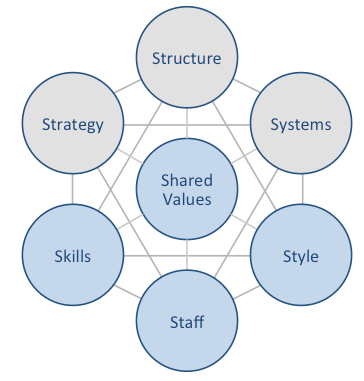
Xiaomi McKinsey 7S model illustrates the ways in which seven elements of businesses can be aligned so that overall effectiveness can be increased. According to the framework strategy, structure and systems are hard elements, whereas shared values, skills, style and staff are considered as soft elements. McKinsey 7S model stresses the presence of strong links between elements in a way that a change in one element causes changes in others. As it is illustrated in figure below, shared values are positioned at the core of Xiaomi McKinsey 7S model, since shared values guide employee behaviour with implications in their performance. Xiaomi McKinsey 7S Model Hard Elements Strategy. Xiaomi business strategy is based on cost leadership. Company’s business strategy also integrates gathering and utilising a large fan base and aggressively increasing the ecosystem of products and services. Moreover, Xiaomi positions itself as an internet and software company rather than a hardware company. Accordingly, the sales of hardware are perceived as a means to deliver software and services in the long-term perspective. Structure. Xiaomi has a matrix organizational structure. The electronics and software company has various business units that are managed independently. Xiaomi organizational structure can also be also classified as flat. Despite its large size employing more than 18000 people in 70 countries, the company has only a few layers of management. Systems. Xiaomi’s business depends on a wide range of systems such as employee recruitment and selection system, team development and orientation system and transaction processing systems. Moreover, there are critically important systems for the company such as customer relationship management system, business intelligence system, and knowledge management system. The mobile internet company aims to increase the efficiency of these and other systems via the integration of internet-based information technologies. Xiaomi Inc. Report contains a full analysis…