
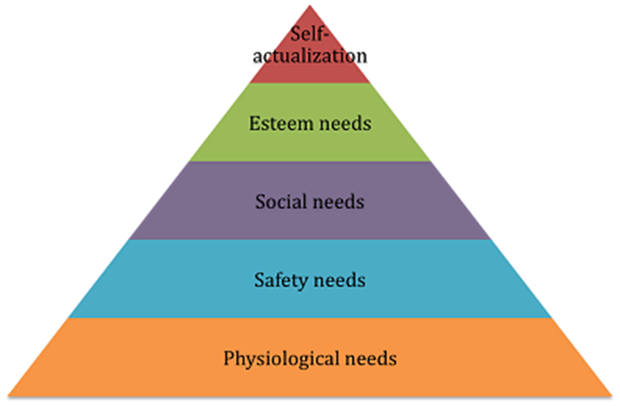
The theoretical framework of Maslow’s Hierarchy of Needs (1943) is considered by many to be the most substantial theory in the area of human motivation. Maslow (1943) categorises human needs into the five different levels and states that are evolved in a sequential manner. Maslow’s Hierarchy of Needs Psychological needs include basic human needs that are necessary to sustain life such as food, clothing, sleeping etc. Satisfaction of psychological needs in individual results to an emergence of safety needs that include being free of fear or deprivation of basic needs. The next level of needs is social needs that follow after the satisfaction of safety needs. Namely, social needs relate to the sense of acceptance by various groups. Esteem needs, emerging in the next stage “motivates a person to contribute his or her best to the efforts of the group in return for the numerous forms of reward that recognition can assume” (Montana and Charnov, 2008, p.239). Adequate satisfaction of esteem needs makes self-actualisation needs predominant. This stage of need is closely associated with maximising an individual’s potential regardless of its nature. The practical implications of “Hierarchy of Needs” are that managers must adopt an individual approach when motivating their subordinates addressing the immediate needs of each individual employee. According Maslow (1943) in their practices organisational managers need to address more immediate needs of employees in order to achieve the highest level of motivation. In other words, trying to appeal to self-esteem needs of an employee that has not satisfied his belonging needs is not the best approach in terms of achieving a high level of employee motivation. References Maslow, A.H. (1943) “The Theory of Human Motivation” Psychological Review, 50(4) Montana, P.J. & Charnov, B.H. (2008) “Management” Barron’s

Employee motivation can be defined as “influencing others in a specific way towards goals specifically stated by the motivator, conforming within organisational constraints” (MacKay, 2007, p.21) and the level of motivation of the workforce represents one of the most critical factors affecting organisational performance. One of the main reasons for increasing importance of motivation in the workplace relates to the role of human resources becoming greater in ensuring long-term growth for the business. Employee motivation is an essential component of a successful business practice. No matter how appealing products and services a company is providing, how efficient are company’s business and marketing strategy and what size of budget does a company have to operate, low morale and lack of motivation in employees could be a major problem for companies who aim to make a profit in marketplace. It has been argued that while each individual has a general idea of what motivation is, these ideas differ from each other. One of the most comprehensive definitions of the term motivation is offered by Business Dictionary (2012) as internal and external factors that stimulate desire and energy in individuals to be interested and committed to a position, role or subject in a continuous manner, and exhibit persistent effort in achieving a goal. Alternatively, motivation can be defined as “a process of stimulating someone to adopt a desired course of action” (Kumar, 2008, p.12), and the level of employee motivation can be justly specified as one of the major factors contributing to overall organisational competitiveness It has been also said that “all employees have unique needs that they seek to fulfil through their jobs. Organisations must devise a wide array of incentives to ensure that a broad spectrum of employee needs can be addressed in the work environment, thus increasing the likelihood of…

Being updated with the relevant legislations is the main responsibility of organisational managers in dealing with the legal aspects of firm’s information system. Moreover, major legal areas of information systems to be addressed by managers include Data Protection Act(1998), appropriate dealings with intellectual properties, abiding to relevant contractual obligations and safeguarding the firm from breaching relevant criminal and civil laws. Main legal requirements of dealing with information in UK are specified in Data Protection Act (1998) and these are formulated through eight main principles. Neglecting or abusing these principles can result in civil or criminal charges for firms involved. The present age of information is causing the importance of management information systems to increase at a rapid pace and this tendency is expected to continue in the foreseeable future. Moreover, today firms have an opportunity of increasing the level of their competitiveness through increasing the level of information systems in decision making at strategic and operational levels. However, there is a set of important security, ethical and legal implications of management information systems discussed in this paper that should not be neglected by organisational managers. Neglecting or abusing these security, ethical and legal aspects of information systems can result in highly negative implications for the company such as damage to the brand image, loss of customer loyalty, or even civil or criminal prosecution in some instances.

It is important to distinguish between ethical and legal implications of information system management in a way that unlike legal issues, ethical issues do not necessarily result in the organisations being punished by law; nevertheless, unethical behaviour can have highly negative implications for the society. Ethical implications of information system management cover a wide range of issues such as disclosure of information to third parties, accuracy of information, information ownership issues, appropriate access to information and others. Moreover, increasing popularity of social networking sites such as Facebook, Twitter and YouTube in the global scale are proving to be another source of information system management ethical issues. Specifically, “a number of information system companies have sprung up to provide products designed to monitor social media” (Stair and Reynolds, 2011, p.30) and this practice is attracting criticism from various parties for being contradictory form ethical viewpoint. Critics argue that information posted in social networking sites are private and firms do not possess ethical rights to use this information for marketing and other purposes. References Stair, R & Reynolds, G. (2011) “Principles of Information Systems” Cengage Learning

Information can be specified as a compulsory element to be used in decision making in organisations. Decisions taken in organisations can be divided into two categories – strategic and operational, and each type of decision is associated with relevant information needs. Specifically, decision making at a strategic level addresses issues that have long-term implications for the performance of the whole organisation in general. For example policy formulation, new market development, new product development, or decisions related to corporate social responsibility issues can be mentioned as instances for strategic decision making. The type of information needed for strategic decision making may include market share, tendencies in global marketplace, consumer preferences, proposed changes in relevant legislation etc. Operational decision making, on the other hand, relate to the type of decisions relating to daily operations that have implications to a particular department, not necessarily the whole organisation. Information needs for operational decision making may relate to regional sales data, supply-chain management for a specific product, or any other similar information. Critical success factors (CSF) can be defined as “the limited number of areas in which satisfactory results will ensure successful competitive performance for the individual, department, or organisation” (Mard et al., 2004, p.114) and CSF can prove to be instrumental in determining organisational need for information. The nature of CSF for any given organisation depends on a range of factors such as the type of industry, the level of competition, the source of competitive advantage for the firm etc. For example, a CSF for a fast-food restaurant can be specified as reducing the duration of time a customer waits for his food without compromising the quality of the food. Accordingly, key decisions (KD) directly related to CSF for this specific business can be specified as deciding what goes into the menu of the…

Job analysis can be explained as “a process of studying and collecting information relating to operations and responsibilities of a specific job” (Giri, 2008, p.69). To put it simply, as the name implies job analysis is establishing requirements associated with a job. Considered to be a foundation of HRM, specific aspects of employment covered by job analysis includes training and development needs, compensation and benefits, health and safety aspects of the position, as well as, legal considerations. The importance of job analysis is closely associated with the possibility of filling a position with the most suitable candidate. In other words, jobs analysis needs to be conducted so that a set of skills and competencies needed to perform duties of a position can be established and the same set of skills and competencies can be used as criteria for the search of appropriate candidates. A high level of importance of job analysis in practical levels can be explained by referring to the real life case study of internet company Yahoo! Specifically, Carol Bartz has been named Yahoo! CEO on January 2009, despite lacking experience of leading an internet-based company, only to be removed two years later due to systematic failures. This situation could have been avoided by appropriately conducting a job analysis for Yahoo! CEO position, as such analysis would have identified previous experience of leading an internet company as a compulsory requirement for candidates. Job Analysis Process, Job Description and Job Specification The process of job analysis can be divided into the following five stages: Planning the job analysis. This initial stage commences with the identification of objectives and seeking co-operations from stakeholders involved. Preparing for and introducing job analysis. This stage is marked with the selection of jobs to be analysed and the formulation of a relevant methodology…

One of the most popular definitions of marketing defines the term as “the management process responsible for identifying, anticipating, and satisfying customer requirements profitably” (Shaw, 2007, p.1). This is to say that the businesses should identify the needs and wants of the customers before they offer any product and service to the customers. AMA, on the other hand defines marketing as “an organizational function and a set of processes for creating, communicating and delivering value to the customers and for managing customer relationships in ways that benefit the organization and its stakeholders” (Ferrel and Hartline, 2010). According to Proctor (2000, p.102), the position and marketing strategy of the company in the market can be evaluated on the basis of product mix, as well as its components such as width, length, depth and consistency. References Proctor, T, 2000, Strategic Marketing: An Introduction, London: Routledge Shaw, S. (2007) “Airline Marketing and Management” Ashgate Publishing

Transactional leadership style has been explained by Krogh et al (2011) as a type of transaction between employees and management where the total obedience of employees is exchanged for the pay they receives for their work. According to Fitzsimons (2011) reward and punishment are the main tools that are used in transactional leadership in an intensive manner. Specifically, transactional leaders tend to punish low performance with specific measures, whereas exceptional performance usually gets rewarded. Transactional leaders usually perceive their main role to consist of clarifying role and task requirements for employees and demanding results regardless of the quality of resources provided to them. Moreover, there are set of other serious shortcomings that are associated with transactional leadership style. First of all, according to transactional leadership theory employees need to be closely monitored in order to perform their job responsibilities in a desired level. Lindebaum and Cartwright (2010) argue that close monitoring of employees may negatively affect the level of their motivation in certain job positions that require creativeness and ‘thinking outside of box’. Besides, Pieterse et al (2010) convincingly argue that transactional leadership limits the level of employee innovative behaviour due to its increased focus on in-role performance, rather than the motivation of the workforce. Furthermore, according to the transactional leadership theory obeying the instructions and commands of people in leadership positions is perceived to be the primary task of employees. While such a principle might be highly effective for certain types of organisations such as military where the orders of leadership cannot be questioned; for business entities the adoption of transactional leadership style might compromise the level of competitiveness of the organisation, because the potential of employees of contributing to the level of competitive edge through the expression of personal initiatives would be suppressed. It has been stated that…

There is a range of factors related to various stages of the implementation of employee training and development programs that impact on the level of training transfer. Individual differences associated with trainees is a major factor affecting the nature of comprehension of training programs by trainees, and ultimately, training transfer. Trainee individual differences might be based upon personal temperament, cultural background, life experiences etc. The level of trainee motivation to participate in the training and to gain necessary knowledge and skills is a decisive factor in training transfer. Nevertheless, the impact of this specific factor can be influenced by organisations in a great extend, in a way that managers can communicate advantages of scheduled training courses for employees in professional and personal levels in order to increase the level of their motivation. Moreover, the level of competency of trainers also plays a significant role in training transfer as highly competent trainers are able to maximise the levels of training transfer through their advanced communication skills and an efficient use of learning materials. Criteria to assess the level of competency of trainers include but not limited to formal qualifications, the years of experience in industry, feedback from other clients etc. An environment where the training session is facilitated has to be mentioned as a separate factor affecting the level of training transfer. Learning environments where trainees feel comfortable and free of pressure are associated with a positive contribution to the level of training transfer. According to the Principle of Identical Elements discussed above learning environments that resemble the actual working environment for trainees make significant positive contribution on the overall outcome of training program, as well as, on the level of training transfer. Importantly, organisational culture also impacts the degree of training transfer for employees. Organisational culture can be explained…

Stakeholders can be defined as “groups or individuals who can affect or be affected by the achievements of a business” (FT Lexicon, 2012). Key stakeholders in training transfer consist of organisations implementing training programs for their workforce, individuals undergoing the training course, and trainer conducting the training course. Each of these stakeholder categories has their roles and responsibilities that impact the outcome of the training in general, and the outcome of training transfer in particular in a direct manner. Organisations sponsoring training programs for their employees are directly interested in the high level of training transfer. Managers representing organisations have the responsibilities of “participating in the training needs investigation, supporting and briefing participants before, during and after the training, setting measurable objectives and rewarding the practice of learning” (Donovan and Townsend, 2004, p.42). Neglecting these responsibilities might be associated with the risks of wastage of financial resources invested in employee training and development initiatives. Audi UK, a car manufacturer originated in Germany serves as a good case study illustrating the immense role of organisation as a key stakeholder in the facilitation of training transfer. In Audi UK employees at all levels regularly participate in a wide range of training and development programs that are organised with the participation of highly competent professionals. Moreover, along a wide range of relevant initiatives Audi UK achieves a high level of training transfer for employees through follow-ups with employees to analyse the extent of application of knowledge and skills gained by employees during training courses. The roles of organisations as a key stakeholder in the provision of training and development programs and contribution to the level of training transfer also depend upon the sector organisations belong to. Specifically, private sector organisations enjoy greater level of freedom in terms of the selection of the training…