

SWOT stands for strengths, weaknesses, opportunities, and threats associated with a business and it is an effective strategic analytical tool used to assess businesses. The following table illustrates GlaxoSmithKline SWOT Analysis : Strengths Increased level of R&D potential Strong financial position Global coverage with presence in more than 100 countries Weaknesses Considerable damage made to brand image because of Avandia drug scandal Ineffective online presence Low level of flexibility due to the large size of the company Opportunities Increasing the level of presence in China and India Following diversification strategy Improving the level of online presence Threats Lawsuits to damage the brand image New competitors joining the market Worsening of economic situation in Europe

GlaxoSmithKline PESTEL Analysis. The level of implementation of GlaxoSmithKline (GSK) marketing strategy is subject to a range of external and internal factors that shape overall marketing environment for the business. PESTEL strategic analytical tool can be used to study the impacts of external factors to the business where the abbreviation stands for political, economical, social, technological, ecological, and legal factors. Political factors affecting the implementation of GSK marketing strategy include possible changes in international trade regulation and competitive regulation likely to be introduced by the governments of China and India. Economic factors impacting GSK marketing strategy include high rate of economic growth in China and India. Moreover, current economic uncertainties associated with European markets might have negative implications on the marketing strategy Social factors with potential implications on GSK marketing strategy are changes in consumer lifestyles, shifts in consumer attitudes and opinions etc. However, Cameron (2012) specifies increasing level of customer resentment towards large amounts of profits made by pharmaceutical companies and sliding images of large pharmaceutical companies as the most significant social factor in the current environment. Technological factors include breakthroughs in pharmaceutical industry, issues associated with licensing and patenting drug manufacturing technology, as well as, the level of development of industry technology. Ecological factors also have specific implications on GSK marketing strategy that include problems related to global warming, and impact to the environment of GSK activities, and the reaction of stakeholders to this impact. Legal factors as one of the most important factors involve rules and regulations directly and indirectly related to GSK operations in local markets, as well as, European law and international trade rules, regulations and agreements.
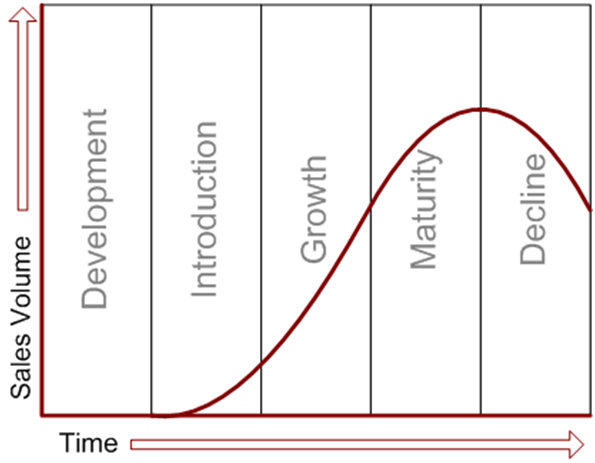
Product Life Cycle model divides the life cycle of products into five stages: development, introduction, growth, maturity, and decline. Each type of the product goes through all of these stages; however, the duration of each stage depends on a wide range of factors such as the nature of the product, its price, the level of competition in the industry, overall economic climate etc. Product Life Cycle model represents a valuable framework to be used in strategic marketing planning. Namely, with the application of the model marketing managers are able to forecast the life cycle of their products, and introduce necessary reflections within relevant marketing strategy.
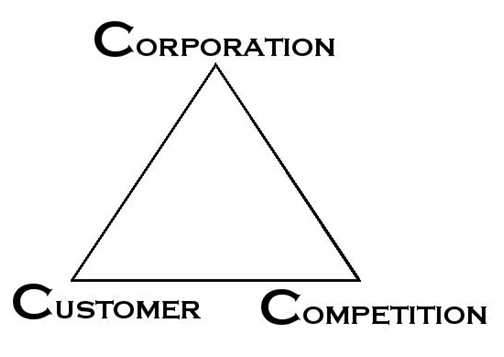
Introduced by Kenichi Ohmae, 3 C’s Model deals with factors that can assist in achieving success for a marketing campaign (Lamb et al., 2011). Namely, 3 C’s stand for corporation, customer and competitors that are known as elements of strategic triangle. Corporation needs effective strategies so that current competitive edge can be further strengthened and additional sources of competitive advantages can be obtained. Specifically, corporate-based strategy involve selectivity and sequencing that involves formulation of competitive advantage, make or buy, that involves reviewing potential for outsourcing some operations, and improving cost effectiveness in relation to various business processes. Customer is seen as the base of any strategy. Accordingly, corporations need to identify their customers clearly by engaging market segmentation on the basis of objectives and customer coverage. Competition can be specified as another important factor. The negative impact of this factor can be minimised through building upon power of the image, capitalising on profit and cost structure differences, and using tangible and intangible resources in a rational way. The practical value of 3 C’s Model relates to identification of important factors effecting marketing strategy and dealing with these factors in an appropriate manner. References Lamb, C.W, Hair, J.F & McDaniel, C. (2011) “Essentials of Marketing” Cengage Learning

Cooks (2008) defines social media as the types of software tools used by individuals in order to consume, convey, create and share content such as blogs, social networking, wikis etc. The literature review revealed a consensus among authors on the idea that during the last decade social media has evolved as an efficient means of communication for business and private purposes. Moreover, Morley and Parker (2010) observe increasing level of addiction to social media among individuals in general, and younger people in particular. Specific characteristics of social media as a communication tools include peripheral traits, facilitation of many-to-many communication, high level of transparency, and many potentials for the disruption of communication. It has been stated that “one of the benefits of using social media services as a communication interface is that a lot of people are already there; they know how to use the features and perhaps the threshold for participating in interaction with others is lower” (Zavoral, 2010, p.413). Additional benefits of using social media as a communication channel in workplaces have been found to include inexpensive or no associated costs (Ruesch and Bateson, 2008), ease of use (Thayer, 2009), possibility to limit visibility whenever necessary (Guffey et al., 2009), and social media serving as a content-sharing medium (Bronstein et al., 2010). According to Bronstein et al. (2010) the use of social media by businesses in general and large multinational corporations in particular is not limited to the facilitation of communication. Rather, social media in its various forms such as company Facebook page or YouTube clip is being valued by increasing numbers of businesses at a strategic level. Moreover, according to Eunson (2012) the introduction of a wide range of innovative social media sites and new platforms for online communication did little to compromise the role of traditional e-mails…

Communication can be effectively defined as “the management of the messages with the objective of creating meaning” (Samovar et al., 2011, p.9). Eight major structural components in communication have been specified by Giffey et al., (2009) as sender, message, channel, receiver, response, feedback, environment, and noise. The role of culture in communications has been stressed by Bronstein (2010), who defines culture as a set of common norms, values and accepted behaviours within the boundaries of a specific group. Specifically, the author convincingly argues that specifications of cultural background of an employee significantly impact the manner in which the employee sends, receives and perceives messages. In other words, content of the message, choice of communication channels and the nature of delivery of communication messages is heavily influenced by specific characteristics of cultural background of the individual who is delivering the communication message. According to concentric model of fields of communication introduced by Eunson (2012) different types of communication can be perceived in an interconnected and systematic way in the following manner: A concentric model of fields of communication Source: Eunson (2012) The model states that the different levels of communication can be interconnected in various ways. Specifically, the concentric model of fields of communication divides communication into six different levels and argues that the more levels of communication are utilised in any particular instance, the better the quality of communication would be. According to Ruesch and Batison (2008) the main barriers to communication include bias, noise, perception, closed-mindedness, and the level of personal stress. However, the main limitation of the article authored by Ruesch and Batison (2008) relates to the fact that the main barriers to communication have been only listed without reflection of the ways in which these barriers have negative implications. Some authors reason that “human communication is largely…

Harmonization is aimed at reducing differences in financial reporting processes around the world. The goal is to achieve some level of comparability in the way financial statements are prepared and presented. When international harmonization occurs, the difficulties for companies and individuals considerably decrease in presenting the financial statements and their interpretations. There are several organizations that have been trying to eliminate the differences between financial reporting standards and achieve international harmonization. If international harmonization is achieved, many countries would benefit from it as it would improve the access to the international financial markets and improve the confidence and knowledge of investors which may even trigger an increase in future investments. As mentioned by Wiley (2000) even if the harmonization is achieved, this will not be fully as there still will be differences in preparation and presentation of financial statements due to reasons such as taxation, culture and the political factors that shape up the accounting standards in any country. Harmonization, as being different from standardization, is the process of creating a similar set of procedures by establishing boundaries as to how much they can differ globally. However, standardization is the process of unifying the reporting standards to make them the same. However, this is almost impossible to achieve. Therefore, harmonization has been implemented considering the facts that even the harmonization can not eliminate the international differences in reporting standards. Garrido, León, and Zorio, 2002 stated that the globalisation has been one of the main drivers of moving towards harmonization by eliminating differences. This has been increasingly important in the case of multinational companies when operating internationally and using different sets of reporting standards which made it less efficient to compare the financial statements. Another importance for harmonization has been an increasing focus on investors as they benefit from new IFRS due…
By John Dudovskiy
Category: Finance
There is a set of problems developing nations facing in world market when trading with industrialised countries: a) Nondiversified economies Many developing nations’ economies are highly dependent on the advanced nations as majority of their exports go to advanced nations and imports come from these advanced nations (Carbaugh 2004) b) Unstable export markets Another characteristic of many developing nations exports are based on primary products (agricultural products, raw materials and fuels) as shown table below. Therefore, when there is a poor harvest or decrease in demand for nation’s specialised product, it can significantly reduce revenues from export and seriously disrupt domestic income and damage employment levels. (Carbaugh 2004). Developing-Nation Dependence on Primary Product 2000 Country Major Export Product Major Export Product as a Percentage of Total Exports Nigeria Oil 96% Saudi Arabia Oil 86 Venezuela Oil 86 Burundi Coffee 79 Mauritania Iron ore 56 Zambia Copper 56 Ethiopia Coffee 54 Chad Cotton 40 Rwanda Coffee 31 Adapted from R. Carbaugh’s “International Economics” (2004, p. 234) c) Worsening terms of trade According to Mankiw (2004) developing nations complain that their commodity terms of trade has declined long time ago, meaning that prices of their exports relative to their imports have fallen. Observers maintain that the export prices of primary products of developing nations determined in competitive market, whereas the monopoly of manufacturers in the industrial nations results in high prices. Furthermore, worsening terms of trade has been used to justify refusal of many developing nations from to attend in trade-liberalisation negotiations (Carbaugh 2004). d) Limited market access. Integration of developing countries as whole into world market has improved significantly. However, protectionism and trade barriers imposed by many advanced nations has been hindrance to developing nations’s market access (Economist.com). Specially, global protectionism in agriculture has been major problem for…

Advantages of specialisation for Developing Countries Increased Production. Developing countries with specialisation are able to gain efficiencies generated from economies of scale and increased output (Mankiw 2004) Production Efficiency. The more efficient use of resources, the higher will be productivity of output of domestic goods and services. Furthermore, international competition leads to use of new technology and marketing methods (Parkin 2008). Benefit to Customers. Parkin (2008) mentions that specialisation in producing limited range of products offer wide range of choice for customers around the world at lower prices as people have tremendous diversity in tastes for different products and they value variety. Arguments against Free Trade and Specialisation. However, Carbaugh (2004) argues that the key to success in free trade can be achieved only through mutually beneficial approach, which satisfies both the giver and taker. Though law of comparative advantage maintains that nations benefit equally from international trade, there might not be mutual benefits between strong and weak countries, as the strong countries tend to take more advantage of it (Mankiw 2004). Many economists believe that current international markets are not level playing field and trade systems in practice favours developed countries and hinder development in the developing or less-developing nations (Carbaugh 2004). They also suggest that organisations such as IMF or WTO mainly work to fulfil interest of powerful countries (Parkin 2008). Another fallacy about free trade is that imports reduce employment, while exports promote growth. Therefore, the notion that import are “bad” while exports are “good” particularly popular among politicians and media (Carbaugh 2004). References Carbaugh (2004) “International Economics”, Ninth Edition, Thomson, New York Mankiw (2004) “Principle of Macroeconomics”, South Western, USA Parkin (2008) “Macroeconomics”, Pearson, USA

Probably there are no any other factor that causes more diversity in accounting than the legal system a country has, as it does not only shape the behaviour of its citizens, but it also prescribes accounting rules and regulates accounting and financial reporting. The degree to which government is involved in standard-setting varies from country to country. Countries that practice common law,such as UK and US have their accounting regulation in the hands of professional organisations with fewer regulations while on the other hand, countries that practice Roman or code law e.g. France and Germany rely on detailed rules that are often included in their company legislation. (Table given below illustrates in which some developed countries’ legal systems fall into this two category.) This leads to less flexibility in the preparation of financial reports and are less likely to justify the accounting treatments as used in common law . Common Law Codified Roman Law England and Wales France Ireland Italy United States Germany Canada Spain Australia Netherlands New Zealand Portugal Japan (commercial) Source: Nobes and Parker (2008) Many studies have showed that “common law” countries tend to be innovative and open to new business ideas, whereas “code law” countries are more likely to follow the formal, written rules and procedures. Further, there seems to be some association of common law countries with particular types of accounting practices. For example, companies operating in common law countries have higher levels of disclosures and tend to report losses quickly (Nobes Parker, 2008). Doupnik and Salter (1995) state that the type of legal system (i.e. code law versus common law) was the main explanation and the basic starting point lied in classifying accounting practices and financial reporting internationally. Another issue that closely related to a country’s legal system is judicial corruption. The…
By John Dudovskiy
Category: Finance