
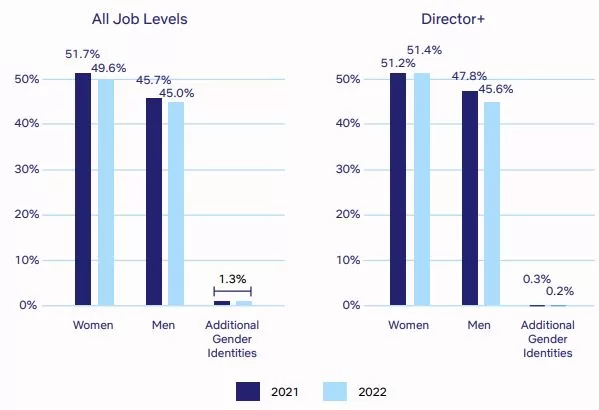
Netflix CSR Programs and Initiatives Netflix Supporting Local Communities The entertainment services provider maintains employee giving program that provides a 2:1 match on employee donations. As part of the program the company and employees donated USD34 million to over 5,000 charities worldwide Netflix and Gender Equality and Minorities 49,6% of Netflix employees are women 50% of US workforce are from historically excluded ethnic and/or racial backgrounds Netflix Fund for Creative Equity helps to create opportunities within the entertainment industry for minorities and historically under-represented groups Figure 1 Global Gender Identities at Netflix for 2022 Energy Consumption by Netflix In 2022 the company completed energy efficiency audits at its major facilities across North America The entertainment services provider uses 100% renewable electricity in all offices and productions it directly manages Carbon Emissions by Netflix Netflix is committed to reduce carbon emission by 50% by 2030 compared to 2019 baseline The entertainment services provider uses clean technology on over 60% of productions it manages directly In 2022 about 50% of the productions Netflix managed incorporated clean mobile power solutions such as grid tie-ins, mobile batteries, battery-hybrid generators, and hydrogen power units, resulting in fuel reductions that lowered emissions by 1,179 MTCO2e The company uses at least one electric vehicle (EV) on screen on all of its directly-managed productions The streaming service supports creators who choose to incorporate sustainability into their storytelling Figure 2 Netflix carbon footpring by business activity in 2022 Netflix and Sustainable Sourcing The company spent about USD 700 million with underrepresented suppliers in 2022 Governance Practices Netflix is beginning a phased declassification of its board in 2023. Starting from 2025 each board member will stand for annual elections The company is eliminating supermajority voting provisions in its articles of incorporation and bylaws The streaming…
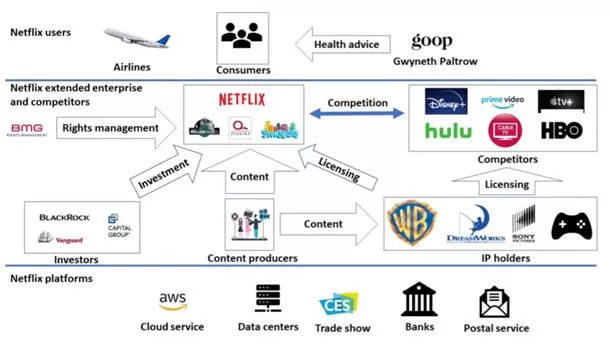
An ecosystem is a network of components (products, services and platforms) that depend on each other and fuel each other to jointly deliver greater value. Netflix ecosystem comprises the companies it owns, content producers, competitors, customers, as well as, investors. Moreover, assisting infrastructure such as AWS cloud service, data centres, trade shows, banks and postal service are also components of Netflix ecosystem. All of the entities listed above are considered elements of ecosystem, because they contribute to the survival and well-being of the ecosystem. Netflix ecosystem Development of business ecosystem can be divided into four stages[1]: 1. Pioneering stage is where ecosystem is formed. For video streaming ecosystem pioneering stage is the second half of 2000s. Netflix invented DVD rental business model and it is one of the first companies that offered online video streaming service. Hong Kong based iTV was the company that introduced online video streaming for the first time, but Netflix was the first company that perfected this business model and made it successful. 2. Expansion stage. Currently, Netflix has 231 million paid memberships in over 190 countries with offices in over 25 countries.[2] The rapid expansion of the company during the last decade caused the expansion of online streaming ecosystem in general, motivating media companies to launch their own rival streaming services such as Disney+, HBO, Hulu and others. 3. Authority stage is when an ecosystem matures. It can be argued that Netflix ecosystem is approaching its authority stage with the global marketplace becoming highly saturated with international, as well as, local on-demand media providers. The video entertainment industry is becoming ready for yet another disruption. 4. Renewal or death stage. It is hard to estimate the time when Netflix ecosystem is going to be renewed or if it is going to cease to exist altogether…
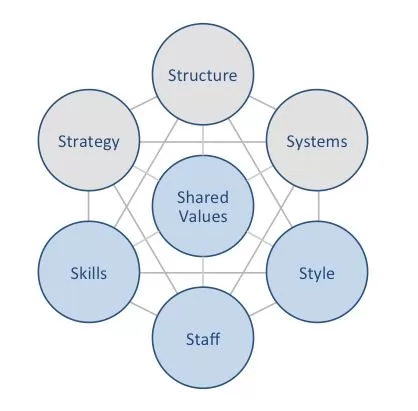
Netflix McKinsey 7S model shows how seven elements of businesses can be aligned to increase the overall effectiveness. According to the framework strategy, structure and systems are hard elements, while shared values, skills, style and staff represent soft elements. McKinsey 7S model stresses the presence of strong links between elements in a way that a change in one element causes changes in others. As it is illustrated in Figure 6 below, shared values are placed at the core of Netflix McKinsey 7S model. This is because shared values guide employee behaviour with implications on their performance. McKinsey 7S model Hard Elements in Netflix McKinsey 7S Model Strategy Nvidia business strategy relies on focusing on revenues maximization over membership growth and investing in original content. The entertainment services provider considers its globally successful original content such as House of Cards (2013-2018), BoJack Horseman (2020) and Squid Game (2021) as its unique selling proposition amid intensifying competition. Moreover, the largest streaming service in the world stays away from news and live sports segments, sticking to movies, series, documentaries and games, as part of its business strategy. Structure Netflix organizational structure is flat and unitary. There are considerably less management layers considering the size of the company and scope of its operations comprising 12500 people in offices in over 25 countries.[1] As a result, the flow of information is fast at the on-demand media provider and this contributes to the flexibility of the business to external macroeconomic changes. Systems There is a wide range of systems and processes that are important for the largest streaming service in the world to sustain its business. These systems include employee recruitment and selection, team development and orientation, transaction processing, customer relationship management, business intelligence, knowledge management and others. Furthermore, the system of…
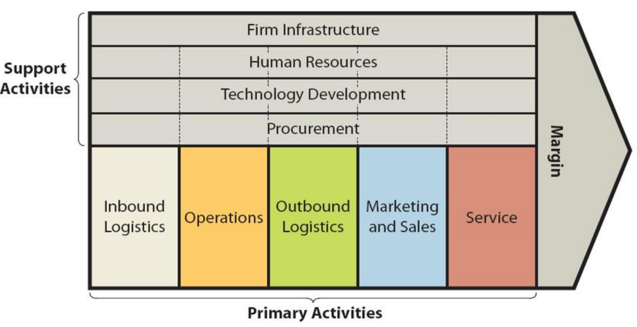
Value chain analysis is an analytical tool that can be used to find business activities that can create value and competitive advantage to the on-demand media provider. Figure below illustrates the essence of Netflix value chain analysis. Netflix Value Chain Analysis Netflix Primary Activities Netflix Inbound logistics Inbound logistics involves the processes associated with receiving and storing raw materials to create output. For a streaming service such as Netflix content is the raw material. Establishing strategic relationship with content producers and intellectual property holders such as Warner Brothers, Dream Works and Sony Pictures are the main sources of inbound logistics value creation for a streaming business. Netflix is utilizing these sources extensively. Currently, Netflix is increasing investments to produce its own, original content such as Squid Game, BoJack Horseman and Stranger Things as a differentiator amid intensifying competition. This shift has certain implications on inbound logistics aspect of the business. Specifically, focus on original content requires greater involvement in inbound logistics for the largest streaming service in the world. Netflix Operations Operations are the stage where inbound logistics are transformed into outbound logistics. For Netflix, operational efficiency and cost advantage are the main sources of value creation at this stage. The on-demand media provider has to maintain its video streaming platform effectively in terms of ease of access, quick search, stability, and security of the server. Netflix Outbound Logistics Outbound logistics refer to the distribution of products and services to customers. Usual sources of value creation in outbound logistics include Delivering to consumers directly without intermediaries, Cooperation with other businesses to share distribution costs and extensive integration of information and communication technologies. Considering that Netflix delivers digital media through streaming and downloads, the relevance of outbound logistics aspect of value chain analysis for the largest streaming service in…
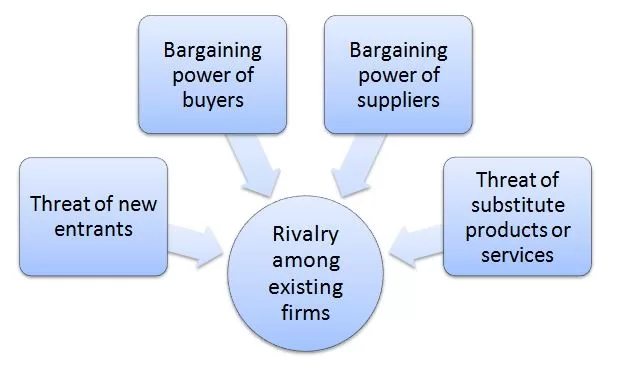
Porter’s Five Forces analytical framework developed by Michael Porter (1979)[1] represents five individual forces that shape an overall extent of competition in the industry. These forces are illustrated in Figure 1 below: Figure 1. Porter’s Five Forces Threat of new entrants in Netflix Porter’s Five Forces Threat of new entrants into the on-demand media streaming is low. Setting up a video steaming website is not difficult from a technical point of view. However, adding an adequate amount of content with the permission of copyright holders and gaining market share is highly difficult. The following are the most noteworthy challenges for new market entrants. Market saturation The market of on-demand media streaming is highly saturated with the streaming giants such as Netflix, Amazon Prime Video, Disney+, Hulu, Apple TV+, HBO Max and others dominating the global market. The majority of representatives of the target customer segment i.e. people with phones, tablets or TVs with internet connection are already subscribed to one or more of the leading streaming services mentioned above. It will be challenging for new market entrants to attract enough subscribers to make a break-even in this sector High entry costs Major market players such as Netflix focus on original content in general and its quality in particular to differentiate themselves in the market. As illustrated in Figure 4 below, the titles of original content produced by the largest streaming service in the world, as well as the hours watched by its customers have been consistently increasing for the past 10 years with the exception of a decline in 2021. Figure 2 Netflix original content by years of transmission[2] Netflix original content spending exceeded USD 5,8 billion in 2022[3] and its main competitors also spend billions of dollars annually for creating new films and programs. Accordingly, the…
Netflix marketing communication mix comprises communication channels to communicate the marketing message to the target customer segment. These channels are print and media advertising, sales promotions, events and experiences, public relations and direct marketing. Netflix Print and Media Advertising Netflix uses print and media advertising extensively as one of the main pillars of its marketing strategy. Specifically, the streaming service uses TV, radio, magazines, newspapers, as well as, billboards and posters to spread its marketing message. Netflix print and media ads are usually captivating and some of them are widely discussed in the media in general and social media in particular expanding the brand coverage with no extra cost for the streaming service. For example, to promote its Altered Carbon series in 2018, the streaming service placed a naked mannequin that appeared to be breathing at the bus stop on Santa Monica Boulevard in Crescent Heights in West Hollywood. The on-demand media provider also benefits from celebrity endorsement in terms of increasing the level of brand awareness internationally. The most famous Netflix endorses include Barack Obama and Michelle Obama, Ryan Reynolds, Jennifer Aniston, Reese Witherspoon, Shonda Rhimes and others. Netflix Sales Promotions Netflix uses the following sales promotion techniques: – Money off coupons. The entertainment services provider partners with a variety of companies to provide special promotional offers. Customers can redeem promo codes on Netflix website and start using its services for a specific period of time – Seasonal sales promotions. The streaming service regularly offers promotions on festive seasons and holidays such as Black Friday, Cyber Monday, Valentine’s Day, Mother’s Day and Father’s Day. Netflix Inc. Report contains a full analysis of Netflix marketing communication mix and Netflix marketing strategy in general. The report illustrates the application of the major analytical strategic frameworks in business studies such as SWOT,…
Netflix segmentation, targeting and positioning efforts are the basis of marketing strategy. Segmentation implies dividing the market into different groups on the basis of common traits and characteristics. The entertainment services provider segments its market on the basis of location, demography, behaviour, psychographic and other variables. Netflix uses the following positioning techniques: 1. Anticipatory positioning. When Netflix pioneered on-demand streaming of films, series and documentaries for a fixed monthly cost in 2007, the demand for such a service initially was low to non-existent. However, then CEO Reed Hastings and his team anticipated the demand for such a service and went ahead with the idea to see the demand gradually growing in the following years. 2. Mono-segment positioning. The largest streaming service in the world targets a single customer segment that is outward-looking, affluent consumers with international credit cards and smartphones. The following table 2 illustrates Netflix segmentation, targeting and positioning: Type of segmentation Segmentation criteria Netflix target customer segment Geographic Region Available virtually everywhere except in China and Russia Density Urban/rural Demographic Age Shows available for all age groups Gender Males & Females Life-cycle stage Bachelor Stage young, single people not living at home Newly Married Couples young, no children Full Nest I youngest child under six Full Nest II youngest child six or over Full Nest III older married couples with dependent children Empty Nest I older married couples, no children living with them Empty Nest II older married couples, retired, no children living at home Solitary Survivor I in labour force Solitary Survivor II retired Occupation Students, employees, professionals, senior manager, executives Behavioral Degree of loyalty ‘Hard core loyals’ and ‘Switchers’ Benefits sought Recreation & Inspiration Personality Easygoing, determined, ambitious User status non-users, potential users, first-time users, regular users, or ex-users of the streaming service Psychographic Social class Working class, middle class and upper…
Netflix marketing mix (Netflix 7Ps of marketing) comprises elements of the marketing mix. These elements are product, place, price, promotion, process, people and physical evidence. Product Element in Netflix Marketing Mix (Netflix 7Ps of Marketing) Netflix produces TV series, films and games across a wide variety of genres and languages. These are referred to as content. Netflix content can be divided into three categories: Licensed non-first window content. Licensed original first-window content Owned original first-window content. Place Element in Netflix Marketing Mix (Netflix 7Ps of Marketing) Netflix has offices in over 25 countries. The entertainment services provider creates films and series in more than 50 countries. Except for Albuquerque Studios in New Mexico and the Egyptian Theater in Los Angeles, Netflix does not own the facilities in which it operates. As of December 31, 2022, the streaming service had approximately 12,800 full-time employees located globally in 65 countries. Netflix is available virtually everywhere except in China and Russia and it has 231 million paid memberships in over 190 countries. [1] Price Element in Netflix Marketing Mix (Netflix 7Ps of Marketing) Netflix pricing strategy integrates the following elements: Value pricing. The entertainment services provider employs value pricing strategy. The company determines subscription cost for its streaming service on the basis of their perceived value by customers. Moreover, the on-demand media provider closely monitors the prices of its major competitors such as HBO Max, Hulu, Amazon Prime Video, Disney+ and Apple TV+ and adjusts its prices accordingly. Geographic pricing. Netflix prices vary in over 190 countries it operates to reflect local consumer purchasing power, competition and a range of other factors. For example, As of July 2023 the Premium package with streaming quality 4K Ultra HD and HDR costs USD 19,99 in USA and R199 (USD 11,16) in South…
Netflix marketing strategy assists in achieving company’s corporate mission of seeking to drive conversation around Netflix content to further enhance member joy. In 2022 The streaming service spent in total to USD 2,53 billion or 8% of total revenues for marketing.[1] Netflix marketing strategy is based on the following principles: – Guerrilla marketing. Guerrilla marketing refers to an advertisement strategy where a company uses unusual methods to draw attention of the public to the brand. The most notable cases of guerrilla marketing by the largest streaming service in the world include a hand crawling by itself in the streets of New York to promote Wednesday show, “Strange Mode” car sharing ride with Lyft and installing doll from Squid Game show in Sydney Harbour. – High level of service personalization. The entertainment services provider suggests personalized content to its users on the basis of the past viewed content. The on-demand media provider suggests personalized content in its platform, as well as, thorough emails to maintain the high level of customer retention. – Meme marketing. Netflix effectively uses social media marketing in general and meme marketing in particular to increase the level of brand awareness in the global scale. One can be forgiven for mistaking Netflix social media pages for pages for meme. – Remaining focused. Netflix only offers movies, series and documentaries. The platform does not offer news and live sports. By remaining focused on movies, series and documentaries alone, the company avoids overextension of brand image and continues to increase the value it provides to its core audience. Netflix Inc. Report contains the above analysis of Netflix marketing strategy. The report illustrates the application of the major analytical strategic frameworks in business studies such as SWOT, PESTEL, Porter’s Five Forces, Value Chain analysis, Ansoff Matrix and McKinsey 7S…
PESTEL is a strategic analytical tool and the acronym stands for political, economic, social, technological, environmental and legal factors. Netflix PESTEL analysis involves the analysis of potential impact of these factors on the bottom line and long-term growth prospects of the popular streaming platform. Political Factors in Netflix PESTEL Analysis There are many political factors that can affect the financial performance of on-demand streaming services such as Netflix. These factors include government stability, trade union activities, bureaucracy and government tariffs. Moreover, corruption, trade controls and the freedom of press also belong to the list of political factors with a potentially significant impact on entertainment services providers. Leaving a market because of war Netflix was indirectly affected by Vladimir Putin’s invasion of Ukraine. Having entered Russian market in 2016, the largest streaming service in the world announced on March 6, 2022 the suspension of its services, projects and acquisitions in the country. Leaving the country within 10 days after Putin declared war in Ukraine was an act of solidarity with Ukraine and other global brands suspending their operations in Russia. At the same time, Netflix had no other choice, because had the company remained in Russia its brand image would have suffered significantly with negative implications on the stock price. Government restrictions Apart from Russia, China is the only country where Netflix is not available. Although they dress it otherwise, the Chinese government has banned the popular streaming platform because they don’t want their citizens to be influenced by western culture. In other words, Chinese authorities fear that a wide range of shows and programs available on Netflix may influence the population and they might become more difficult to control. Taking into account the massive size of Chinese market, not being allowed to operate in the market is…