
Leadership can be defined as “the ability to inspire confidence in and support among the people who are needed to achieve organisational goals” (DuBrin, 2012, p.28).[1] Alternatively, leadership is “the discipline of deliberately exerting special influence within a group to move it toward goals of beneficial permanence that fulfil the group’s real needs” (Haggai, 2009, p.20)[2]. There is a difference between leadership practices in private and public sector. The following is the list of popular leadership theories: Contingency theories of leadership Emotional Intelligence Fiedler’s Theory Leadership Continuum Theory Path-Goal Theory The Great Man Theory There are many types of leadership styles and the following are the most popular leadership styles: Autocratic Leadership Style Consultative Leadership Style Democratic (Participative) Leadership Style Laissez-Faire Leadership Style Transactional Leadership Style Transformational Leadership Style You can find analysis of leadership practices at major international companies in this portal here. [1] DuBrin, A.J. (2012) “Leadership: Research Findings, Practice, and Skills” 7th edition, Cengage Learning [2] Haggai, J.E. (2009) “The Influential Leader: 12 Steps to Igniting Visionary Decision Making” Harvest House Publishers
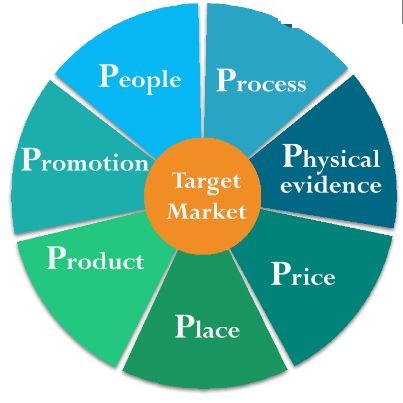
Marketing mix, also known as 7Ps of marketing includes individual marketing elements that form overall offer to customers. The concept was developed by marketing professor E. Jerome McCarthy and originally published in his book Basic Marketing. A Managerial Approach in 1960.[1] Initially the concept consisted of 4 Ps – product, place, price and promotion. As the field of marketing became more sophisticated additional 3 Ps – people, process and physical evidence were added by Bitner and Booms[2]. The additional 3Ps are also called ‘service mix Ps’, because they integrate important aspects of services into the marketing mix concept. Furthermore, in 2007 Larry Londre introduced another 2Ps – Partners/Strategic Alliances and Presentation. However, this latest addition has not been widely accepted among marketing researchers and practitioners, thus here we will stick to 7Ps of marketing. Marketing mix is a useful tool to tailor your products and services to the needs and wants of the target customer segment, but it is not a one-stop-shop for developing a comprehensive marketing strategy. A successful marketing strategy needs to address a range of other frameworks such as segmentation targeting and positioning, marketing communication mix and others. Product Element in 7Ps of Marketing Product or a service is the starting point in the marketing mix. Companies need to take into account the following variables, among others when developing new products: In what type of packaging is the product offered? Are products offered in various colours sizes etc.? What design and technical features differentiate the product in the competition? Are products durable and robust enough to appeal to the needs and wants of the target customer segment? What are the levels of quality and functional performance? Can he product be customized to individual users? Is the product easy to use and maintain? Is the product upgraded regularly? Place…
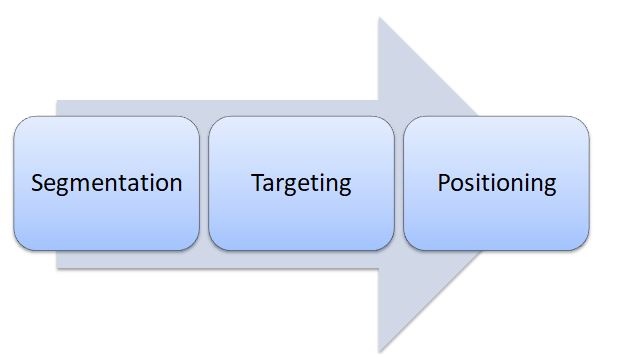
Segmentation, targeting and positioning (STP) is a marketing model that assists classifying population segments according to their needs and common characteristics, selecting specific segments and developing products and services for this particular segment. The basic premise behind STP is that you cannot sell everything to everyone. Therefore, you need to limit your product and service offerings and target limited population segment that have higher chance to purchase them. Today, Amazon is trying to be everything for everyone, but even Amazon started only as an online bookseller to gradually increase its offering to increasing numbers of customer segments. STP is effective because it allows personalisation of products and services to the needs and wants of selected consumers. STP approach shifts the focus from product to consumers and helps in satisfying customer needs and wants profitably. Application of Segmentation, Targeting and Positioning Segmentation targeting and positioning initiatives include the following stages: 1. Segmenting the market. Segmentation is dividing population on the basis of their common traits and characteristics. Segmentation helps identifying niches with specific previously untapped needs. There are many types and bases of segmentation. The table below the most popular types of segmentation. Type of segmentation Segmentation criteria Example Geographic Region North America, Asia, Europe Density Urban/rural Climate Hot, cold, wet, dry Demographic Age Teenagers, middle aged, elderly. Gender Males & Females Life-cycle stage Bachelor Stage young, single people not living at home Newly Married Couples young, no children Full Nest I youngest child under six Full Nest II youngest child six or over Full Nest III older married couples with dependent children Empty Nest I older married couples, no children living with them Empty Nest II older married couples, retired, no children living at home Solitary Survivor I in labour force Solitary Survivor II retired Occupation Students, employees, professionals, senior manager, executives Behavioral Degree of loyalty…
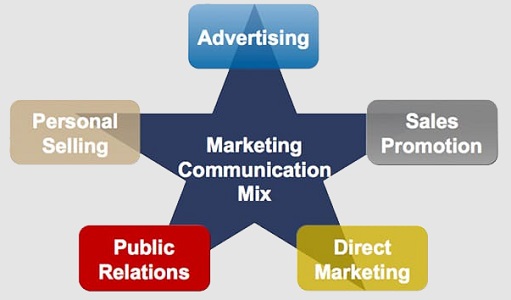
Defined as a “dialogue between business unit and its present and potential customers that takes place during pre-selling, selling and post-selling stages”[1], marketing communication mix, or promotion mix is considered to be a fundamental aspect of business marketing initiatives. Kotler and Keller (2009)[2] divided marketing communication mix into the following six categories: advertising, sales promotion, events and experiences, public relations and publicity, direct selling and personal selling. 1. Advertising is “a paid non-personal communication about an organisation and its products transmitted to a target audience”[3]. The following are important platforms of print and media advertising: TV Radio Magazines Newspapers Billboards & posters Viral marketing Celebrity endorsement Product placement 2. Sales Promotions is a marketing strategy which involves using temporary campaign or offer to increase interest and demand on products and services. The following are popular sales promotion techniques: Seasonal sales promotions. Businesses may reduce the prices of certain items during holidays and festive seasons such as Christmas holidays. Money off coupons. Customers receive coupons by mail, in store or they cut coupons our of magazines or product packaging to purchase the product next time for lower price. Purchase of a product allows the customer to participate in a game to win a price. Discount vouchers. A voucher that can be used to purchase a product at a reduced price. Free gifts. Customers get an item for free if they purchase a product. Point of sale materials. Use of posters, display stands and other promotional tools to present the product to customers within the shop. Loyalty cards. Possibility for customers to earn points for buying specific products or buying from specific sellers. Accumulated points can be exchanged for goods or other offers. For example, Tesco Clubcard, Sainsbury’s Nectar etc. 3. Events and experiences, as a marketing mix component relate to a…
Marketing can be defined as the activity, set of institutions, and processes for creating, communicating, delivering, and exchanging offerings that have value for customers, clients, partners, and society at large.[1] In simple terms, marketing is the action of promoting and selling of products and services. The most popular marketing concepts and tools include the following: Marketing Strategy 7Ps of Marketing Segmentation, Targeting & Positioning Marketing Communication Mix Brand Essence Wheel Brand Development Process Relationship Marketing [1] Definitions of Marketing (n.d.) American Marketing Association, Available at: https://www.ama.org/the-definition-of-marketing-what-is-marketing/
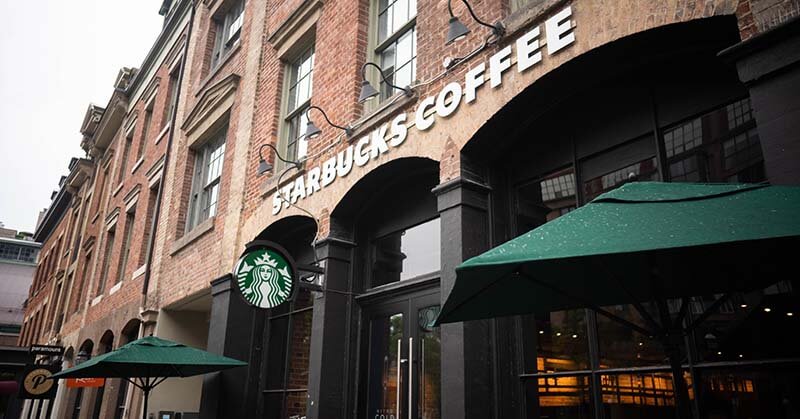
A company is not just a member of a single industry but it is a part of an ecosystem that crosses a wide range of industries. Despite the coffee chain being in the business for more than five decades, Starbucks ecosystem is still in the early stages of its development. When a company has an advanced ecosystem its products and services are highly compatible with each other and customers will miss out on a wide range of benefits and functionalities if they want to break out of the ecosystem. Think Apple or Microsoft. Starbucks has not been able to develop an effective business ecosystem until now partially due to the nature of products and services the company offers. In other words, the global coffeehouse chain offers limited range of products and services it has not been successful in creating compatibility and dependence between products and services. Recognising the importance of having an ecosystem, Starbucks came up with the idea for digital ecosystem in 2020 as part of measures to deal with COVID-19 crisis. Specifically, Seattle-based international coffee chain is attempting to create digital third place, shifting its third place – a place away from home and work value offering to a digital environment.[1] Development of an effective ecosystem comprises the following four stages – pioneering, expansion, authority, renewal or death. [2] These stages relate to Starbucks ecosystem in the following manner: 1. Pioneering stage. The initial stage is associated with the formation of ecosystem. Starbucks ecosystem at this early stage involves initiating global digital community – a community defined by collaboration, experiences, and shared ownership – all centred around Starbucks coffee. 2. Expansion stage. At this stage ecosystem extends to achieve maximum market coverage and critical mass. The world’s largest coffeehouse chain can extend its relevance to integrate art,…
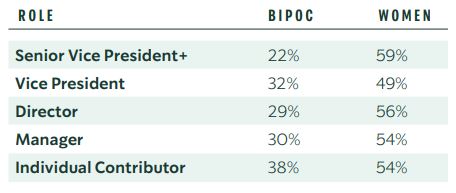
Starbucks CSR programs and initiatives are led by Michael Kobori, chief sustainability officer for the world’s largest coffeehouse chain. CSR initiatives for Starbucks cover wide range of business aspects and employee relationships such as supporting local communities, educating and empowering workers, gender equality and minorities, energy and water consumption, waste reduction etc. CSR Programs and Initiatives Starbucks Supporting Local Communities Starbucks Community Store program aims to assist local non-profit organizations in their efforts to provide education and training to achieve poverty eradication for the young segment of population. The company plans to open 100 Community Stores by the end of 2025. Starbucks has cooperated with non-profit organizations, community leaders and organizational stakeholders to provide more than 520,000 hours of volunteering service around the globe.[1] The global coffeehouse chain runs FoodShare food donation program in all company operated stores in US and Canada. 10.4 million and 1.2 million meals were donated in US and Canada respectively in FY21. Starbucks Educating and Empowering Workers Starbucks College Achievement Plan is an education program that allows employees to obtain online degrees from Arizona State University. Approximately 2500 employees earned their degrees via this program in FY21 alone It has been noted that “at the height of the global financial crisis, when other companies were cutting HR costs wherever they could, Starbucks invested in staff training, including coffee tastings and courses that ultimately qualified for credit at higher education institutions”[2] In FY21 the company oversaw more than 136000 course enrolments in Starbucks Coffee Academy and more than 55,000 course completions since launch. Starbucks and Gender Equality and Minorities At present about 40% of Starbucks US employees are minorities and 65% are women. Among vice presidents, 48% are women and 15% are minorities. The global coffeehouse chain aims to achieve at least 30% BIPOC…
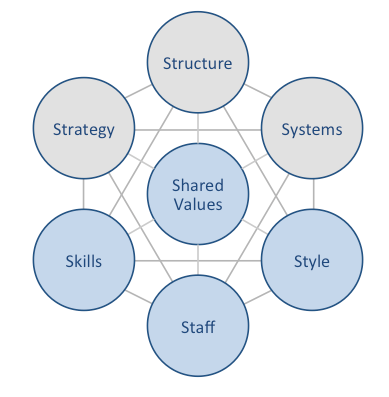
Starbucks McKinsey 7S model is used to highlight the ways in which seven elements of businesses can be aligned to increase effectiveness. According to this model, strategy, structure and systems represent hard elements. At the same time, shared values, skills, style and staff are soft elements. McKinsey 7S model stresses the presence of strong links between elements. Specifically, a change in one element causes changes in other elements. As it is illustrated in figure below, shared values are positioned at the core of Starbucks McKinsey 7S model, since shared values guide employee behaviour with implications in their performance. McKinsey 7S model Hard Elements in McKinsey 7S Model Strategy Starbucks business strategy is based on product differentiation with the focus on the quality of products and services. Moreover, the coffee chain giant effectively positions Starbucks stores as a ‘third place’ away from home and work, where customers can meet friends, relatives or spent time alone. Currently Seattle-based international coffee chain is positioning itself as a digital third place as well. Technological innovations and intensive integration of technology into various business processes in general and ordering process in particular represent another important aspect of Starbucks business strategy. The launch of Mobile Order & Pay feature, which allows customers to buy without getting in line, the launch of voice ordering app and “sending text message notifications to customers in the Seattle area when their mobile orders are ready”[1] can be mentioned to illustrate this point. Structure Starbucks Corporation has a hybrid organizational structure which combines geographic, brand-based and functional hierarchy structures. Operations are divided into North America (USA and Canada) and International (China, Japan, Asia Pacific, Europe, Middle East, Africa, Latin America and Caribbean) divisions. Brand-based divisions, on the other hand, consist of Starbucks, Teavana®, La Boulange®,, Evolution Fresh™, Seattle’s…
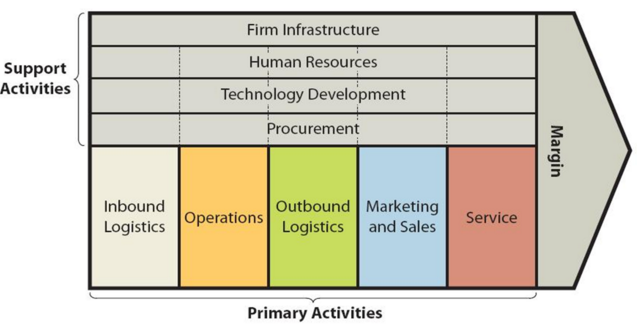
Starbucks value chain analysis is an analytical framework that assists in identifying business activities that can create value and competitive advantage for the global coffeehouse chain. Figure below illustrates the essence of value chain analysis. Starbucks Value chain analysis Starbucks Primary Activities Starbucks Inbound logistics Starbucks inbound logistics and supply chain was subjected to a dramatic restructuring in 2010 after Howard Schultz had returned to the role of CEO for the second time. The restructuring initiative of Starbucks inbound logistics involved simplification of supply-chain management and the creation of a single, global logistics system. Unroasted Arabica coffee beans are brought from Asia, Africa and Latin America to the US and Europe in containers via sea. Also, the coffee chain purchases green coffee beans from multiple coffee-producing regions around the world. These are delivered to one of the following regional roasting plants and distribution centres: Kent Flexible Roasting Plant – Kent, Washington. Augusta Roasting Plant – Augusta, Georgia. Sandy Run Roasting Plant – Gaston, South Carolina. York Roasting Plant and Distribution Center – York, Pennsylvania. Evolution Fresh Juicery – Rancho Cucamonga, California. Coffees are roasted and packaged and taken to dozens of central distribution centres around the globe. Along with coffees from regional distribution centres, central distribution centres also receive deliveries from vendors for a wide range of products starting from coffee machines to napkins. Central distribution centres make more than 70,000 deliveries per week to Starbucks 25,085 stores located in 75 countries.[1] The world’s largest coffeehouse chain also grows its own coffee. Since 2013 Starbucks has its first own 240-hectar coffee farm in PoasVolacno, Costa Rica.[2] Such a shift in the sourcing of products can increase the effectiveness of new product development initiatives for the business as the company will have a chance of experimenting with developing new sorts of…

Porter’s Five Forces analytical framework developed by Michael Porter (1979)[1] represents five individual forces that shape the overall extent of competition in the industry. Starbucks Porter’s Five Forces are represented in figure below: Porters Five Forces Threat of new entrants in Starbucks Porter’s Five Forces Analysis Threat of new entrants in international coffee chain industry is low. The following factors reduce the threat of new entrants for Starbuck’s industry within Porter’s Five Forces. 1. Market saturation. Coffee chain market is highly saturated and more so in developed countries. Market saturation implies an increase of a market share for a specific coffee house at the expense of a competitor. New entrants into the coffee house chain business find such a reality discouraging to enter the business and achieve long-term growth. 2. Access to distribution channels. New market entrants are going to face significant issues to access distribution channels because potentially attractive locations for coffee stores are already occupied by coffee chains, restaurants and retail outlets. It took Starbucks 36 years to reach its current status that comprises total more than 33800 company operated and licensed stores.[2] Similarly, other major players such as Costa, Caribou Coffee,McDonald’s, Dunkin Donuts, Pret-a-Manger have secured thousands of advantageous locations during the decades of operations. 3. Economies of scale. Establishing coffee house chains requires massive capital investments. It can prove to be highly challenging to secure investment to establish new business in this industry unless the business plan is based on previously untapped value proposition. Bargaining power of buyers in Starbucks Porter’s Five Forces Analysis Bargaining power of Starbucks buyers is significant. The following considerations need to be taken into account in this regard: 1. Abundance of choice. Customers can choose from a wide range of established coffee chains as well as local specialty coffee…