

Effectiveness of Xiaomi leadership can be considered as one of the main competitive advantages for the business. Xiaomi CEO Lei Jun is a respected businessman in China who previously led Kingsoft and founded Joyo.com that was sold to Amazon in 2014. It is said that Lei has never yelled at his staff. When he encounters a problem, he just smiles and gets down to business, and tries to find a solution. In social gatherings, Lei is always a good listener.[1] Named businessmen of the Year by Forbes in 2014 and along with Alibaba Founder Jack Ma, Lei Jun is rightly considered as the face of China Inc.[2] Xiaomi CEO is recognized as an effective charismatic leader worldwide. Along with Lei Jun, seven co-founders of the company have senior leadership roles with the titles of president and vice-presidents. Having co-founders in the senior management team is an important factor due to increased sense of ownership with positive implications on the performance of executives. Xiaomi has been dubbed as “Apple of China” for its emulation of design of Apple’s products, as well as, Lei Jun style of product announcements and his general image that resembles late Apple founder and CEO Steve Jobs. However, Lei Jun leadership style is fundamentally different from Steve Jobs leadership. Specifically, while Steve Jobs was known for his centralized and micro-managing leadership style, Xiaomi CEO has a reputation for being a good listener and takes into account views of other members of his senior management team. Xiaomi leadership challenges at present include maintaining cost leadership position amid intensifying competition from other budget internet technology brands such as Oppo and Vivo. Xiaomi Inc. Report contains a full analysis of Xiaomi leadership. The report illustrates the application of the major analytical strategic frameworks in business studies such as SWOT, PESTEL,…
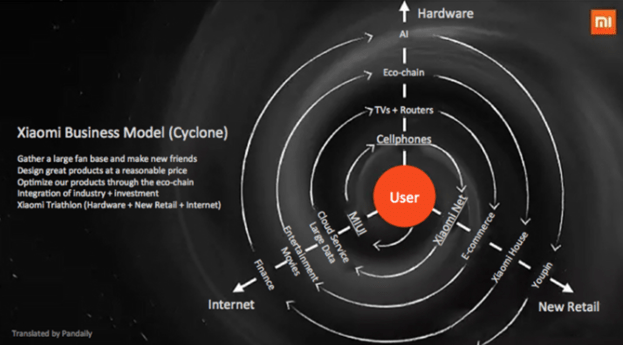
Xiaomi business strategy can be classified as cost leadership. According to its founder and CEO Lei Jun, Xiaomi was founded on the belief that “high-quality technology doesn’t need to cost a fortune.”[1] Accordingly, the company offers smartphones and other internet-technology products and services for affordable prices. On a wider perspective, Xiaomi business strategy is based on the following four pillars: 1. Gathering and utilising a large fan base. Xiaomi has a large fan base involving millions of people across the globe. Fans spend countless hours online discussing Xiaomi products on various forums, thus increasing the level of brand awareness with no extra cost for the company. The mobile internet company enjoys cult-like following, the same way as its major competitor Apple. According to its business strategy, Xiaomi fosters, develops and encourages its fans via Mi Fan Festivals that involves discounts and gifts. The motto of the company is “Just for Fans” and the company is also known to recruit its new employees among Mi Fans. 2. Designing great products at a reasonable price. Xiaomi practices ‘design as you built’ philosophy, incorporating Mi Fans feedback in a constant manner at all stages of new product development. Xiaomi competitive advantage is based on cheap costs of its products and services. In simple terms, cheap costs of Xiaomi products and services is the main reason for consumers buying those products and services. 3. Constant optimization of products through eco-chain. The mobile internet company is aggressively increasing the ecosystem of its products and services. This is another important aspect of Xiaomi business strategy. Currently, Xiaomi ecosystem comprises 55 companies including 29 companies which were incubated from the ground up by Xiaomi.[2] The ecosystem produces ever-increasing range of products ranging from smartphones to rice cookers. 4. Xiaomi Triathlon: Hardware+New Retail+Internet. As it is illustrated in…
Xiaomi Inc. is a privately owned electronics and software company founded in 2010 by serial entrepreneur Lei Jun, along with seven other co-founders. The mobile internet company has established its presence in 70 countries and regions and it is among the top 5 in 16 markets. Xiaomi currently employs about 18,000 people. In 2017 Xiaomi generated more than RMB 100 billion revenues and expected to get listed in the Fortune Global 500 list in foreseeable future. Xiaomi business strategy is based on cost advantage. Moreover, the company gathers and utilizes its large fan base in an efficient manner with positive implications on customer loyalty and the bottom line for the business. An aggressive expansion of ecosystem of products and services is also placed at the core of Xiaomi business strategy. The mobile internet company has matrix and flat organizational structure. According to framework of Ansoff Growth Matrix, Xiaomi uses all for strategies – market penetration, product development, market development and diversification, in an integrated manner. Efficient leadership by founder and CEO Lei Jun, impressive rate of growth and cost advantages compared to competition are considered as major strengths associated with Xiaomi. At the same time, the company has noteworthy weaknesses such as low profit margin, lower smartphone capabilities and functionalities compared to major competitors and difficulties of sustaining competitive advantage. Xiaomi Inc. Report contains the application of the major analytical strategic frameworks in business studies such as SWOT, PESTEL, Porter’s Five Forces, Value Chain analysis and McKinsey 7S Model on Xiaomi. Moreover, the report contains analyses of Xiaomi business strategy, leadership and organizational structure and its marketing strategy. The report also discusses the issues of corporate social responsibility. 1. Executive Summary 2. Business Strategy 3. Leadership 4. Organisational Structure 5. Organizational Culture 6. Xiaomi and Ansoff Matrix 7. SWOT Analysis…
Uber Technologies Inc. is a global transportation technology company that operates in more than 10,000 cities in approximately 71 countries. The ride-hailing giant and its subsidiaries employ approximately 22,800 people globally (Annual Report, 2020). The global transportation technology company generated revenues of USD 11,1 billion in 2020, a decline of 14% compared to the previous year. Uber incurred operating losses of USD 3.0 billion, USD 8.6 billion and USD 4.9 billion in 2018, 2019 and 2020 respectively. The largest taxi company in the world has no cars of its own. Drivers are independent contractors for the company and they use their own or rented cars to drive with Uber using Uber app. The company has effectively disrupted the taxi industry in the global scale. Uber business strategy involves increasing service range to cater for the needs of great amount of customers and focusing on high levels of user convenience. Moreover, cost-saving through technological innovation is placed at the core of Uber business strategy. The company follows growth path through acquisitions, purchasing start-ups that can contribute to its ecosystem. The ride-hailing giant had a leadership crisis in 2017. Lack of leadership skills of co-founder and the first CEO Travis Kalanick had caused the formation of a poor corporate culture. As a result the company suffered from a range of serious scandals involving discrimination, sexual harassment and even mobbing. Uber CEO was even caught on video rudely arguing with driver about declining fares (Wong, 2017). Mr. Kalanick had to step down from leadership role as demanded by investors and Expedia’ CEO Dara Khosrowshahi became a new CEO for Uber. Uber possesses considerable strengths such as the first mover advantage, global market leadership and the brand value and advanced level of user convenience. At the same time, the company has serious weaknesses such…

Struggling with your dissertation? You are not alone. Many students: Don’t know where to start Feel overwhelmed by structure and methodology Spend weeks making little real progress Worry about losing marks for avoidable mistakes How to Write a Dissertation: A Step-by-Step System to Plan, Write and Defend Your Dissertation in the age of AI 8th edition. Previously published as “The Ultimate Guide to Writing a Dissertation in Business Studies” Date March 2026 Author John Dudovskiy You will receive a link on your email to download the e-book shortly after the payment. $24.99 One time payment Proceed to Checkout Why not just use ChatGPT or AI tools? AI tools can generate answers. But they do not teach you how to build a proper dissertation. They often: Give generic responses Miss academic structure Fail to meet examiner expectations Lead to inconsistent or weak arguments This guide is different It gives you a complete system, not random answers. You will learn: How to structure your dissertation from start to finish How to justify your methodology properly How to align your work with academic expectations How to avoid mistakes that AI tools often introduce 👉 Think of this as your roadmap — not just information Description Table of contents List of tables List of figures “Of all the research books I have read, this is the easiest to understand. I now feel like I know exactly what I need to do” - Jonathan, Pittsburgh, USA Why this e-book? How to Write a Dissertation: A Step-by-Step System to Plan, Write and Defend Your Dissertation in the age of AIcontains step-by-step guidance derived from the experience of assisting hundreds of students who have successfully completed dissertations in business studies. Unlike many other books devoted to this topic, How to Write a Dissertation: A Step-by-Step System to…

Your dissertation needs to include suggestions for future research. Depending on requirements of your university, suggestions for future research can be either integrated into Research Limitations section or it can be a separate section. You will need to propose 4-5 suggestions for future studies and these can include the following: 1. Building upon findings of your research. These may relate to findings of your study that you did not anticipate. Moreover, you may suggest future research to address unanswered aspects of your research problem. 2. Addressing limitations of your research. Your research will not be free from limitations and these may relate to formulation of research aim and objectives, application of data collection method, sample size, scope of discussions and analysis etc. You can propose future research suggestions that address the limitations of your study. 3. Constructing the same research in a new context, location and/or culture. It is most likely that you have addressed your research problem within the settings of specific context, location and/or culture. Accordingly, you can propose future studies that can address the same research problem in a different settings, context, location and/or culture. 4. Re-assessing and expanding theory, framework or model you have addressed in your research. Future studies can address the effects of specific event, emergence of a new theory or evidence and/or other recent phenomenon on your research problem. My e-book, The Ultimate Guide to Writing a Dissertation in Business Studies: a step by step assistance offers practical assistance to complete a dissertation with minimum or no stress. The e-book covers all stages of writing a dissertation starting from the selection to the research area to submitting the completed version of the work within the deadline. John Dudovskiy

Research supervisors play a great role in the success of your project; therefore, it is important to establish appropriate and beneficial relationships with your supervisor from the beginning of your research process. Dealing with supervisor is a critical success factor impacting the outcome of the project In some universities you are able to choose your dissertation supervisor. If this is the case with your university, then you should give preference to more experienced supervisor in your research area. You must have realistic expectations. Do not expect your supervisor to immerse in your work in great details. The responsibility of your supervisor is to direct you towards the right path no to complete research on your behalf. Do not expect your supervisor to immerse in your work in great details Adhering to the following principles can increase the quality of your interactions with your supervisor significantly making your task of producing a quality dissertation much easier: 1. Take time to prepare for each meeting with your supervisor. You will have only a limited number of meetings with your supervisor and you must strive to make the most of each meeting. It is critically important to address each point mentioned by your supervisor during the last meeting. 2. Respect the time of your supervisor. Supervisors are usually dealing with a number of students writing dissertation simultaneously, and most of them have teaching classes as well. You must prepare questions for your supervisor in advance, and refrain asking unintelligent questions such as if you need to put course title on the cover of your work or asking questions about submission date which can be found on dissertation handbook. Asking such questions is a waste of time for you and your supervisor and it will most likely annoy your supervisor. 3. Communicate…

Research methods refer to the systematic techniques used to collect, analyse, and interpret data in order to answer research questions. In business research, they include decisions about research philosophy, approach, design, data collection, sampling, analysis, and ethical considerations. On this page: What are Research Methods? Research Philosophy Types of Research Research Approach Research Design Data Collection Methods Sampling Data Analysis Methods Ethical Considerations Component Purpose Example Research Philosophy Defines view of knowledge Positivism, Interpretivism Research Approach Guides logic of study Deductive, Inductive Research Design Overall plan of study Exploratory, Conclusive Data Collection Gathering information Surveys, Interviews Sampling Selecting participants Random, Purposive Data Analysis Interpreting data Statistical analysis, Thematic analysis Ethics Ensuring responsible research Consent, confidentiality Research methods at a glance What Is Research Methods? Research methods is a broad term. While methods of data collection and data analysis represent the core of research methods, you have to address a range of additional elements within the scope of your research. The most important elements of research methodology expected to be covered in business dissertation at Bachelor’s, Master’s and PhD levels include research philosophy, types of research, research approach, methods of data collection, sampling and ethical considerations. These decisions are interconnected and must be logically consistent with one another. For example, the research philosophy influences the research approach, which in turn affects the research design, data collection methods, and data analysis techniques. Understanding how these elements relate to each other helps ensure that the research process is coherent and methodologically sound. The main components of research methodology commonly addressed in business dissertations are discussed below. Research Philosophy Research philosophy is associated with clarification of assumption about the nature and the source of knowledge. All studies are based on some kind of assumptions about the world and the ways of understanding the world. There is no…

Research validity in surveys relates to the extent at which the survey measures right elements that need to be measured. In simple terms, validity refers to how well an instrument as measures what it is intended to measure. Reliability alone is not enough, measures need to be reliable, as well as, valid. For example, if a weight measuring scale is wrong by 4kg (it deducts 4 kg of the actual weight), it can be specified as reliable, because the scale displays the same weight every time we measure a specific item. However, the scale is not valid because it does not display the actual weight of the item. Research validity can be divided into two groups: internal and external. It can be specified that “internal validity refers to how the research findings match reality, while external validity refers to the extend to which the research findings can be replicated to other environments” (Pelissier, 2008, p.12). Moreover, validity can also be divided into five types: 1. Face Validity is the most basic type of validity and it is associated with a highest level of subjectivity because it is not based on any scientific approach. In other words, in this case a test may be specified as valid by a researcher because it may seem as valid, without an in-depth scientific justification. Example: questionnaire design for a study that analyses the issues of employee performance can be assessed as valid because each individual question may seem to be addressing specific and relevant aspects of employee performance. 2. Construct Validity relates to assessment of suitability of measurement tool to measure the phenomenon being studied. Application of construct validity can be effectively facilitated with the involvement of panel of ‘experts’ closely familiar with the measure and the phenomenon. Example: with the application…
Ethical considerations in research refer to the principles and standards that ensure the protection of participants, the integrity of data, and the honesty of the research process. They guide how researchers collect, analyse, and report data in a responsible and transparent manner. On this page: Ethical Considerations in the Use of AI Core Principles of Ethical Considerations When to Address Ethical Considerations Ethical Considerations in the Use of AI The increasing use of AI tools such as ChatGPT in academic research introduces new ethical considerations that must be carefully addressed. Most common ethical risks of AI use include plagiarism or unintentional duplication and over-reliance on AI-generated content. Moreover, inclusion of inaccurate or fabricated information and the lack of transparency in the research process is also risks AI use can cause in your work. When using AI in your dissertation, you should: Ensure that AI-generated content is not presented as your own original thinking without modification Use AI tools as support tools, not as substitutes for critical analysis Verify the accuracy and reliability of any information generated by AI Follow your university’s guidelines regarding AI usage and disclosure Clearly acknowledge the use of AI tools where required AI can assist your research (which you should acknowledge), but you remain fully responsible for the accuracy, originality, and integrity of your work Core Principles of Ethical Consideration Ethical considerations are one of the most important parts of any research project and must be clearly addressed in your dissertation. Ethical research in business studies involving primary data collection is based on the following nine core principles: No harm to participants – physical, psychological, or emotional Informed consent – participants must fully understand the study Voluntary participation – no pressure or coercion Confidentiality and anonymity – identities must be protected Honesty and transparency…