
Marriott marketing strategy is designed to reach its target audience of travellers and to encourage them to book a stay at a hotel or resort belonging to it portfolio. Marketing costs for the largest hotel chain in the world amounted to USD 635 million in 2022, USD 470 million in 2021, and USD 276 million in 2020[1]. Marriott marketing strategy focuses on the following key elements: – Brand differentiation. Marriott International differentiates its brand from other hotel companies by emphasizing its commitment to quality, service, and innovation. The company also offers a wide range of hotel brands to suit the needs of different travellers, from budget-minded travellers to luxury travellers. – Unique selling proposition. Along with its world-class amenities, commitment to customer services is unique selling proposition for Marriott hotels. Employees are trained to go the extra mile to make guests feel welcome and valued. – Customer segmentation. Marriott International segments its customers into different groups based on their travel needs and preferences. This allows the company to develop targeted marketing campaigns that are relevant to each segment. – Omni-channel marketing. Marriott International uses a variety of marketing channels to reach its target audience, including online, offline, and social media. The company also integrates its marketing campaigns across all channels to provide a seamless customer experience. – Product placement strategy. Product placement is one of the key elements of Marriott marketing strategy. One of Marriott’s most famous product placement deals was with the popular TV show “The Real Housewives of Beverly Hills.” The show featured the cast staying at the Ritz-Carlton, Los Angeles on several occasions. This exposure helped to position the Ritz-Carlton as a luxury hotel brand that was popular with celebrities and other high-profile individuals. Marriott has also placed its hotels in a number of successful movies, including “The Devil Wears…
PESTEL is a strategic analytical tool and the acronym stands for political, economic, social, technological, environmental and legal factors. Marriott PESTEL analysis involves the analysis of potential impact of these factors on the bottom line and long-term growth prospects of the international hotel chain. Political Factors in Marriott PESTEL Analysis There are some political factors that may affect Marriott International. Such factors include political stability, security and the risk of terrorism in a given territory, US-China trade wars, the rise of nationalism and terrorism and others. Moreover, the level of bureaucracy and corruption, freedom of press and trade union activities are also political factors with the potential impact on Marriott and other international hotel chains. Political stability Political stability is essential for international hotel business. It allows hotel chains to operate in a predictable and safe environment, which is necessary for investment and growth. When there is political instability, it can lead to a number of negative consequences. For example, political instability can deter tourists from visiting a country, which can lead to a decline in demand. It can also increase the costs of operations, such as the cost of security measures and insurance premiums. In some cases, political instability can even lead to Marriott having to close its hotels in a country. For example, in 2022, Marriott was forced to close some of its hotels in Ukraine following the Russian invasion. Trade union activities Trade union activities can have a significant impact on hotel business, both positive and negative. Trade unions can help to improve the working conditions for employees. They can negotiate for higher wages, better benefits, and safer working conditions. This can lead to a more motivated and productive workforce, which can benefit Marriott’s bottom line. Trade unions can also help to improve the…
SWOT is an acronym for strengths, weaknesses, opportunities and threats related to organizations. The following illustrates Marriott SWOT analysis: Strengths 1. Diverse portfolio of brands 2. Global presence 3. Strong loyalty program 4. Asset-light business model Weaknesses 1. Labour issues 2. Brand image damaged due to data breach Opportunities 1. Targeting millennial and Gen Z segments 2. Increasing focus on alternative lodging 3. Focusing on emerging economies 4. Entering into adjacent industries Threats 1. Increased competition from alternative lodging 2. Currency fluctuations 3. Geopolitical tensions 4. Global pandemic Marriott SWOT Analysis Strengths in Marriott SWOT Analysis 1. Diverse portfolio of brands. Marriott International has 30 brands[1] in its portfolio appealing to the needs and wants of a wide range of customer segments. The company has something to offer every type of traveller, from budget-minded backpackers to luxury-seeking executives. This diversity gives the hotel chain substantial competitive advantage. Specifically, it allows the company to reach a wider range of customers. A traveller looking for a budget-friendly hotel is just as likely to book a room at a Fairfield Inn by Marriott as a traveller looking for a luxury hotel is to book a room at a Ritz-Carlton. 2. Global presence. Marriott is the largest hotel chain in the world and operates properties in 138 countries and territories[2]. Such a global presence gives the company a number of advantages. For example, global presence gives the company a competitive advantage over smaller hotel chains. Smaller hotel chains typically do not have the resources to expand into new markets and build new hotels. Marriott’s global presence allows the company to quickly and easily expand into new markets and compete with local hotel chains. Second, the hotel chain’s global presence allows it to leverage its brand recognition. Marriott is one of the most…
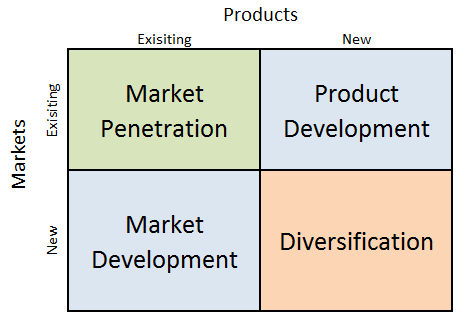
Marriott Ansoff Matrix is a marketing planning model that helps the international hotel chain to determine its product and market strategy. Ansoff Matrix illustrates four different strategy options available for businesses. These are market penetration, product development, market development and diversification. Marriott Ansoff Growth Matrix Within the scope of Ansoff Matrix, Marriott International uses all four growth strategies in an integrated manner: 1. Market penetration. Market penetration refers to selling existing products and services to existing markets in increased quantities. Market penetration is one of the main growth strategies for Marriott. The company uses this strategy through competitive pricing for some of the brands within its portfolio, promotional discounts, targeted marketing and other means. Moreover, Marriott Bonvoy loyalty program plays in instrumental role in increasing the effectiveness of market penetration. 2. Product development. This growth strategy involves developing new products to sell to existing markets. Marriott has a strong track record of developing and launching new brands and hotel concepts that meet the evolving needs of its customers. For example, the company launched several new brands in recent years, such as Moxy Hotels, AC Hotels by Marriott, and Autograph Collection, as well as, new hotel concepts such as Tribute Portfolio and Element Hotels. 3. Market development. Market development strategy is associated with finding new markets for existing products. An extensive focus on market development business strategy has allowed Marriott International to become the largest hotel chain in the world operating in 138 countries and territories under 30 brand names.[1] 4. Diversification. Diversification involves developing new products to sell to new markets and this is considered to be the riskiest strategy. Marriott uses diversification sparingly, preferring to stick to its core hotel business. The rare cases of diversification for the hotel chain include entering into vacation rentals, timeshares and operating…

Marriott organizational structure had to change significantly with new executive appointments early in 2023. Following the departure of company’s president Stephanie Linnartz to become president and CEO of Baltimore-based sports equipment company Under Armour, Anthony Capuano became Marriott’s President and CEO[1]. Marriott International has a hybrid organizational structure that combines elements of both a matrix and functional structure. The company’s matrix structure is evident in the combination of functional and divisional configurations. Marriott has functional divisions such as marketing, sales, and operations, but it also has divisional units organized by geographic region. This allows the largest hotel chain in the world to achieve both global uniformity and local diversification and responsiveness. Marriott Organizational Structure The matrix structure works in conjunction with a regional structure, with each region having its own functional divisions. For example, the Greater China region has its own marketing, sales, and operations divisions. This allows Marriott to tailor its operations to the specific needs of each region. Marriott’s organizational structure is also characterized by a high degree of centralization. The company’s CEO and executive team have a significant amount of authority over decision-making. This centralization allows Marriott to maintain a consistent brand image and service quality across all of its properties. Marriott International’s hybrid organizational structure has several advantages. The matrix structure allows the company to achieve both global uniformity and local diversification and responsiveness. The regional structure allows the hotel chain to tailor its operations to the specific needs of each region. The centralization of authority allows the company to maintain a consistent brand image and service quality across all of its properties. However, there are also some potential disadvantages to Marriott organizational structure. The matrix structure can be complex and time-consuming, and it can lead to conflict between functional and divisional units. The centralization…

The current CEO of Marriott International is Anthony Capuano. He has been with the company for over 25 years and has held a variety of leadership positions, including Chief Development Officer and President of Global Development. Capuano is known for his strategic thinking and his ability to build and lead high-performing teams. Marriott International‘s leadership team is also notable for its diversity. The company’s executive team includes women, people of colour, and representatives from all over the world. This diversity of experience and perspectives helps Marriott International to better understand its customers and to develop innovative products and services. In terms of leadership style, Marriott is known for its commitment to servant leadership. Servant leaders focus on serving their employees and customers, rather than the other way around. This approach has helped Marriott International to create a positive work culture and to build strong customer relationships. Marriott International has a leadership development program called Voyage. Voyage is a 12-18 month program that is available to recent university graduates and provides a combination of practical hands-on experience and leadership training. Participants in the Voyage program rotate through different departments within a Marriott hotel and receive training from experienced leaders. Upon successful completion of the program, participants are well-positioned for leadership roles within hotel chain. Furthermore, Marriott leadership practices integrate the following important elements: Focus on employee development. The largest hotel chain in the world invests heavily in employee development and training. The company believes that its employees are its most valuable asset, and it is committed to helping them succeed. Fostering the culture of innovation. Marriott encourages its employees to be innovative and to come up with new ideas. The company has a number of programs in place to support innovation, such as its “TakeCare” program, which allows employees to submit ideas for improving the company.…

Fundamental Analysis of Marriott Stock Fundamental analysis refers to the practice of using financial activity to forecast stock prices. The following table illustrates main financial ratios for Marriott International: Ratio Marriott International performance Price-to-Earnings (P/E) Marriott’s P/E ratio is currently 22.4, which is slightly above the average P/E ratio of the S&P 500 index (18.6). In other words, Marriott’s stock is currently trading at a premium to the broader market Price-to-book (P/B) Marriott’s P/B ratio is currently 3.2, which is above the average P/B ratio of the S&P 500 index (2.3). This can be interpreted as Marriott’s stock is currently trading at a premium to the broader market based on its book value. Enterprise value to earnings before interest, taxes, depreciation, and amortization (EV/EBITDA) Marriott’s EV/EBITDA ratio is currently 11.5, which is in line with the average EV/EBITDA ratio of the hotel industry (11.0). This suggests that Marriott’s stock is currently trading at a fair valuation relative to its peers. Debt-to-Equity Ratio Marriott’s debt-to-equity ratio is currently 1.2, which is considered to be a healthy level of debt. In other words Marriott is well-positioned to manage its debt obligations. Return on Equity (ROE) and Return on Assets (ROA) Marriott’s ROE and ROA are both above the average ROE and ROA of the hotel industry. This suggests that Marriott is a profitable company that is generating good returns on its equity and assets. Marriott International main financial ratios Overall, Marriott’s financial ratios suggest that the company is well-managed and financially sound. Technical Analysis of Marriott Stock Technical analysis is the reliance of historical stock price activity to predict future price activity. Short-term trend The short-term trend for Marriott International is neutral. The stock is currently trading in a range between USD 198.23 and USD 206.55. A…
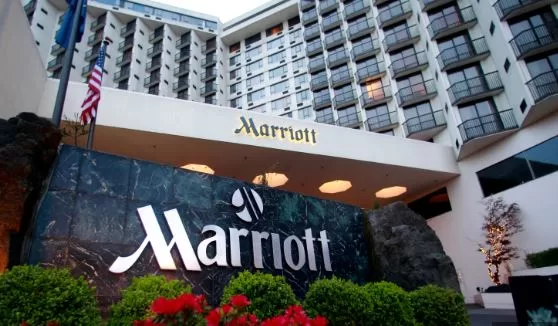
Marriott business strategy consists of the following 3 elements: 1. Pursuing asset-light business model. Operating in light-asset manner is one of the cornerstones of Marriott business strategy. Under this model, Marriott focuses on managing and franchising hotels, rather than owning them. This allows the hotel chain to expand rapidly and efficiently, without having to invest heavily in real estate. Light-assed strategy provides the company with a range of substantial advantages such as reduced capital investment and as a result, increased flexibility to enter into new markets and experiment with new brands. Furthermore, this strategy reduces exposure to the risk of real estate market downturns. 2. Growth through acquisitions. Marriott International has been a major user of acquisitions to fuel its growth. In 2016, it acquired Starwood Hotels & Resorts Worldwide in an USD 13.6 billion deal, which made it the world’s largest hotel company. The acquisition added nearly 1,300 hotels to Marriott’s portfolio, including brands such as Sheraton, W, and Westin. Since the Starwood acquisition, Marriott has continued to make smaller acquisitions to expand its reach into new markets and segments. For example, in 2017, it acquired Delta Hotels and Resorts, which added 38 hotels in Canada to its portfolio. In 2022, it acquired Hoteles City Express, which added 152 hotels in Mexico, Costa Rica, Colombia, and Chile. 3. Focusing on bleisure travellers. Bleisure travelling, a portmanteau of “business” and “leisure”, refers to the trend of business travellers extending their trips to include leisure activities. Marriott International is increasing its focus on bleisure travellers as part of its long-term business strategy. Up to date, this new customer segment, the business traveller who wants more choices for accommodations, that new blended traveller, and younger travellers who want more space for their travels, have been mainly served by Airbnb and…
Marriott International is a worldwide operator, franchisor, and licensor of hotel, residential, timeshare, and other lodging properties in 138 countries and territories under 30 brand names. Started as a root beer stand in 1927 in Washington D.C., USA, Marriott has grown into the largest hotel chain in the world. For the full year 2022, gross fee revenues totalled USD 4.1 billion, a significant increase of more than 50 percent compared to 2021. Adjusted EBITDA reached nearly USD 3.9 billion in 2022, up almost 70 percent year over year. Full year adjusted diluted earnings per share (EPS) more than doubled from 2021, totalling USD 6.69. In 2022, Marriott International grew from 7,989 properties (1,479,179 rooms) at year-end 2021 to 8,288 properties (1,525,407 rooms) at year-end 2022, reflecting gross additions of 394 properties (65,376 rooms) and deletions of 94 properties (19,079 rooms), including the impact of the Company’s decision to suspend its operations in Russia. Marriott business strategy integrates pursuing asset-light business model and growing through acquisitions. Moreover, the largest hotel chain in the world focuses on increasing customer segment known as “bleisure travellers”. CEO Anthony Capuano and senior management pursue servant leadership style and the hotel chain has a hybrid organizational structure that combining elements of matrix and functional structures. Marriott International Inc. Report contains the application of the major analytical strategic frameworks in business studies such as SWOT, PESTEL, Porter’s Five Forces, Value Chain analysis, Ansoff Matrix and McKinsey 7S Model on Marriott. Moreover, the report contains analyses of Marriott’s business strategy, leadership and organizational structure and ecosystem. The report also analysis marketing strategy, ecosystem and discusses the issues of corporate social responsibility. 1. Executive Summary 2. Business Strategy 3. Marriott Stock Performance Analysis 4. Leadership 5. Organisational Structure 6. Organizational Culture 7. Marriott and Ansoff Matrix 8. SWOT Analysis…
Marriott International Inc. Report contains the application of the major analytical strategic frameworks in business studies such as SWOT, PESTEL, Porter’s Five Forces, Value Chain analysis, Ansoff Matrix and McKinsey 7S Model on Marriott. Moreover, the report contains analyses of Marriott’s business strategy, leadership and organizational structure and ecosystem. The report also analysis marketing strategy, ecosystem and discusses the issues of corporate social responsibility.