

Planning process for tourism industry comprises the following stages: 1. Study recognition and preparation. The first stage in planning process is associated with the recognition of the need for the strategy in order to obtain and/or increase competitive advantage to contribute to long-term growth. Depending on available budget and a range of other factors, studies may be planned to be conducted on local regional or national levels. 2. Setting of objectives or goals for the strategy. Goals and objectives need to be formulated according to SMART principle, where the acronym stands for specific, measurable, achievable, realistic and time-bound. 3. Survey of existing data. The survey of existing data or secondary research can be done through analysing relevant information available on wide range of tourism reviews websites, newspapers, magazines, books and other online and offline published materials. The types of data that need to be collected from these sources include, but not limited to patterns of tourist behaviours, availability and quality of accommodation, impacts of environmental factors, social and cultural characteristics of tourism destinations etc. Importantly, the survey of existing data should cover all three directions: the state of issues at present, projected changes in the state of issues, and outline of principles for monitoring for the future. 4. Implementation of new surveys. New surveys are conducted in order to obtain fresh data and/or fill the information gap in relation to the tourism industry. Surveys can be conducted through online or offline questionnaires or interviews. When conducting the survey it is very important to select respondents i.e. sample group members from amongst target customers for tourism destinations. 5. Analysis of secondary and primary data. In case of questionnaires, data analysis can be done through representing collected information in bar-charts, pie-charts etc. In case of interviews, on the other hand, data analysis may involve finding common patterns…

The term of tourism can be defined as “the temporary movement of people to destinations outside their normal places of work and residence, the activities undertaken during their stay in those destinations, and the facilities created to cater to their needs” (Gunn, 2002, p.9, as taken from Mathieston and Wall, 1982), and tourism has been assessed as the largest industry in the global scale. Tourism provides both, economic and non-economic benefits to any given country. Economic benefits of tourism to a national economy is straightforward and it is associated with creation of new jobs, decrease in the levels of unemployment, stimulation of production of products and services to be consumed by tourists and others. Non-economic benefits of tourism, on the other hand, include facilitation of cultural exchanges, contribution to the levels of knowledge, and facilitation of communication. Strategy can be defined as “the determination of the basic long-term goals and objectives of an enterprise, and the adoption of courses of action and the allocation of resources necessary for carrying out these goals” (Campbell et al., 2012, p.12, taken from Chandler, 1962). Accordingly, strategic planning can be explained as “the process of developing approaches to reach a defined objective” (Axson, 2010, p.25). Tourism industry has become more competitive than ever before, and therefore the importance of strategic planning for tourism industry is greater than ever before. The primary aim of the tourism industry relates to the achievement of adequate balance between the interests of public and private sectors. Three general principles of planning for tourism can be specified as anticipation, regulation and monitoring. Anticipation involves making projections about the future state of the tourism on the basis of relevant secondary and primary data. Regulation, on the other hand, is closely associated with the levels of regulation of tourist and affiliated organisations…
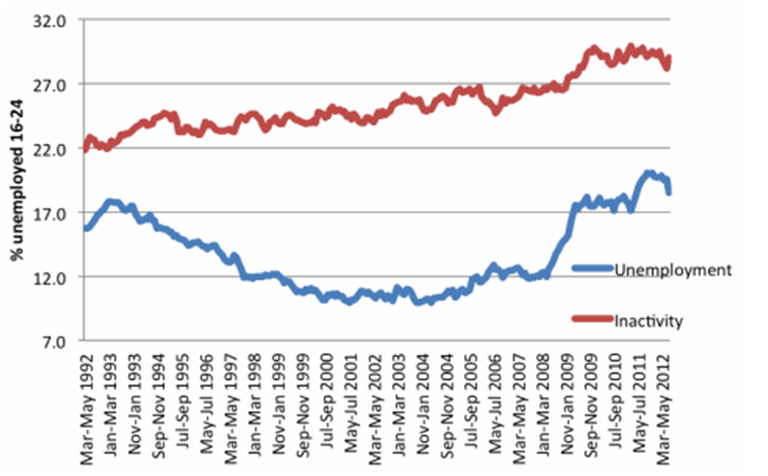
Unemployment is serious social and economic issue for the society, and unemployed individuals in many levels. Unemployment amongst young people is considered to be a special case as “young people between their required school life and their first job are very susceptible to unemployment” (Kurten, 2007, p.3). Moreover, a high level of youth unemployment has massive negative implications for the government on short-term and long-term perspectives. According to International Labour Office (2012), individuals aged between 16 – 25, who are available for work in 15 days, not currently employed, and are looking for employment opportunities in an active manner can be classified as young unemployed. However, in the UK, the age range of young unemployed individuals is specified as 16 – 24 years old. The level of youth unemployment has been consistently rising in the UK during the past several years (Figure 1). Moreover, it has been estimated that the numbers of young individuals who have not been working for more than 2 years have increased from 40,000 to more than 100,000 during the last four years, amounting to the increase of 168 per cent, and the numbers of Job Seeker Allowance claimants amongst young people have increased 315 per cent during the last six month (Al-Katib, 2012). Figure 1 Youth unemployment and inactivity statistics Source: Office of National Statistics (2012) The lack of skills and experience amongst young people in the UK is considered to belong to the list of major reasons behind increasing level of unemployment. Moreover, continuing economic problems in the EU and the UK have been found to have negative implications on the local job market in UK in general, and the job market for young people in particular. There is a stark difference on the levels of employment amongst young people who are engaged in…

This paper represents a business plan sample for Product Placement Opportunities®, a marketing services company that provides a platform for medium sized businesses to engage in product placement in a cost-effective manner through its website www.pp-opportunities.com. The business plan is built upon the gap in the in the marketing services industry that relates to allowing media, special event and computer games businesses to utilise their product placement opportunities in a direct manner, without using the services of marketing agencies. The comprehensiveness of the business plan is ensured by explaining mission statement, business strategy and objectives in a detailed manner. The main source of revenue for Product Placement Opportunities® relates to charging media, special event and computer games and other businesses for advertising their product placement opportunities on www.pp-opportunities.com. Price skimming pricing strategy has been chosen as the most suitable for the business. Analysis of principal personnel qualifications and experience contained within the plan highlights the ways in which competitive advantages are going to be derived. Moreover, cash flow forecast, profit and loss accounts forecast and balance sheet associated with the business plan have been developed on the basis of situational analysis and analysing market size for Product Placement Opportunities® services. The business plan also contains discussion related to relevant legal requirements, such as the company’s legal structure, commercial dealings, insurance and others. Glossary of Terms 1 1. Description of Business 2 2. The Mission and Vision Statement 3 2.1 Business Idea 3 2.2 Trading Status 4 2.3 Management & Ownership 4 2.4 Business Objectives 5 2.5 Business Strategies 5 3. Product and/or Service Plan 6 3.1 Product Placement Opportunities® service description 6 3.2 Product Placement Opportunities® Unique Features 7 3.3 Pricing Strategy& Value Issues 7 4. The Market Plan 8 4.1 Market Research Methodology 8 4.2 Secondary Research 8 4.3…

This paper represents a case study report devoted on the issue of increasing levels of youth unemployment in the UK. The report starts with a brief description of relevant existing key policies. This is followed by the identification of gaps on youth unemployment that need to be addressed. The report also contains discussions about relevant policy goals and the extent of their alignment with government preferences. Moreover, relevant policy options analyses are included in this report with detailed explanations of two the most suitable and appropriate policy options taking into account present economic and political circumstances in the UK. The report is concluded by making recommendations regarding the implementation of a specific policy option with detailed explanations provided. Youth unemployment is proving to be a serious challenge in the UK with highly negative short-term and long-term economic and social implications. Specifically, nearly 1.5 million, or more than 20 per cent of young people in the UK are found to be not engaged in education, employment or training (ACEVO, 2012). Moreover, according to estimations, the net present value cost of youth unemployment for the next ten years is going to amount to £28 billion (ACEVO, 2012). A wide range of negative implications of youth unemployment include negative impact on national economy for short-term and long-term perspectives, negative impact on future earning potentials of youth involved, detrimental impacts on mental and individual health of young individuals involved (Gregg et al., 2011), and increase in the level of anti-social behaviour within the society (Howell, 2005). The major reasons for increasing levels of youth unemployment in the UK have been specified as the recent global economic and financial crisis, failure in the UK immigration policies (Sunley et al., 2011), and systematic employment policy failures (Furlong, 2012). 1. Introduction: Nature of the Problem 1 2.…

It has been justly stated that Human Resource Development (HRD) is becoming a unique philosophy in organisations and central to bringing about effective change. Intensifying levels of competition in the market has caused the profile of HRD to increase for organisations in both sectors, private, as well as, public. HRD can be defined as “the process by which corporate management stimulates the motivation of employees to perform productively” (Roussel, 2006, p.195). In simple terms HRD can be explained as a set of initiatives and programs introduced by organisations with the aims of equipping its members with necessary skills and competencies to be able to meet the demands of their jobs. HRD can have a substantial positive impact on the level of implementation of organisational changes, as well as, on the overall outcome of change initiatives. As it has been briefly mentioned above, this impact can be maximised by organising relevant employee training and development programs that aim to increase the level of knowledge of employees about the importance of change and teaching employees about the ways of dealing with the change. Employee training and development programs offer a range of significant benefits at various levels that include positive implications on the level of employee productivity, higher level of employee motivation and job satisfaction and improvement on the quality of work.

There are several principal differences between public sector and private sector organisations, and these differences include organisational aims and objectives, organisational stakeholders and stakeholder expectations, the levels of public scrutiny, the levels of impact by political factors and others. Organisational Aims and Objectives Private sector organisations pursue the main objective of profit maximisation. Top level executive and marketing management in private sector organisations may attempt to create an image of pursuing other objectives as well such as protecting the environment, making the lives of people more convenient, and creating value for people in many other ways. However, these objectives for private sector organisations are secondary, and they have been developed only to aid the primary objective of profit maximisation. Public sector organisations, on the other hand, usually pursue aims and objectives other than profit maximisation. Moreover, objectives of public sector organisations in the UK may relate to a wide range of areas such as policing, providing education, providing healthcare etc. Organisational Stakeholders and Stakeholder Expectations Customers and shareholders are the most important organisational stakeholders for private sector organisations and their expectations are straightforward. Specifically, customers expect to get the best possible deal from the business, whereas the expectations of shareholders are closely associated with increasing profitability in short-term and long-term perspectives. In case of public sector organisations, on the other hand, stakeholder expectations are closely associated with the delivery of products and services in an adequate manner. It can be stated that population is the most important stakeholder group for public sector organisations. The Levels of Public Scrutiny Public sector organisations are generally subjected to scrutiny to a greater extent compared to private sector organisations in the media and from the government. Moreover, the main reason behind this difference relates to the sources of funding of these…
The report starts with the identification of gap in the knowledge about doing business in emerging markets in general, and Indonesia in particular. This is followed by providing recommendations to managers in relation to dealing with specific issues and practices they are likely to be faced with in Indonesia. The report is concluded by providing a summary of the key points of the research and mentioning the key points of advice. International market expansion opportunities for businesses enabled by intensive economic globalisation during the last several decades have increased the numbers of international assignment for managers at top levels. Importantly, “international managers need to have a clear view of where they want their firm to be in the future; they have to organise to implement their plans; they have to motivate those who work for them; and they have to develop appropriate control mechanisms” (Griffin, 2010, p.161). However, implementation of all of these tasks in practical levels is associated with a set of significant difficulties that relate to cross-cultural differences, family adjustment issues in a new country, language adaptation challenges and others. This report advises managers seeking to work in an emerging market on management practices in an international and cross-cultural context focusing on Indonesian consumer electronics market. The main reasons for the choice of Indonesia as an emerging market to be discussed in this report relates to the importance of Indonesia Investment Guarantee Fund – the best practice guarantee facility for investors and the potential possessed by Indonesia to become the next member of BRIC (Wagner, 2012, online) with positive implications on the performance of businesses operating in this country. 1. Introduction 1 2. Identification of Gaps in Knowledge 2 3. Recommendations Regarding Issues and Practices in Indonesia 4 3.1 Cross-Cultural Differences 4 3.1.1 National culture 4 3.1.2 Organisational…

Global forces impacting UK businesses include, but not limited to increasing scale of international trade, increasing levels of multiculturalism in UK organisations, increasing levels of inter-dependency of national economies and others. The impact of global forces on UK Business Organisations can be effectively analysed using PESTEL analysis where the abbreviation stands for political, economical, social, technological, ecological, and legal factors impacting businesses. The following table contains the application of PESTEL analysis in relation to businesses operating in the UK. Political The level of global political stability The level of bureaucracy in international affairs The extent of freedom of media Global trade control initiatives Threat of international terrorism Tariffs between the UK and other countries Global copyright, patent and intellectual property disputes Economical Impacts of intensifying economic globalisation Global economic crisis Sock market fluctuations Cost advantages possessed by emerging superpowers such as China, India etc. Impact of The World Bank and The World Trade Organisation Increasing importance of outsourcing and offshoring initiatives Social Changes in family values in global scale Changes in family patterns (same-sex marriages, single parents etc.) Increasing popularity of immigration and migration practices Increasing mobility between social classes Greater concern for minorities in society Technological Level of global technological infrastructure Industry-specific technological breakthroughs Regular emergence of innovative communication technologies Adoption of technology as competitive edge by increasing numbers of businesses Ecological Impacts of global warming tendencies Increasing levels of air and pollution Increasing level of sensitivity towards “green” problems among business stakeholders Activities and initiatives of global environmental organisations Legal Laws and regulations related to data protection Global data protection rules and regulations Increasing levels of “legal globalisation” Changes in cross-country employment and health and safety laws The case studies of Martin Lishman and Aquaco mentioned above represent a few cases where UK businesses benefit from…

International trade is the exchange of capital, products and services across borders. Advantages of international trade include greater utilisation of resources, importing products that can not be produced locally, and increasing the variety of choice to consumers. However, international trade may be associated with disadvantages as well such as loss of local jobs and high level of dependency on foreign markets. Significance of international trade to UK business organisations can be explained by referring to the concept of comparative advantage. According to the concept trade between two countries can be made in a mutually beneficial manner, if each country has comparative advantage to manufacture products to be traded. One of the leading English economists of the 19th century David Ricardo uses the cases of England and Portugal producing cloth and wine as it is presented in Table 2. According to Table 2, England possesses relative advantage in producing cloth as it less labour hours are required. Portugal, on the other hand, has relative advantage in wine production, because only 80 hours are required to produce wine as compared to 90 hours to produce cloth. Cloth Wine Ratio of price of wine to the price of cloth Ratio of price of cloth to the price of wine England 100 120 1.20 0.83 Portugal 90 80 0.88 1.12 Illustration of the concept of comparative advantage Source: Hunt and Lautzenheizer (2011) In other words, England can produce each unit of cloth for lower prices compared to wine, while for Portugal it is cheaper to produce each unit of wine than producing each unit of cloth. Accordingly, both England and Portugal can consumer maximum amounts of cloth and wine if they focus on producing products within their relative advantage, and engage in international trade. Impact of international trade to UK businesses can be illustrated…