
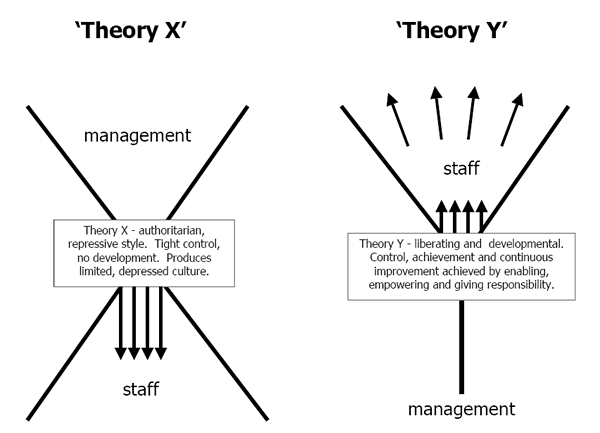
Theory X and Theory Y framework proposed by McGregor in his classic book The Human Side of Enterprise (1960) consists of two alternative set of assumptions. Theory X percieves employees to be lazy, irresponsible and untrustworthy, while according to theory Y employees are approached as one of the most valuable assets of the company. According to Theory X assumptions employees do not like their work, they lack ambition and responsibility and employees prefer to be led rather than leading others. Theory X assumes average human being to dislike the work and avoid it whenever possible. The following statements relate to Theory X assumptions: Most people must be controlled and threatened so that they can produce an adequate level of output Responsibility is avoided by an average human who desires security above all An average human being has a little ambition and has to be closely supervised at all times Theory Y set of assumptions, on the other hand, is based upon the idea that employees are generally enthusiastic about their work, they are creative and self-directive, and also employees readily accept responsibility. Theory Y is based on the following alternative assumptions: The expenditure of physical and mental effort in work is as natural as play or rest Methods of making people work are not limited to control and punishment, high level of commitment in organisational aims and objectives can result in self-direction Commitment to organisation can be achieved by designing satisfying jobs If proper conditions are created, an average human can not only learn how to take responsibility, but he can also learn to seek responsibility In practical levels, McGregor’s Theory X and Theory Y framework aims to demonstrate the potential of employees that organisations should recognise so that the level of organisational efficiency can be increased. However, as…

According to the Great Man theory leaders are born with a set of specific skills and traits that makes an individual destined for a leadership position. Also known as a trait perspective to leadership it suggests that “certain individuals have special innate or inborn characteristics or qualities that differentiates them from non-leaders” (Northouse, 2010, p.4). Specifically, these characteristics were believed to include height, weight, appearance, intelligence, disposition and others. Furthermore, “charismatic and inspirational leaders instil faith in a better future for the followers in terms of their self-expression, self-evaluation, and self-consistency” (Bass and Riggio, 2006, p. 39). Analysis of the ‘Great Man’ theory has a direct relevance to this study. It has been noted that “through most of the imperial period, literate Chinese had a Great Man theory of how their civilisation developed” (Ebrey, 2010, p.10), and thus, the theory might have impacted upon the current pattern of Chinese-style leadership. Therefore, specifications, major viewpoints, and main criticisms associated with the Great Man theory need to be analysed in a great detail within the scope of the literature review. Critics of the Great Man theory note that “leadership is an identifiable set of skills and practices that are available to all of us, not just a few charismatic men and women. The “great person” – woman or man – theory of leadership is just plain wrong” (Kouzes and Posner, 2008, p.32). Moreover, it has been argued that “leadership skills and savvy mature over time and under appropriate conditions” (Gallos, 2008, p.61), so any individual can increase the level of own leadership qualities if the individual is faced with relevant situations under appropriate circumstances. References Bass, B.M. & Riggio, R.E. (2006) “Transformational Leadership” 2nd edition Gallos, J.V. (2008) “Business Leadership: A Jossey-Bass Reader” 2nd edition, John Wiley & Sons Northouse, P.G.…

Thomas (2009) offers a comprehensive analysis of issues associated with intrinsic motivation at work. The author argues that “intrinsic rewards come to workers directly from the work they do – satisfactions like pride of workmanship or the sense that they are really helping customers” (Thomas, 2009, p.13). Three C’s of intrinsic motivation have been identified by Kohn (1993) as collaboration, content and choice. Specifically, according to Kohn (1993), collaboration involves creating an atmosphere where employees can cooperate with each-other as team members, whereas, content relates to understating the manner in which any specific job adds value and contributes to the achievement of organisational objectives. Choice element of intrinsic motivation, on the other hand, involves providing greater freedom and autonomy to employees in terms of dealing with their responsibilities, and increasing the level of their involvement in decision-making. It is important to note that although the theoretical framework of three C’s of intrinsic motivation has been introduced by Kohn (1993) almost two decades ago; it is still adequately relevant in modern work environment. References Kohn, A. (1993) “Punished by Rewards: The Trouble with Gold Stars, Incentive Plans, A’s, Praise, and Other Bribes” Thomas, K.T. (2009) “Intrinsic Motivation at Work: What Really Drives Employee Engagement” 2nd edition, Berrett-Koehler Store
By John Dudovskiy
Category: HRM

Described as a “complex social process, rooted in the values, skills, knowledge, and ways of thinking of both leaders and followers” (Gallos, 2008, p.1), leadership, and studies on leadership represent important points in both theoretical and practical levels. At the same time, it is important to stress that “studies of leadership differ, often greatly, in their assessment of the leader’s impact on firm performance” (Wasserman et al., 2010, p.28). Nevertheless, “leadership in management involves concern both for task performance and for people’s needs, aspirations and expectations” (Sadler, 2003, p.82) The increasing level of importance of leadership in modern organisations can be explained by referring to highly dynamic nature of the marketplace, increasing importance of employee motivation in terms of achieving organisational objectives, and constant search for additional sources of competitive advantage (Grout and Fisher, 2011) Furthermore, a direct link between the quality of organisational leadership and the level of employee motivation has established by Kellerman (2010). In a management project involving several organisations and using observation primary data collection method Kellerman (2010) has found positive correlation between the level of effectiveness of leadership practices within organisations and the level of employee motivation. According to Lepard and Foster (2003), amid the increasing importance of effective leadership within organisations the task of measuring the level of efficiency of leadership practices still remains to be complex and ambiguous. Authors further claim that “the exercise of leadership is sometimes viewed as an art that resists measurement” (Lepard and Foster, 2003, p.5). References Gallos, J.V. (2008) “Business Leadership: A Jossey-Bass Reader” 2nd edition, John Wiley & Sons Grout, J. & Fisher, L. (2011) “What You Need to Know about Leadership” John Wiley & Sons Kellerman, B. (2010) “Leadership: Essential Selections on Power, Authority, and Influence” McGraw-Hill Professional Lepard, D.H. & Foster, A.G. (2003) “Powerful…

Intensifying forces of globalisation have caused the numbers of expatriates to increase in many counties around the globe. An expatriate is anyone “living or working in a country of which he or she is not a citizen and who can be classified as possessing skills critical to the success of the performance of foreign subsidiaries” (Weber, 2011, p.1). While the skills and competencies brought by expatriates can be highly beneficial for businesses, as well as, for the development of a host country economy; expatriate human resources are influenced by a range of factors. This article analyses the influence of international perspective of employment laws on expatriate human resources. Specific issues discussed in the article include labour law, expatriates, and the impact of legislations issued by international bodies upon expatriate human resources. Labour law and expatriates Specific issues covered by labour law in HR include recruitment and selection, pay and benefits, employment rights, employment contract, provision of training and development, assurance of equal opportunities for all employees, health and safety issues etc. Each of these issues can be analysed from the spectre of expatriate human resources. Recruitment and selection of expatriates differs from recruitment and selection of resident candidates in a way that specific attention needs to be paid to the issues of adaptability to a new culture, candidate’s level of cross-cultural awareness in general, and the level of empathy to the local culture in particular, family situation of candidates, his or her language skills etc (Briscoe et al., 2008). The issues of pay and benefits, as an important aspect of employment covered by employment law represent another point where expatriate human resources are directly influenced. Specifically, a set of related issues such as medical insurance of expatriates and their retirement plans are regulated to the labour law of local…

Marketing tactics of the business need to be developed according to the overall strategic positioning of the brand. This point can be effectively explained with the use of 4P’s of marketing, also known as marketing mix that stand for product, price, promotion, and place. In other words, the use of marketing tactics in general and individual elements of marketing mix in particular should correspond to the strategic positioning of the company. Conversely, in occasions where there is no link between strategic positioning and marketing tactics within an organisation the substantial proportion of financial resources committed to the implementation of the marketing tactics is going to be wasted. In case of GlaxoSmithKline (GSK), for example there is a clear link between strategic positioning of the brand and marketing tactics utilised in a way that the latter supports the former. To put it simply, the manner in which product, price, promotion, and place marketing mix elements are dealt with by GSK is fully in line with strategic positioning of the brand. Specifically, GSK strategic positioning relates to achieving market leadership in terms of size and product range, and accordingly, marketing tactics selected by GSK such as emphasizing R&D scope of the company are closely linked to this positioning. The merits of relationship marketing for GSK marketing strategy are immense. Effective utilisation of relationship marketing allows GSK to increase the levels of customer attraction and retention, possibility of charging customers for intangible aspects of customer relationships, and the possibility of obtaining valuable feedback from customers.
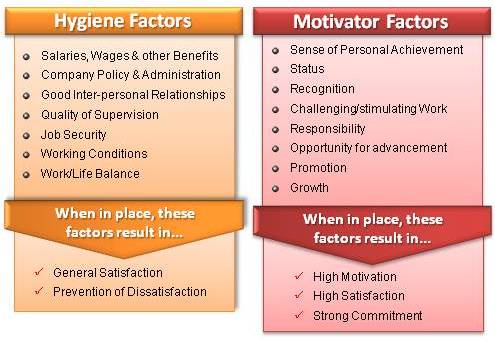
A major work in the field of employee motivation is done by Frederick Hertzberg (1964) that includes Two-factor Theory among other works of the author. According to the Two-Factor Theory a distinction has to be made in the workplaces between motivators and hygeine factors. Motivators cause the employees to enhance the level of their performance and effectiveness in the workplace and include career growth, responsibility, achievement etc. Hygeine factors, on the other hand, are essential in the workplaces in order for the employees not to be dissatisfied, at the same time, when these factors do not cause satisfaction. Hygiene factors include job security, financial compensation, the quality of management etc., whereas motivator factors are recognition of contribution by management, personal and professional growth opportunities, status associated with the position etc. It is important for managers to be able to make clear distinction between motivators and hygiene factors. This is because while the provision of hygiene factors may lead to greater level of employee satisfaction, it does not necessarily contribute to the level of employee motivation. Therefore, apart from ensuring the provision of hygiene factors in an effective manner, managers need to invest in motivational factors as well.

Regardless of its industry, size or other variables, firm’s marketing strategy needs to be aligned with the overall corporate strategy in order for the firm to be able to grow in long-term perspective. To put it simply, rather than being independent of corporate strategy, strategic marketing needs to be able to contribute to the achievement of strategic objective an en efficient manner. It has been stated that “because the link between marketing strategy and shareholder value has not been made, boards have tended to look at two other more transparent strategies. One has been cost reduction – sometimes disguised by more appealing names such as reengineering, downsizing or right sizing. …The other common remedy has been acquisition” (Doyle, 2008, p.19). References Doyle, P.(2008) “Value-Based Marketing” 2nd edition, John Wiley

Relationship marketing can be defined as attracting, maintaining and enhancing customer relationships and its importance is increasing with the intensifying level of competition for all industries. Rossiter and Percy (1998, p.55) offer the definition of relationship marketing as the maximisation of long-term gain for the consumer, as well as, manufacturer. The essence of relationship marketing is related to building long-term relationships with customers instead of conducting one-time transactions with customers. The objectives of relationship marketing are “to identify and establish, maintain and enhance, and, when necessary, terminate relationships with customers and other stakeholders at a profit so that the objectives of all parties involved are met” (Brink and Berndt, 2009). References Brink, A. & Berndt, A. (2009) “Relationship Marketing and Customer Relationship Management” Juta Publications Rossiter, JR & Percy, L, 1998, Advertising Communications and Promotion Management, 2nd ed., Boston, McGraw-Hill.

Introducing change and improvements regularly in various business processes has become one of the basic conditions of survival in a competitive global marketplace of today. However, even when the importance and necessity of change is understood by many its implementation in practice is associated with a set of substantial challenges caused by a range of reasons such as loss of power, fear of unknown, job security, economic factors etc. (Zimmerman, 2011). This article analyses and evaluates diversification strategies implemented in Ford Motor Company by its President and Chief Executive Officer (CEO) Alan Mulally. Ford Motor Company is global auto manufacturer that employs about 164,000 members of workforce in about 70 plants worldwide (Annual Report, 2011). The article covers three main themes: main drivers of change in Ford, key changes introduced by Alan Mulally, and an analysis of change management style of Alan Mulally. Main Drivers of Change in Ford Motor Company By 2006 when Alan Mulally was appointed Ford President and CEO there were a set of stark drivers of change. Specifically, at the time among other issues “Fords major problems was consensus management in the process of designing automobiles” (Herbold, 2011). For example, Ford Fusion sedan introduced in the same year was not equipped with navigation and side air bags, despite the fact that most of the competitor cars of the same class were equipped with such accessories. Analysis conducted by Mulally has identified that the main reason behind such a practice was high level of involvement of finance department over the design and functionality of cars (Fuller, 2011). In other words, in order to bring down the costs of manufacturing, finance department have been asking engineers and designers to be engaging in excessive cost saving when designing cars and equipping them with technological gadgets and functionalities.…