

Specific features need to be present within teams in order for the team to be able to achieve its objectives efficiently. ‘Integrated Model for Team Effectiveness’ framework proposed by Reis and Geller (2010) can be used in order to explore this issue with sufficient level of depth. The framework specifies eight most important features of effective teams in the following manner: Purpose. Effective teams understand, share and value team’s objectives Strategy. The ways of achieving team objectives are clear to each team member Team roles. The existence of all needed roles such as shaper, specialist, critic has been ensured within the team Work processes. Efficient operating procedures are put in place that effectively contribute to the achievement of team objectives Team processes. There is a great level of respect, understanding and trust amongst team members. Engagement. High level of team engagement is achieved through effective utilisation of motivational tools Feedback and metrics. Objective and timely information is communicated to team members regarding the team performance and their individual performances Stakeholders. Appropriate level of interaction between the team and key stakeholders is maintained. It is important to note that all team members do not need to possess the same set of personal traits, skills and competencies, rather variety within the team is welcomed to an extent that it produces a balanced outcome that would allow the achievement of team objectives efficiently. Nevertheless, there is a common set of skills and competencies to be possessed by each member of team regardless their role and function within the team. First of all, each team member needs to possess effective communication skills in order to be able to formulate their viewpoint in an appropriate manner, an adequate level of cross-cultural knowledge is also important for team members taking into account increasing forces of…

Different roles needed for the team can be explained through Belbin’s Team Roles Theory. Specifically Belbin (1993) divides roles within teams into the following nine categories: Plant is the one who is creative and can propose effective solutions to complex issues. However, this role may be associated with certain weaknesses such as such us ignoring incidents and remaining excessively preoccupied to focus on other important issues Resource investigators are the type of individuals who are extraverts with good communication skills, and thus it is easy for them to make contacts. However, these individuals need to be monitored due to their over-optimism, and tendency to lose interest and enthusiasm. Co-ordinators are confident and mature decision-makers who are good at delegation. Specific measures need to be provisioned so that co-ordinators are not perceived as manipulators. Shapers in teams are dynamic individuals who perform well under pressure. However, shapers need to be dealt with care due to their proneness to provocation and they also may offend the feelings of other people. Monitor/evaluators are valuable team members due to their strategic and detailed approach to issues. But this category of team members may not may great leaders because of the lack of drive and difficulties associated with inspiring others. Team-workers as co-operative and responsive employees make invaluable contribution to the achievement of team objectives. However, it has to be remembered that leaving team-workers alone in crisis or near crisis situations may result in negative consequences. Implementers are the ones who are highly efficient due to their discipline and reliability. Nevertheless, their occasional inflexibility and lack of speed in embracing new opportunities have to be compensated for by other team members Completer/finisher team members are needed to provide ‘final touch’ to projects and ensure their timely delivery. However, these types of employees have a set…
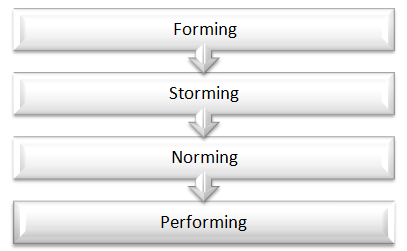
It has to be understood that successful performance of a team can be achieved only after a specific period of time required for the group members to get to know and accustomed to each-others personalities working styles etc. Tuckman Theory for developing teams offers an effective explanation of this matter in the following manner: Different stages of Tuckman Theory for developing teams During the forming stage team members are introduced to each-other and team aims and objectives are communicated to them. This is followed by the storming stage that can be described as “the time when team members begin to realise that the task is different or more difficult than they have imagined” (Hass, 2011, p.62), and interpersonal conflicts may arise in the team, therefore this stage can be specified as the most challenging part of the team formation process. The norming stage relates to time when formal and informal roles and responsibilities have been set and agreed within the team and the actual team performing process has commenced. Performing stage, as the most desirable stage from management viewpoint involves team members feeling positive and excited about the teamwork. Some teams also face adjourning stage, implying the end of the teamwork.

Note: the following post is from 2012. You can access the latest Hilton Worldwide Holdings Inc. Report published in August 2016 here. Hilton Hotels & Resorts is global hotels and resorts company with more than 540 locations in 78 countries (A Room for You, 2012, online). The parent company, Hilton International comprises a range of famous brands such as Waldorf Astoria Hotels & Resorts, Conrad Hotels & Resorts, Doubletree, Embassy Suites Hotels, Hilton Garden Inn, Hampton Inn, Homewood Suites by Hilton, Home2 Suites by Hilton, and Hilton Grand Vacations (Our Brands, 2012, online) Position of Hilton Hotels & Resorts within Travel and Tourism Industry in the UK Travel and tourism industry in the UK represents one of the key sectors in the national economy and according the research conducted by Oxford Economics “travel and tourism’s total contribution to GDP in the UK was GBP 101 billion in 2011 or 6.7% of total GDP” (The World Travel & Tourism Council, 2012, online) The following figure represents the structure of the UK tourism industry, and within this structure Hilton belongs to accommodation category. Moreover, the UK is the second biggest market for Hilton Hotels & Resorts after the US, and thus the UK market represents a point of focus for Hilton strategic level management. Hilton Hotels Main Stakeholders and Their Interests Stakeholders of company’s including Hilton Hotels & Resorts can be divided into two categories: internal and external. Internal stakeholders represent parties that belong to Hilton such as shareholders and employees. The primary interests of shareholders are profit maximisation, whereas employee interests include gaining a wide range of tangible and intangible compensation from their employment. External stakeholders, on the other hand, are parties that do not belong to Hilton; nevertheless they have interest in the business from various perspectives. The…
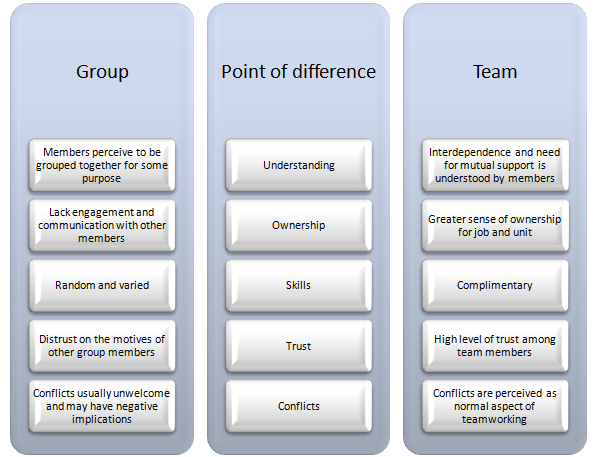
It is important to stress that “the group definition describes the individuals within it as having a common interest, while the team definition describes the members within it as striving for a common goal” (Carter, 2009, p.4). Moreover, there is an individual accountability for group members, whereas the level of accountability for team members can be individual, as well as, mutual. Also, groups and teams differ in terms of creativity in a way that in groups creativity may be suppressed due to distrust and lack of communication amongst group members, while in effective teams high level of creativity is achieved through synergy and communication (Schermerhorn, 2011). The following figure illustrates the main points of differences between teams and groups: References Carter, M. (2009) “Unique Team Enhancement: All About Team Building and How to Build a Great Team” Dorrance Publishing Schermerhorn, J.R. Jr. (2011) “Introduction to Management” 11th edition, John Wiley & Sons
Team building blocks can be explained as foundations for effective teambuilding. The following most essential team building blocks are going to contribute to the success of HSBC customer service team: Appropriate leadership. Effective leadership practices are in place in HSBC derived from strong leadership of HSBC Group CEO Stuart Gulliver. Clear goals and objectives. Team goals and objectives to be developed according to SMART principle, the abbreviation standing for specific, measurable, achievable, realistic, and time-bound (Courtis et al., 2006) is going to contribute to successful team operations. Effective operating procedures. The latest IT facilities have been integrated within HSBC customer services and these make team operating procedures more convenient. Developing individuals. The issues of developing individuals are approached effectively by HSBC management with specifically designed ‘learning pods’ within some branches and a range of relevant programs available. Openness and confrontation. HSBC organisational culture is associated with openness to new ideas and viewpoints (O’Donnell and Boyle, 2008) and this may have positive contribution on new customer services team performance. Regular review. Regular individual performance appraisals and group performance reviews conducted at HSBC is going to serve as one of the important customer services team building blocks References Courtis, J., Ratcliffe, E.B. & Allsop, D. (2006) “The Bluffer’s Guide to Management”, Oval Projects O’Donnell, O. & Boyle, R. (2008) “Understanding and Managing Organisational Culture” CPMR Discussion Paper
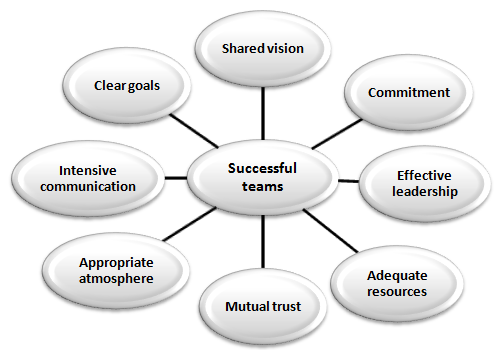
Important features of successful teams can be specified as effective leadership, availability of resources, mutual trust, appropriate atmosphere, intensive communication, and clear goals (Marr, 2009). The following diagram illustrates the most common features and characteristics present in successful teams. References Marr, B. (2009) “Managing and Delivering Performance”, Butterworth-Heinemann
The importance of teamwork can be explained in a way that it “builds morale and actually results in getting more accomplished with the resources you have because the team members develop ownership of the solution to a problem and want make it work” (Lindh et al., 2009, p. 1011). According to Badaki (2007, p.192) as taken from Webster’s Collegiate Dictionary teamwork can be defined as “work done by several associates with each doing a part but all subordinating personal prominence to the efficiency of the whole”. Business Dictionary (online, 2012), on the other hand, defines teamwork as “the process of working collaboratively with a group of people in order to achieve a goal”. References Badaki, F. (2007) “Team Art: The Science of Success in the Primary Human Organisations” Azuri Editions Lindh, W.Q., Pooler, M., Tamparo, C. & Dahl., B.M. (2009) “Delmar’s Clinical Medical Assisting” Cengage Learning Teamwork (2012) Business Dictionary, Available at: http://www.businessdictionary.com/definition/teamwork.html

A team can be defined as “group of people who work together to achieve a common goal or objective, who produce high-quality results, and who enjoy doing so” (Lewis, 2004, p.66). An alternative, more comprehensive definition of the term has been proposed by Halverson and Tirmizi (2008, p.4) as taken from Bailey and Cohen (1997, p.241) as “a collection of individuals who are independent in their tasks, who share responsibility for outcomes, who see themselves and are seen by others as an intact social entity, embedded in one or more social systems and who manage their relationships across organisational boundaries”. Winning team members believe their goal is relevant, possible, and worthy of effort and sacrifice” (Miller, 2009, p.60). Teams have become the main units to rely on to achieve organisation’s aims and objectives in today’s workplaces. In order for a team-work based project to be successful it is important that various talents and skills are gathered and good working atmosphere is created for them, taking into account the fact that different kind of motivation is required for each role and providing the relevant kind of motivation (Shermon, 2004). Sharma (2009) mentions team life cycle to consist of the following stages: forming, storming, norming, performing, adjourning. Roles and Relevant Skills that are Important for the Team There are different roles to be played within the teams in order for the teamwork to be a successful one. Belbin (1981) distinguishes ‘plant’, monitor evaluator, co-ordinators, resource investigator, implementers, completer finishers, team-workers, shapers, and ‘specialists’. There are also other classification offered by other researchers as well, however, Belbin’s work is considered to be the most comprehensive in that aspect. Each of above characters should be present within a team for the team to function in an efficient manner. However, if looked at individually the personalities…

To meet the high expectations of on-time delivery while keeping the delivery costs low, e-grocers need to use fairly advanced optimization techniques and information technology systems. With every grocery retailer there is a flow of finished goods from its suppliers, then from the company to its customers. Grocery retailers also exchange and receive information which provides valuable data for the system. These include feedback from the marketplace in the form of customers’ orders, customer reaction, and information on needs and wants; flows of information within the company that provide data in the form of inventory schedules, production schedules and so on as well as orders from the company to outside suppliers’. From a standpoint the whole company and the market in which it operates can be deemed as a series of linkages and relationships, and the efficiency in which the company operates can be seen to depend on how well these connections work. Having a system that works smoothly at minimum cost, would possibly allow for the company performance to be high. However this is not always the case in practice where it is common to find bottlenecks and poor integration between different parts of this system, leading to disappointing results. There are various methods and systems that can be implemented by retailers and over the past years the big supermarkets tried to adopt centralised models but where quick to abandon them in the past decade once they realised they would struggle with being efficient. This excludes Ocado which remains at the other end of the spectrum. ‘Ocado maintains that its centralised model will prove more efficient than the supermarkets’ store-picking approach once it achieves a critical mass’. The drawback is that Ocado might incur some difficulties if its tries to implement the hub and spoke system for the entire…