

Design can be explained as the process of giving something a deliberate aesthetic form. Design of mobile phones is one of its primary success factors. Key features of a mobile phone design elements may relate to physical design of the handset, user input, mobile context, usability of the devise, design of content and others. Portability marks one of the most important features of design elements of mobile phones. Finding an effective balance between portability and usability is one of the most challenging tasks for modern mobile handset designers. On one hand, customers expect conveniently usable keyboards and wide screen sizes from modern mobile phones so that the device can be used with no or minimum strain eyes. On the other hand, designing large keyboards and enlarging screen sizes in a mobile phone can only be achieved by enlarging the physical size of the devise with negative implications on its portability. Therefore, designers of mobile phones need to find an effective balance between usability and portability. Generally, The design process of a mobile phone may include the following stages: 1. Design brief. This initial stage in mobile phone design process involves the formulation of initial ideas for the design. Initial ideas for the design may be obtained from customer feedback of the previous models or changes in the marketplace associated with innovation or breakthrough. 2. Product design specifications stage relates to the market research and analysis of the problem. During this stage data related to customer needs and wants in relation to mobile phone designs are going to be collected and analysed. 3. Concept design is a stage in design process where outlines of key features of the design are developed. For a mobile phone concept design may include specification of the size of the screen, size and form of buttons,…

The primary, traditional benefit of mobile phones can be specified as being able to engage in conversation with other people. However, benefits offered by mobile phones have been extended mainly during the past two decades to include communication through texting, recreation through games, taking pictures and videos, browsing internet etc. The primary benefits of mobile phones that relates to serving as a communication platform, has traditionally facilitated the communication through phone calls and text messaging. However, thanks to the internet browsing capabilities in modern mobile phones, communication can also be facilitated through e-mails, chats and video calls. Increasing levels of capabilities of advanced mobile phones in terms of taking pictures and videos are causing mobile phones to impose direct competitions to manufacturers of cameras and camcorders. This fact can be pointed to as another substantial benefit of mobile phones. Moreover, internet browsing capabilities of mobile phones have substantially increased the range of their benefits to offer the possibilities of shopping, reading news, listening to music and watching films online, working with spreadsheets, and even serving as a wallet to purchase products and services offline. To summarise the point, mobile phones have become an integral part of daily life for most people to such as extent that they cannot imagine their life without this product. Mobile Phone Value to Customers Value proposition of mobile phones to customers are significant and this value is associated with serving as an effective communication tool through several mediums such as phone calls, text messages, e-mails and video calls, recreation, making purchases, working etc. It is important for mobile phone manufacturers to be able to distinguish between customer wants and needs in order to be able to achieve long-term growth. Customer need is associated with specific functional or emotional benefit or the product that customer…

This report has been written for Managing Director of a business organisation and the report illustrates company e-business strategy sample. The report has been written because although the current website of the company has some e-commerce facilities its contribution to the level of revenues is significantly below from its full potential. The report discusses specific elements and issues of e-business strategy such as intranets and extranets, security and legal issues facing an online business organisation, and role of search engine in e-business strategy. Moreover, the report contains explanations of potential impact of a well-designed website on an e-business entity. The 21st century is being rightly classified as the age of information and Internet and innovations in information technology (IT) play increasingly great role in processional and even personal lives of many people. Moreover, internet offers unprecedented opportunities for business organizations. 1. Introduction 1 2. The role of intranets and extranets in business communication 1 3. Security and legal issues facing an online business organisation 2 4. Role of search engines in e-business strategy 3 5. Impact of well-designed website on an e-business 4 6. Conclusions 6 References 8 Amazon Bing Facebook Google Next Tesco Twitter Yahoo How do I receive the report? Once payment is made you will receive a link to you e-mail you have registered with on Pay Pal or the e-email you have entered when specifying bank details to download the report. The report is downloaded in PDF format. The link will stay active for 7 days. How can I use the report to complete my academic assignment/research? Reports and essays offered by research-methodology.net are professionally written samples in their respective areas. Reports and essays are intended to be used as guides and sources of secondary data for reference purposes. I did not receive the link/I can…

Personal Development Plan (PDP) “is a document completed by an individual that details their intentions and actions with regard to their own development” (Cunningham et al., 2004, p.129). My personal development plan associated with the achievement of my career goals is represented in the following table: Plan Actions Time/Deadline Increasing the level of cross-cultural awareness Attending cross-cultural awareness training session December 2014 Learning from real-life special events Attending special events of various types and critically analysing the effectiveness of organisation and management Every month until June 2016 To remain updated with the latest trends and news in events industry To subscribe to “Special Events” magazine and to be reading each issue Every month To be increasing the level of knowledge about theoretical aspects of event management Reading relevant academic literature Every month To be improving personal leadership skills Attending ‘Essentials of Leadership’ 5-day program offered by London Business School July 2014 To be enhancing the level of personal creativity Attending ‘Creativity and Innovation’ 2-day course offered by Impact Factory September 2014 To be improving personal time management skills Attending ‘Time Management’ 1-day training course offered by Activia Training November 2014 To find a personal coach among accomplished event managers Studying the personalities of successful event managers, and initiating a contact with a highly experienced event manager January 2015 It is important to note that personal development needs to be perceived as a continuous process throughout the whole duration of career rather than being accepted as a one-time or occasional initiative. Accordingly, all aspects of personal development plan provided in table above such as increasing the level of cross-cultural awareness, learning from real-life special events, remaining updated with the latest trends and news in events industry, and to be improving personal leadership skills are going to be invested in for the…
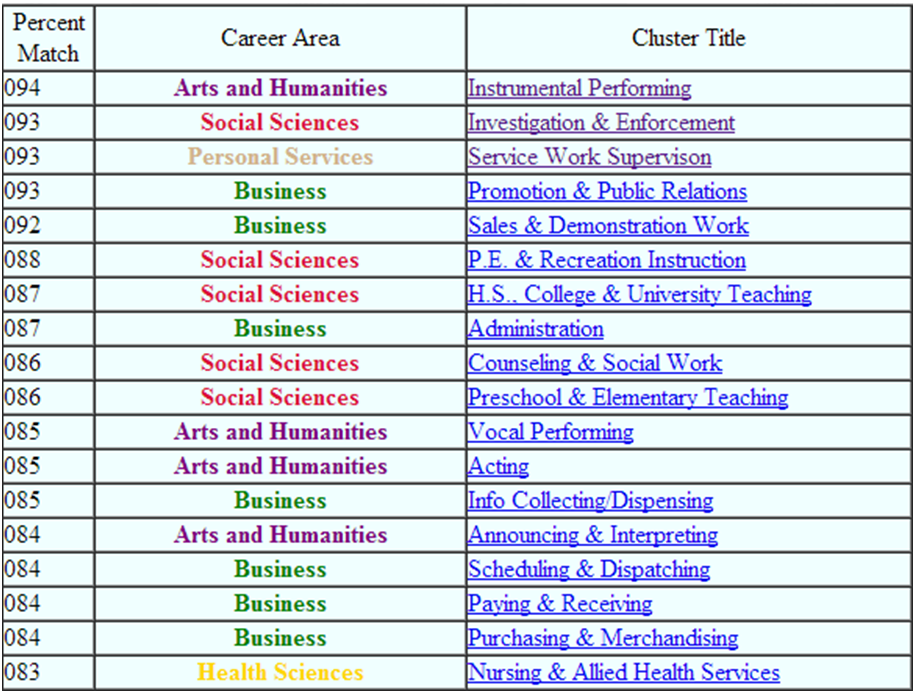
My self-assessment has been completed with the application of Careerlink Inventory, an online skills and interests inventory. This software provides an assessment of five different aspects of individual personality and suggests relevant career recommendations. Specifically, personality aspects assessed consist of aptitudes, interests, temperaments, and physical capacities and working conditions (Careerlink Inventory, 2014, online). The advantages of Careerlink Inventory include practical assistance in making educational and career choices through finding an appropriate match to personal aptitudes, interests, temperaments, and physical capacities. Answers given to Careerlink Inventory multiple choice test questions are analysed by the software and the level of match between responses and a wide range of career areas are represented in percentages. The following table illustrates percentage matches between my skills and interests and a range of career areas and cluster titles according to Careerlink Inventory self-assessment results. Careerlink Inventory self-assessment results Results of Careerlink Inventory self-assessment indicate that there is a 94% match between my skills and interests and Arts and Humanities career area. Report provided by Careerlink Inventory states that this specific career area is closely associated with entertaining audiences and a high level of creativity. Importantly, the same points equally relate to successful event management as well, and from this perspective Careerlink Inventory finds event management as a suitable career choice for me. Moreover, Careerlink Inventory self-assessment has found 93% match between my skills and interests and Social Sciences career area. It is clarified in self-assessment results report that Social Sciences involve serving the public interests in a wide range of manners. In other words, my skills and interests are best applied in serving the interests of public, and this can be done through dealing with various aspects of event management in a successful manner. There is also 93% match between my skills and interests and Personal…

It has been noted that “research is a term used literally for any kind of investigation that is intended to uncover interesting or new facts” (Walliman and Walliman, 2011, p.1). The career research process I have used is the one proposed by Morgan (2010) and it consists of the following stages: 1. Assessment. The research process commences with assessment of personal skills and knowledge, as well as, passion in order to be able to identify genuine career aspirations. Specifically, my hobbies and spheres that attracted my interest the most have been deeply analysed during this initial stage of career research process. 2. Collecting Information. Both, primary and secondary data sources have been used to collect the relevant information during the second stage of career research process. Secondary sources of data used in research process comprise industry analyses, industry magazines and newspapers, and a range of books devoted to career management. Primary data sources used during the career research, on the other hand, include individuals already employed in the industry. 3. Presentation. This stage includes improvement of the verbal pitch, and development of a personal marketing plan as a prospective employee. A high level of importance of developing a personal marketing plan can be explained by increasing level of competition in the job marker for graduates with little or no formal job experiences. 4. Project management. Achievement of career objectives is approached as a project management with identification of short-term and long-term goals and organising regular reviews. 5. Interview preparation. Performances in interviews play a great role in the achievement of career objectives, and accordingly interview preparation is identified as a strategic stage in career progression. 6. Project update. This stage in career research process involves career progression monitoring conducted in a regular basis, and strategy modification if necessary. References Morgan, H. (2010) “The…

A wide range of factors have impact upon a brand than a business strategy and generally these factors can be divided into two categories: internal and external. Internal factors affecting brand include business strategy, internal conventions, brand legacy marketing mix and marketing implementation. External factors, on the other hand, include, but not limited to category, cultural, and needs conventions. Crossan and Apaydin (2010) confirm this viewpoint and specify core elements of the brand as expression, perception, and recognition that are subjected to the impact of internal and external factors specified above. Moreover, Fog et al. (2010) argue that regardless of industry and nature of the business brands cannot exist independent of the company, its organisational culture, suppliers, distributors and buyers, at the same time specifying these elements as factors affecting branding aspect of the business. It has been argued that “it can be easier to establish a new brand if there is a history of product or service experience which has already earned trust and credibility” (Davis and Baldwin, 2006, p.29). However, Alessandri (2009) offers an alternative viewpoint claiming that the level of effectiveness of branding strategy depends upon the quality of brand identity, the choice and the level of implementation of communication channels to promote the brand, and the quality of products and services above all. The personality of CEO of the company is considered to be another major factor affecting brands and branding initiatives by Fioroni and Titterton (2009). Moreover, the issues of brand personification have been explained by Fioroni and Titterton (2009) by referring to the example of Virgin Group, where it’s CEO Richard Branson has successfully established himself as a core of the brand. A wide range of secondary data authors share their viewpoints in terms of improving brand image and value in a global scale.…

The process of brand development can be divided into four stages. The first stage involves analysing the current situation. The purpose of this stage relates to the identification of gap in customer satisfaction with specific ranges of products and/or services. The second stage of brand development process relates to the formulation of a brand vision. Specifically brand vision is developed in a way that it is directly associated with eliminating gap in customer satisfaction with great level of effectiveness. The third stage is the combination of strategy and creativity. Regarding this particular stage it has been stated that “strategy alone would not succeed; it must be accompanied by a creative identity that engages the senses appropriately, and enough publicity and advertising to arose demand for the brand” (Healey, 2008, p.16). The fourth stage involves analysing the outcome and introducing necessary changes. By the time this stage is reached firms would have results of the level of acceptance of brand by the firm target customer segment. Accordingly, necessary modifications can be introduced to brand strategy in order to eliminate shortcomings that have been identified. References Healey, M. (2008) “What is Branding?” Rockport Publishers

Ingredient branding, as the name implies “is strategic brand management for materials, components, parts, services, etc” (Kotler and Pfoersch, 2010, p.17). Pride et al. (2011) credit the global microprocessor company Intel for the development of the term of ingredient branding. Namely, the introduction of “Intel Inside” program in 1991 was initiated with the main purpose of marking Intel microprocessors from the products of its competitors and build an effective consumer brand. It has been stated that “an ingredient branding strategy pulls demand from end users through the distribution channel back to the original equipment manufacturers, who feel pressure to use the branded ingredients in the goods they make” (Mohr et al., 2009, p.415). At the same time, some respected marketing scholars argue that “ingredient Branding can start in a later stage of a product life cycle” (Kotler and Pfoersch, 2010, p.19). Moreover, Kotler and Pfoersch (2010) specify general targets of ingredient branding in the following manner: General Targets of Ingredient Branding Source: Kotler and Pfoersch (2010) The issue of relationship between brand role and distributors’ own-brands’ market share has been addressed by Kapferer (2012) who identifies individual functions of branding and their consumer benefits in the following manner: Function Consumer benefit Identification To be clearly seen, to quickly identify the sought-after products, to structure the shelf perception Practicality To allow savings of time and energy through identical repurchasing and loyalty Guarantee To be sure of finding the same quality no matter where or when you buy the product or service Optimisation To be sure of buying the best product in its category, the best performer for a particular purpose Badge To have confirmation of your self-image or the social image that you represent to others Continuity Satisfaction created by a relationship of familiarity and intimacy with the brand that you…

Four main components of branding can be specified as positioning, storytelling, design, price, and customer relationships and each of these components are discussed further below in a greater detail. 1. Positioning Positioning means “defining in the mind of a customer what a brand stands for and how it compares with competing brands” (Healey, 2008, p.8). The origin of the concept of brand positioning can be linked to the idea that consumers form particular opinion regarding each brand they encounter and by engaging in brand positioning companies attempt to influence this opinion in a favourable manner. Brand positioning can be divided into four different components. The first component relates to the class of the product of service, as well as, to the structure of the relevant marketplace. The second component of brand positioning involves segmentation of consumers. Consumer perception in relation to the brand compared to the competitors forms the third component of brand positioning. Final, the fourth component of brand positioning relates to the benefits associated with purchasing products and services of the brand. 2. Storytelling It has been stated that in branding through storytelling “the story is what drives the bond between the company and the consumer” (Fog et al., 2010, p.23). Four elements of storytelling as part of branding can be specified as message, conflict, character and plot. All of these four elements should be present in a branding strategy in order to in order for the strategy to be successful. In order to implement storytelling with an increased level of efficiency companies must communicate the same story to organisational stakeholders through an effective integration of various marketing communication channels. 3. Design It has been argued that “design, in all its varieties, has the potential to bring brands to life in a way that can…