
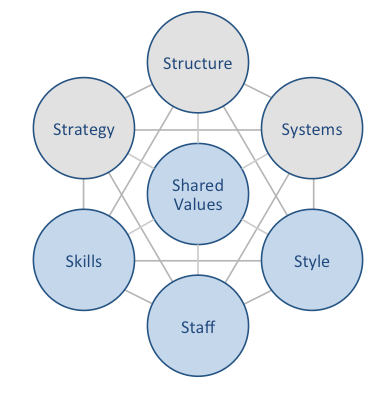
Samsung McKinsey 7S model attempts to explain how seven individual elements of the business can be aligned to increase effectiveness. According to this model strategy, structure and systems represent hard elements, whereas shared values, skills, style and staff are soft elements. McKinsey 7S model argues that there are strong links between elements in a way that a change in one element causes changes in others. As it is illustrated in figure below, shared values are positioned at the core of Samsung McKinsey 7S model, since shared values guide employee behaviour with implications in their performance. Samsung McKinsey 7S model Hard Elements Strategy. Samsung business strategy is mainly based on market readership, i.e. replicating innovations made by market leaders in terms of introducing new products and/or adding innovative features to new products. Samsung’s major competitor, Apple can be specified as company Samsung mainly replicates from. Moreover, Samsung business strategy is based upon scanning and utilising opportunities in the market and new product development on a regular basis. Structure. Samsung organizational structure is divisional and the company is divided into three divisions on the basis of products: IT & Mobile Communications (IM), Consumer Electronics (CE), and Device Solutions (DS). Each division is managed separately according to unique aspects and characteristics of its products. As the outcome of review of optimal organizational structure completed on April 2017, the senior management decided not to shift to holding pattern of organizational structure. Nevertheless, Samsung organizational structure may change in medium term perspective. This is due to a series of scandals the company had to deal with recently, including the imprisonment of Jay Y. Lee, a former Samsung executive and founding family member for his role in bribery and embezzlement. Systems. Samsung’s long-term growth prospects depend on smooth running of a wide range of systems. These…

Facebook McKinsey 7S framework illustrates how seven individual elements of businesses can be aligned to increase effectiveness. According to McKinsey 7S model, structure and systems represent hard elements, whereas shared values, skills, style and staff are soft elements. The framework stresses the presence of strong links between elements in a way that a change in one element causes changes in others. As it is illustrated in figure below, shared values are positioned at the core of Facebook McKinsey 7S framework, since shared values guide employee behaviour with implications in their performance. Facebook McKinsey 7S Framework Hard Elements Strategy. Facebook follows cost leadership business strategy with a particular focus on user experience. According to its mantra “1% is finished”, the social media company develops new products and services and improves its current range of products and services in a continuous manner. Additionally, important elements of Facebook Inc. business strategy include growth via acquisitions and continuous exploration of new ways of site monetization with positive implications for the bottom line. Structure. Facebook Inc. has a hybrid organizational structure that integrates important elements of hierarchical and divisional organizational structures. Elements of hierarchical structure are expressed via presence of multiple levels of management in the company, whereas elements of divisional or matrix organisational structure are evident on the formation of product-based teams on the global scale. The founder, Chairman of the Board and CEO Mark Zuckerberg is the main driving force and the ultimate operational and strategic decision maker in the company. Systems. Facebook Inc. business operations rely on a wide range of organizational systems. The ranges of systems that are the most critical for the social media company include HR system, information system, security system and others. Security system in particular is a critical success factor and it relates to both, company’s own security, as…
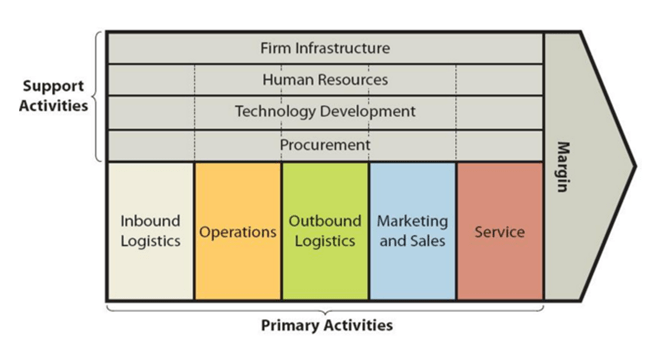
Value chain analysis is a strategic analytical tool that can be applied to analyse business activities to be able to identify those activities that contribute most the overall competitive advantage of the business. Facebook value chain analysis provided below discusses sources of competitive advantage of the social media company by referring to its primary and support business activities. Figure 1 below illustrates the essence of value chain analysis. Figure 1 Facebook Value Chain Analysis Primary Activities Inbound logistics Facebook Inc. inbound logistics refers to ways the company acquires resources and uses according to its needs. The range of resources used by the social media giant includes hardware, various types of technologies and office supplies. Generally, value chain analysis framework analyses the processes of receiving and storing raw materials until their transformation into the final goods. However, due to Facebook Inc.’s business model illustrated in Figure 6 below, tangible resources such as hardware and technology used by the company are only secondary in their nature and the primary resources used to attract the customers are intangible. Specifically, Facebook offers its customers unique intangible ‘products’ of informational nature, i.e. content. From this point of view, inbound logistics of content is highly cost-effective since the content is uploaded by users of in the forms of texts, pictures and videos without any additional costs for the business. Operations Facebook is available in more than 90 different languages, and the company has offices or data centres in more than 30 countries around the world. Moreover, there are five support offices and more than 35 sales offices located globally.[1] Approximately 84.5% of Facebook daily active users are outside the US and Canada.[2] As it is illustrated in Figure 2 below, Facebook operations mainly involve the transformation of raw content into user-friendly format via profile page, timeline,…
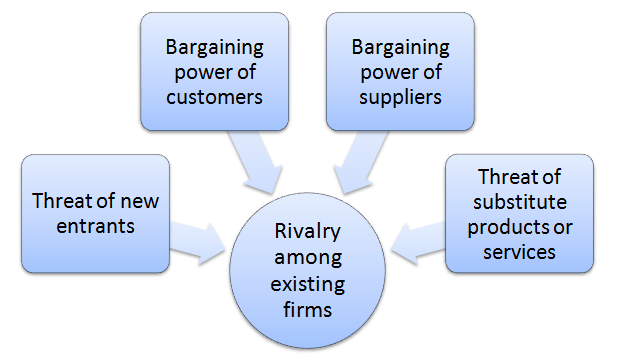
Facebook Inc. Porter’s Five Forces analytical framework assesses an overall extent of competition in the social media industry. Developed by Michael Porter (1979)[1] consists of five individual forces as illustrated in Figure 1 below: Figure 1. Facebook Inc. Porter’s Five Forces Rivalry among existing firms in social media industry is fierce. Alphabet Inc. (Google) is the most prominent competitor for Facebook and Google Adsense and Facebook Ads are two most popular competing platforms for online advertising. Generally, the major players in the industry include Facebook, You Tube, Reddit, Twitter, Instagram, Pinterest, Tumblr, LinkedIn, Yahoo! Answers, Yelp and others. As it is illustrated in Figure 2 below, Facebook is the most popular social networking website in the US with an approximate market share of 42.4 per cent. Most popular social networking websites in the USA (as of August 2016)[2] The rate of the industry growth is immense, diversity within the competition is vast with no switching costs for customers and this fact further intensifies the rivalry among existing market players. Moreover, “there are several regional social networks, such as Renren in China, Mixi in Japan, vKontakte in Russia, etc., and these compete with FB for users in their respective geographies. Increased regulation in certain markets such as China is more beneficial to regional players”.[3] Threat of new entrants into social media industry is significant. Although there are certain industry entry barriers such as capital requirements for marketing and expected retaliation from existing businesses, it is generally easy to built websites and mobile apps. New social media platforms based on innovative ideas and/or integrating innovative features can secure funding from investors to pose a threat to the market share of Facebook, Google+ and other established market players. Taking into account decreasing popularity of Facebook among teens,[4] it can be argued that a new social…
Below is Argos SWOT analysis template Strengths 1. Solid presence in the UK with more than 800 stores and about 10% market share in general merchandise retail segment 2. Ownership of a range of brand portfolio including Homebase, Elizabeth Duke, Alba, Bush, Chad Valley and others 3. Cost-effective business model pioneered by the company 4. Efficient cost-control measures in place Weaknesses 1. Brand image damaged due to a range of ethical scandals related to working on Sunday, pricing in Ireland and others 2. Overdependence on the UK market 3. An absence of clear target customer segment 4. High employee turnover due to low wages Opportunities 1. Greater utilization of online sales channel 2. Pursuing international market expansion strategy 3. Development of own-brand products 4. Finding and exploiting new sources of competitive advantage on the basis of technological innovations Threats 1. Engagement in price wars with other retail chains with negative implications on the bottom line 2. Negative implications on Brexit on the national economy 3. Decline of catalogue showroom business model 4. Decline in the quality of service due to the further pursuit of cost leadership How to use the Argos SWOT Analysis template above Expand each point above into one or more paragraphs with discussions and analysis. Additional points related to Argos strengths, weaknesses, opportunities and threats not listed above can also be included if you think they are relevant points and add value to the work. You will need to support your arguments with references from reliable sources such as annual report of the company, industry journals and magazines and government publications. Your discussions will need to include statistical data and preferably charts and graphs with references to the sources. You can also find many examples for the application of SWOT…
By John Dudovskiy
Category: Beauty & Fashion

Facebook Inc. segmentation, targeting and positioning comprises a set of activities directed at identifying specific groups among the population as potential customers (site users) and developing products and services according to the needs and wants of this specific group. Segmentation involves dividing population into groups according to certain characteristics, whereas targeting implies choosing specific groups identified as a result of segmentation to sell products to. Since its launch in 2004 as a social networking site exclusively for Harvard students, Facebook’s target customer segment has been consistently expanding. Nowadays, the social media giant targets a wide range of customers aged from 13 years old and older. Positioning refers to the selection of the marketing mix the most suitable for the target customer segment. Facebook uses multi-segment type of positioning and accordingly, it targets multiple customer segments at the same time with different social media platforms. For example, Facebook social media site targets individuals interested in a full range of social media services such as pages, news feed events etc., whereas Instagram targets customer segment who are interested exclusively on photo sharing. Facebook Inc. also uses adaptive positioning strategy across its brands, repositioning products and services according to changes in preferences of the target customer segment. The following table 2 illustrates Facebook segmentation, targeting and positioning: Type of segmentation Segmentation criteria Facebook Inc. target customer segment Facebook Messenger Instagram What’s Up Oculus Geographic Region International International International International International Density Urban & rural Urban & rural Urban & rural Urban & rural Urban Demographic Age 13 and upwards 13 and upwards 13 – 40 16 – 45 13 – 40 Gender Males & Females Males & Females Males & Females Males & Females Males & Females Life-cycle stage Bachelor Stage Newly Married Couples Full Nest I Full Nest II Full Nest…

Facebook Inc. marketing communication mix is associated with the integration of individual elements of marketing mix into the marketing strategy of the social media company. Elements of the marketing communication mix include print and media advertising, sales promotions, events and experiences, public relations, direct marketing and personal selling. Advertising Being a popular e-commerce company, Facebook Inc. also occasionally advertises itself via traditional media such as billboards and television. In the UK, the company has already invested more than GBP 6m in advertising through traditional media in 2015, compared to a meager GBP 16,000 spent by the company in the previous year.[1] Moreover, Facebook traditional media advertisements in the UK included major TV channels and The London Underground. Nevertheless, viral marketing remains to be the main advertising technique extensively utilized by Facebook. Recently, the company launched a massive ad campaign for Facebook Live, placing user videos at the core of the campaign.[2] The social media giant also runs its own advertisements on Facebook. Generally, For 2015, 2014, and 2013, advertising accounted for 95%, 92% and 89%, respectively, of the company’s revenue.[3] Sales Promotion The list of the most popular sales promotions techniques used by many businesses around the globe include money off coupons, competitions, discount vouchers, free gifts, point of sales materials, loyalty cards and others. Up to date, Facebook has not used any of these sales promotions techniques in order to increase the sales of its Facebook Ads. Instead, the social media company chooses to concentrate on increasing the level of customization of its advertising service reflecting the unique aspects of each business that wants to advertise on Facebook in terms of target customer segment, advertising budget, duration of advertisement campaign and others… Facebook Inc. Report contains more detailed discussion of Facebook Inc. marketing communication mix and marketing strategy.…
Below is Emirates Airlines SWOT analysis template Strengths 1. Substantial support from oil-rich Dubai government 2. Wide coverage of 72 countries in 6 continents 3. Highly positive brand image via exceptional customer services and sponsorships 4. Effective promotion of flight safety to pre-schoolers 5. Benefits from the economies of scale Weaknesses 1. Extensive reliance on international onward moving traffic 2. Highly intensive competition 3. Weaker presence in a strategic US market compared to other major international airlines 4. High costs of operations 5. Not catering for middle-class and budget customers Opportunities 1. International market expansion strategy – covering more international destinations 2. Development of a new segment for middle-class and budget travelers 3. Increasing the integration of IT into various aspects of service provision 4. Formation of strategic cooperation with other businesses in catering industry 5. Emergence of competitor vulnerabilities Threats 1. Decline of tourism to Dubai 2. Further increases in the costs of fuel 3. Changes in government rules and regulations that may put the airline in a disadvantaged position 4. Risk of terrorist attacks in the planes and airports 5. Risk of oil-related financial crisis How to use the Emirates Airlines SWOT template above Expand each point above into one or more paragraphs with discussions and analysis. Additional points related to Emirates Airlines strengths, weaknesses, opportunities and threats not listed above can also be included if you think they are relevant points and add value to the work. You will need to support your arguments with references from reliable sources such as annual report of the company, industry journals and magazines and government publications. Your discussions will need to include statistical data and preferably charts and graphs with references to the sources. You can also find many examples for the application of SWOT…
By John Dudovskiy
Category: Airline

Facebook Inc. 7Ps of marketing mix explains the role of seven important elements of the marketing mix in achieving the primary objective of the business, i.e. profit maximization. These seven elements are product, place, price, promotion, process, people and physical evidence. Product. Facebook Inc. product portfolio includes the following: Facebook. A website and mobile application that enables users to connect, share, discover, and communicate with each other on mobile devices and personal computers. Instagram. A mobile application that enables people to take photos or videos, customize them with filter effects, and share them with friends and followers in a photo feed or send them directly to friends. Messenger. A messaging application available for mobile and web on a variety of platforms and devices. WhatsApp. A fast, simple and reliable mobile messaging application that is used by people around the world and is available on a variety of mobile platforms. Oculus. Oculus virtual reality technology and content platform power products that allow people to enter a completely immersive and interactive environment to play games, consume content, and connect with others. Except Oculus virtual reality gears, all of the products offered by Facebook Inc. are intangible in nature and they are upgraded by the company in a regular basis and the use of Facebook products and services requires minimum IT skills. Place. Facebook Inc. is an e-commerce business without physical stores and physical customer service offices. An access to Facebook products and services are subject to the following three conditions: Access to a desktop computer, laptop, tablet or a smartphone Access to internet via desktop computer, laptop, tablet or a smartphone Being located in a country where Facebook is not banned. There are few countries such as China, Iran, and North Korea, where access to Facebook is restricted due to political reasons.…

PESTEL is a strategic analytical tool and the acronym stands for political, economic, social, technological, environmental and legal factors affecting business organizations. Facebook PESTEL analysis involves a critical analysis of the impact of these factors on the social networking website. Political Factors There is a wide range of political factors such as political stability in the region, the freedom of press, the state of human rights and others that affect Facebook revenues in direct and indirect ways. The social networking site is often used by millions of people as a platform to voice disagreement with government policies and corrupt practices all over the world. This has caused the restriction of the social networking site in a number of developing countries with human rights issues, where governments are afraid that people can use Facebook to spread information and unite for their cause. For example, access to Facebook has been or is currently restricted in whole or in part in China, Iran, and North Korea[1] for the same reasons. Moreover, along with being impacted by political factors, Facebook also has its own impact on the formation of political landscape in the US and elsewhere. “Ever since the so-called “Facebook election” of President Obama in 2008, the social media giant has been a political reference point for citizens, politicians and media alike”[2] In 2015, the social media giant established its own Political Action Committee as an attempt to strengthen its ties to Washington, D.C. and to be able to further influence the political climate in the US in its favour. Taking into account increasing popularity of Facebook and its increasing role as news source and communicated tool its influence and integration into political process in local, national and even international levels is expected to increase in the future. Economic Factors The implications of…