
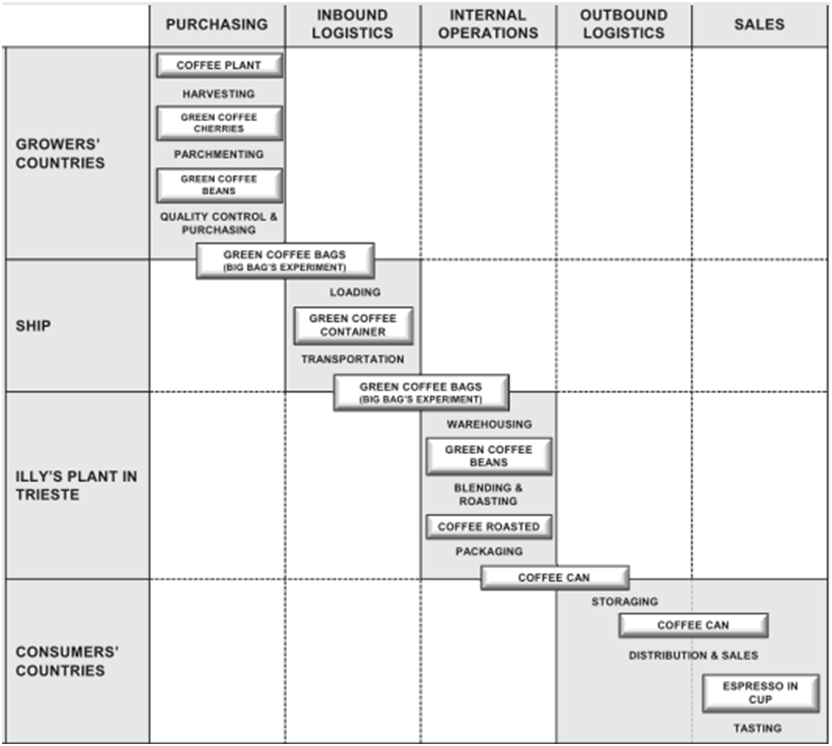
Illy is a global coffee brand that is sold in 140 countries and employs more than 800 people globally (Illy: By the Numbers, 2013). The main difference between traditional logistics and supply chain has been drawn by Agrawal and Smith (2009) in a way that supply chain is a much broader concept than logistics and it focuses on the quality of relationships between various elements within the supply chain with the aims of achieving improvements Elements of supply-chain management (SCM) have been specified by Wisner et al. (2008) as purchasing, operations, distribution, and integration. Wisner (2008) argues that effectiveness in one particular element does not compensate shortcomings in other elements, and thus businesses need to strive to strive to obtain competitive advantages each of these elements. Three major tendencies impacting SCM have been specified by (Muller, 2011). Firstly, increasing numbers of businesses are acquiring their resources from other countries. Secondly, timeframe associated with the delivery of resources and the quality of resources is playing increasing role for firms in terms of obtaining competitive advantage. Thirdly, rapid technological developments among a range of other factors are causing uncertainties in the market with direct implication on SCM practices Ruston et al. (2010) advocate the adoption of strategic approach in dealing with suppliers. This viewpoint has been supported by a wide range of other authors as well, and the benefits of adopting a strategic approach with suppliers have been listed as more effective quality control based on trust (Leeman, 2010) and achieving greater level of supplier cooperation in times of economic difficulties (Agrawal and Smith, 2009). Basu and Wright (2012) further expand this point and argue that adoption of strategic approach in dealing with suppliers based on ethical practices can have highly positive implications on business brand image if these relationships are communicated…

The nature of leadership in private sector organisations is directly impacted by the primary purpose of such organisations and this primary purpose is profit maximisation (DuBrin, 2012). This opinion is confirmed by Goldsmith et al. (2010), who perceive profit maximisation as the main assessment criteria for private sector organisational leaders. According to Gold et al. (2010) constant search for competitive advantage can be justly specified as one of the most fundamental characteristics of leadership in private sector organisations. According to this stance, competitive advantage can be derived from a wide range of sources and business processes, and it is the responsibility of a business leader to be able to formulate the most appropriate competitive advantage, and ensure its efficient utilisation. Stanfield (2009) explore the issues of ethics for modern business leaders and conclude that the level of ethical requirements have increased for business leaders in the last several decades contributed by increasing level of scrutiny business leaders are being subjected to. Stanfield (2009) offers justification for this claim by stating that increasing role of viral media in the society makes any evidence of unethical behaviour hard to escape from. Maintaining high level of flexibility and implementing changes in relation to various business processes in a constant manner is pointed to as a significant challenge to business leaders by Kezar et al. (2011) and Kreitner and Cassidy (2012). Moreover, Kezar et al. (2011) stress the role of assertiveness and communication skills for business leaders in order to be able to implement changes in an efficient manner. The issue of talent management by business leaders comprehensively addressed by Bertocci and Bertocci (2009) reveals another important aspect of successful leadership practice. Specifically, according to Bertocci and Bertocci (2009) human resources need to be perceived as the most valuable business asset in the 21st…

Major differences between public and private sector organisations have been specified and addressed by a range of management scholars. According to Wirick (2009) the main difference between public and private sector organisations relates to forms of ownership. Specifically, public sector organisations are owned and operated by government, whereas private sector organisations are not part of the government. The form of ownership as the main distinctive point between public and private sector organisations has also been mentioned by Kassel (2010), Sims (2010) and others. Linked to the point above, aims and objectives of organisations have also been specified by authors as a major point of difference between public and private sector organisations. Kassel (2010) and Starling (2010) assert that the primary objective of organisations operating in private sector is profit maximisation. Gallos (2008) advises not to be deluded by charitable acts of private sector organisations in regards to intentions and insists that all of these acts are aimed at supporting the primary objective of private sector organisations which is profit maximisation. The aims of public sector organisations, on the other hand, involve serving the interests of taxpayers through various manners according to the type of the organisation (Sims, 2010). For example, public schools aim to provide education to citizens within a country, whereas the objectives of public health organisations involve providing quality healthcare. Importantly, the source of funding of organisations represents another point of difference between public and private sector organisations (Sabatier, 2007). Namely, public sector organisations are funded by taxpayers; therefore serve the interest of taxpayers, while private sector organisations are funded by individuals and corporate investors aiming to make a profit. References Gallos, J.V. (2008) “Business Leadership: A Jossey-Bass Reader” 2nd edition, John Wiley & Sons Kassel, D.S. (2010) “Managing Public Sector Projects: A Strategic Framework for Success…

According to Grigoroudis and Siskos (2009) as taken by Oliver (1997) “satisfaction is the consumer’s fulfilment response. It is a judgement that a product or service feature, or the product or service itself, provided (or is providing) a pleasurable level of consumption-related fulfilment, including levels of under-or overfulfillment” (Grigoroudis and Siskos, 2009, p.4) The Business Dictionary (online, 2013) defines private sector as a part of national economy that consists of private enterprises including personal sector (households) and corporate sector (companies). The definition of the public sector is suggested by The Free Dictionary (2011) as “the part of an economy that consists of state-owned institutions, including nationalised industries and services provided by local authorities” (The Free Dictionary, online, 2011). Although the term ‘quality’ on its own is widely known and does not require further elaboration, some authors have offered their viewpoints regarding the definition of the term within the context of customer services. Specifically, it has been stated that, “quality of the delivered products or services is essential to achieving customer satisfaction. The quality concept embraces how to meet all customers’ requirements, including how they are greeted on the telephone or at the counter, the speed with which a query is responded, providing new services when required, and ensuring the delivered services satisfy the community needs” (Nagel, 2000, p.47). Introduction According to Grigoroudis and Siskos (2009) the advantages of private sector organisations over the public sector organisations include better level of the service, more information about various aspects of customer services, better management, market testing and rewarding performance. Secondary data authors (Murley, 1997) argue that a part of the issue of effective customer service provision within public sector relates to the identification of customers in public sector in the first place. Discussing police services specifically, the author reasons that “their customers…
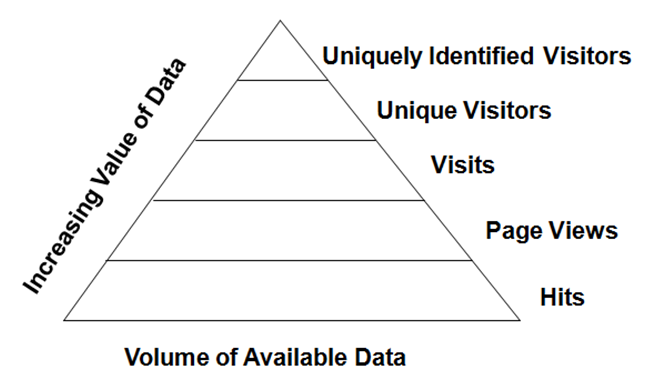
The Pyramid Model of Web Analytics Data associates the increasing value of data with filtering hits to the site towards uniquely identified visitors. According to the Pyramid Model of Web Analytics Data an e-commerce web-site gets certain amount of hits (visits) associated with a certain numbers of web site page views. This data is perceived to be the most basic information and the level of its value is highly compromised from an organisational viewpoint. Pyramid Model of Web Analytics Data Further in the line of increasing value of data come the actual visits to the site and the proportion of unique visitors within overall visits. This information can be used by e-commerce business management to assist in decision making. In Pyramid Model of Web Analytics information about uniquely identified visitors is considered to be the most valuable set of data. Data at this level may include geographical locations of uniquely identified visitors, landing and exit pages on the e-commerce website, the duration of time spent on each specific web page and other important aspects of consumer behaviour. From this perspective, the Pyramid Model of Web Analytics represents an effective model in terms of explaining the value of data provided by web analytics tools.

This article represents a brief analysis of diversification and expansion opportunities into Chinese market for a local restaurant and cafe in the UK. The article contains a brief overview of Chinese market, discusses market entry strategies available to the business, and discusses a range of most important factors impacting the business proposal. Overview of Chinese Market China is a newly emerging superpower, with the levels of GDP suppressing 72.1 trillion USD in 2011 (Statistical Yearbook, 2012) and the further increase has been forecasted with positive implications on the on the amounts of consumer spending. Currently, a set of multinational fast-food brands such as McDonald’s KFC, and Pizza Hut restaurants are increasing the level of their presence in an aggressive manner that can be interpreted as a signal for increasing level of demand in China towards foreign food and lifestyle. Market Entry Strategies Alternative market entry strategies the restaurant and café can employ in order to enter China consist of licensing, franchising, joint-ventures and wholly owned subsidiaries. Licensing involves local restaurants in China to trade under the license of the UK restaurant. This type of market entry offers the advantages of low risk and lower level of capital requirements. However, the disadvantages include limited scope of participation in operations, and lower potentials for generating significant revenues. Franchising is similar to licensing to a certain extent, but different in a way that it involves closer level of cooperation between the parties, and grants the right to a local business in China to use the logo and trademark of the restaurant in UK. Joint-ventures are another form of market entry available to the restaurant and café in the UK to enter China. The advantages of joint-ventures include shared risk and expenses, and gaining expertise in the local market. However, joint-ventures…

A critical path can be explained as “a series of tasks which, if delayed, would affect the completion date of the overall project” (Shelly and Rosenblatt, 2011, p.113). Critical path analysis is the path through the network with the greatest total duration. A project can have more than one critical path, if several paths tie for the greatest duration (Denvir, 2010). Network or critical path analysis is a technique used to help plan, run and monitor projects. This technique can be applied to any type of project. And a network consists of activities and events. The network shows the sequence of jobs that determine the shortest time to complete the project. It highlights the critical path or critical activities. These are the critical jobs or tasks in the project where any delay results in the whole project being delayed. In other words, these critical activities have no flexibility; they must start and finish on time in order for the project to be completed on time. A Simple Example Let’s suppose that a UK-based restaurant is aiming to enter Chinese market The following table illustrates activities that need to be undertaken in order to enter Chinese market. Activities Duration Dependency A) Dealing with legal issues 3 weeks – B) Renting buildings 4 weeks A C) Design of restaurants 4 weeks A, B D) Employee recruitment and selection 5 weeks – E) Setting up supply-chain management 6 weeks A F) Marketing initiatives 5 weeks C G) Training of employees 2 weeks C, D H) Opening the restaurant 1 week C,E, G The application of critical path analysis to these activities leads to the construction of the following figure: Critical path for the completion of the project would be the longest path in terms of time duration. Accordingly, as it can be…

Web analytics can be defined as “the analysis of qualitative and quantitative data from your website and the competition, to drive a continual improvement of the online experience that your customers, and potential customers have, which translates into your desired outcomes” (Kaushik, 2009, p.5). In simple terms, web analytics relates to assessment and analysis of internet data in order to understand the pattern of usage of a website. Starting from recently web analytics is also being referred to as data analytics to highlight the role of data and intelligence in analyses. Web analytics can be divided into two groups: onsite and offsite. Onsite web-analytics involve visitor and server data through page tagging, and other measures, whereas off-site web analytics relate to comments, site visibility, page view opportunities etc. References Kaushik, A. (2009) “Web Analytics 2.0: The Art of Online Accountability & Science of Customer Centricity” John Wiley & Sons
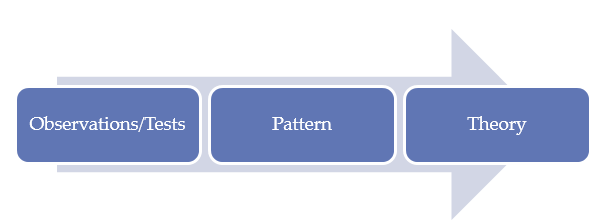
Inductive approach, also known in inductive reasoning, starts with the observations and theories are proposed towards the end of the research process as a result of observations[1]. Inductive research “involves the search for pattern from observation and the development of explanations – theories – for those patterns through series of hypotheses”[2]. No theories or hypotheses would apply in inductive studies at the beginning of the research and the researcher is free in terms of altering the direction for the study after the research process had commenced. On this page: • Types of inductive reasoning• Application of inductive approach in business research• Inductive vs deductive reasoning• When to use inductive approach The main differences between the two approaches are illustrated in the table below: Feature Inductive Approach Deductive Approach Starting point Observations and empirical data Existing theory Purpose Generate new theory Test existing theory Direction of reasoning Specific → general General → specific Research methods Often qualitative Often quantitative Outcome Development of concepts and theories Confirmation or rejection of hypotheses It is important to stress that inductive approach does not imply disregarding theories when formulating research questions and objectives. This approach aims to generate meanings from the data set collected in order to identify patterns and relationships to build a theory; however, inductive approach does not prevent the researcher from using existing theory to formulate the research question to be explored.[3] Inductive reasoning is based on learning from experience. Patterns, resemblances and regularities in experience (premises) are observed in order to reach conclusions (or to generate theory). Still unsure whether inductive approach is the right choice for your research? Get a clear, justified methodology for your research topic in minutes See how it works Types of Inductive Reasoining The following are the five main types of inductive…

The majority of authors do acknowledge that “there are almost as many different definitions of leadership as there are people who have tried to define it” (Northouse, 2010, p.2). Nevertheless, one of the most popular definitions of leadership has been proposed as “the influencing process of leaders and followers to achieve organisational objectives through change” (Lussier and Achua, 2010, p.6). More straightforward definition of leadership can be worded as “the ability to guide others, whether they are colleagues, peers, clients, or patients, toward desired outcomes” (Marshall, 2011, p.2). Leaders have been explained as “people who have a clear idea of what they want to achieve and why” (Doyle and Smith, 2009, p.1). The term of leadership can also be defined as an activity or the ability of leading people towards the achievement of a common goal (Gold et al., 2010). Leadership definitions are divided by Northouse (2010) into two categories: trait and process. The following figure illustrates the nature of the impact of leaders on followers according these two alternative categories of definitions: Trait and Process definitions of leadership Source: Northouse (2010) The definition of strategic leadership read as “behaviour that depends on combining perceptions of threats opportunities, cognitions, analyses, and risk preferences” (Bass and Bass, 2008, p.43). A related term, ‘charisma’ has been defined by The Free Dictionary (2012) as a rare personal quality attributed to leaders who arose fervent popular devotion and enthusiasm. Additional alternatives of leadership definition “the ability to inspire confidence in and support among the people who are needed to achieve organisational goals” (DuBrin, 2012, p.28). “the discipline of deliberately exerting special influence within a group to move it toward goals of beneficial permanence that fulfil the group’s real needs” (Haggai, 2009, p.20) “an influence relationship among leaders and followers who intend real changes…