
Hilton Hotels is a global flagship brand of Hilton Worldwide Holdings Inc.and it has 572 hotels and resorts in 85 countries and territories across six continents. Hilton Worldwide is the largest hotel company and the fastest growing hotel company in the world. Along with Hilton Hotels, a vast yet focused portfolio of Hilton Worldwide 13 brands in the premium hotels and resorts sector such as Waldorf Astoria, Conrad, Canopy, Curio, Double Tree, Embassy Suites and Hampton. Incorporated in 1919 by Conrad Hilton, currently, Hilton Worldwide owner base comprises 10,000 owners, of which 76% are repeat owners. The company has achieved Adj. ABITDA increase of 13 per cent in 2015 compared to the previous year. Importantly, the company converted 14,000 rooms from competitors’ brands and independent hotels during the same period. In 2015, the company earned the total revenues of about USD 11.2 billion, an increase of about 7 per cent compared to the previous year. In January 2016 Hilton Worldwide launched its latest brand Tru by Hilton which is intended to target mid-scale customer segment. Hilton Worldwide mission statement is formulated in the following manner: “To be the most hospitable company in the world – by creating heartfelt experiences for Guests, meaningful opportunities for Team Members, high value for Owners and a positive impact in our Communities.” Hilton business strategy can be described as service differentiation with a focus on quality, maintaining the highest level of standards and integrating IT systems into various aspects of service provision. The most noteworthy weaknesses associated with Hilton Worldwide include debts of more than USD 10 billion, overdependence on the US market and the lack of flexibility of the business due to its large size. Hilton Worldwide Holdings Inc. Report contains the application of the major analytical strategic frameworks in business studies such as…
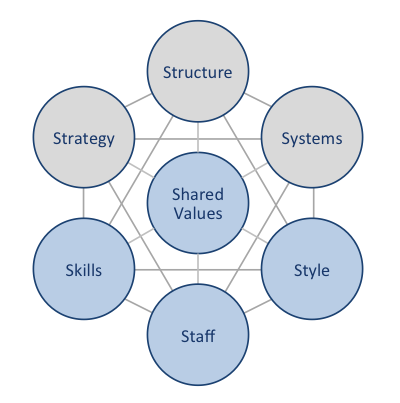
Red Bull McKinsey 7S framework explains how seven key elements of businesses can united to increase the overall effectiveness of the company. According to Red Bull McKinsey 7S framework strategy, structure and systems represent hard elements, whereas shared values, skills, style and staff are soft elements. As it is illustrated in figure below, shared values are positioned at the core of Red Bull McKinsey 7S framework, since shared values guide employee behaviour with implications in their performance. Red Bull McKinsey 7S Framework Hard Elements Strategy. Red Bull pursues the business strategy of product differentiation. The company differentiates its energy drinks according to the perception of ‘Red Bull gives you wings’. Specifically, according to the company’s marketing message, consumption of Red Bull energy drinks result in enhanced mental and physical performance. Benefiting from first mover advantage and an extensive reliance on marketing also represent important elements of Red Bull business strategy. Structure. Red Bull organizational structure can be described as divisional and company runs two business divisions: Red Bull soft drinks and other businesses. Red Bull soft drinks division comprises Red Bull Energy drinks (regular, sugar free, zero calories and Red Bull editions) and Red Bull Simply Cola. Other business division, on the other hand, comprises motor racing, media, MVNO and fashion online retailing. Systems. Main systems that run Red Bull GmbH include information system, HR system, financial system, quality management system and others. The management attempts to achieve a close integration between individual systems within the organization in order to increase the overall effectiveness of the company… Red Bull GmbH Report contains a detailed discussion of Red Bull McKinsey 7S framework. The report also illustrates the application of the major analytical strategic frameworks in business studies such as SWOT, PESTEL, Porter’s Five Forces, Value Chain analysis and on Red Bull.…
Strengths 1. Leadership in the global scale 2. Highly diversified product portfolio in food and beverage industry 3. Strategic relationships with other global brands such as Coca-Cola, Colgate Palmolive and General Mills 4. Advanced research and development capabilities 5. Benefits from the economies of scale due to the massive size of the business Weaknesses 1. Damage to brand image by CSR-related incidents 2. Lack of flexibility of the business due to its massive size 3. Challenges in terms of quality maintenance 4. Difficulty of sustaining competitive advantage Opportunities 1. Business diversification into other industries 2. International market expansion, primarily in Asia 3. Increasing nutritional value of foods 4. Further grow of the business via mergers and acquisitions Threats 1. Supermarkets and retailers developing own label products 2. Further increase of popularity of eating out 3. Threats of consumer food contamination 4. Increasing prices of raw food 5. Competition from local producers How to use the Nestle SWOT template above Expand each point above into one or more paragraphs with discussions and analysis. Additional points related to Nestle strengths, weaknesses, opportunities and threats not listed above can also be included if you think they are relevant points and add value to the work. You will need to support your arguments with references from reliable sources such as annual report of the company, industry journals and magazines and government publications. Your discussions will need to include statistical data and preferably charts and graphs with references to the sources.
By John Dudovskiy
Category: Food & Grocery
Strengths 1. High level of brand awareness 2. Effective integration of technology on the provision of exceptional customer services 3. High level of employee retention despite the large size of the business 4. Advanced service personalization Weaknesses 1. Debts of more than USD 9.1 billion 2. Damage to the brand image due to videotaping scandal involving Erin Andrews 3. Complexity of the business model 4. Operational costs are increasing Opportunities 1. Increasing presence in developing countries, particularly, China and India 2. Innovations in customer service provision 3. Formation of strategic alliances with other businesses in catering industry 4. Emergence of competitor vulnerabilities Threats 1. Stagnation of growth due to macroeconomic climate 2. Further intensification of competition 3. Decline in travel and hospitality industry due to the threat of terrorist attacks 4. Cases of customer negative experiences in Marriott spreading via socials media channels with negative effects on the brand image How to use the Marriott SWOT template above Expand each point above into one or more paragraphs with discussions and analysis. Additional points related to Marriott strengths, weaknesses, opportunities and threats not listed above can also be included if you think they are relevant points and add value to the work. You will need to support your arguments with references from reliable sources such as annual report of the company, industry journals and magazines and government publications. Your discussions will need to include statistical data and preferably charts and graphs with references to the sources.
By John Dudovskiy
Category: Catering
Strengths 1. A high level of brand awareness at a global scale 2. An effective and proven franchise system 3. Diversified menu 4. An effective marketing strategy Weaknesses 1. Burger King food is perceived to be unhealthy 2. High employee turnover due to low wages 3. Business model easily imitable 4. Low control of businesses due to franchise model Opportunities 1. Increasing nutritional value of food 2. Increasing presence in Asian markets 3. New product development 4. Engaging in business diversification Threats 1. Increase in prices of raw materials 2. Further intensification of competition 3. Shifts in consumer eating habits 4. Potential unrest among franchisees How to use the Burger King SWOT template above Expand each point above into one or more paragraphs with discussions and analysis. Additional points related to Burger King strengths, weaknesses, opportunities and threats not listed above can also be included if you think they are relevant points and add value to the work. You will need to support your arguments with references from reliable sources such as annual report of the company, industry journals and magazines and government publications. Your discussions will need to include statistical data and preferably charts and graphs with references to the sources.
By John Dudovskiy
Category: Catering
Strengths 1. Excellent brand reputation for high quality 2. Solid financial position 3. Regular substantial investments in research and development with positive outcome 4. Impressive product portfolio 5. Patent ownership for many safety features Weaknesses 1. Overly expense costs 2. Expensive service and maintenance 3. Lack of flexibility of the company due to its large size 4. Mercedes Benz is less popular among younger consumers compared to BMW Opportunities 1. Formation of strategic alliances in automobile industry 2. Increasing presence in emerging economies 3. Investing in development of hybrid and fuel-efficient cars 4. Engaging in mergers and acquisitions 5. Gaining new sources of competitive advantage via research and development Threats 1. Economic instability and crisis 2. Changes in government regulations impacting automobile industry 3. Further intensification of competition in the marketplace 4. Intensifying volatility in fuel prices 5. Car functionality issues resulting in recalls and damage to the brand image How to use the Mercedes Benz SWOT template above Expand each point above into one or more paragraphs with discussions and analysis. Additional points related to Mercedes Benz strengths, weaknesses, opportunities and threats not listed above can also be included if you think they are relevant points and add value to the work. You will need to support your arguments with references from reliable sources such as annual report of the company, industry journals and magazines and government publications. Your discussions will need to include statistical data and preferably charts and graphs with references to the sources.
By John Dudovskiy
Category: Automobile
Strengths 1. Attractive prices – cost leadership in the global hotel industry 2. A high level of brand awareness 3. Solid financial performance due to strong cost leadership competitive advantage 4. Advantages of crew certification, training and maintenance due to using a single aircraft family – the Airbus A319 and A320 5. Solid financial performance in Europe Weaknesses 1. Difficulty to compete with Ryanair on cost levels 2. Seasonality of earnings 3. Brand image damaged as a result of dispute between EasyJet founder Stelios Haji-Ioannou and the company’s management 4. The competitive advantage is difficult to sustain 5. Low number of departure airports Opportunities 1. Growth of budget airline’s market share due to increasing economic uncertainty in Europe 2. Opportunities for further cost reductions thanks to creativity and innovations 3. Greater concentration on business passengers 4. Further engagement in business diversification following the success of EasyHotel 5. Improvement of operating framework Threats 1. Decline in the quality of service due to the further pursuit of cost leadership 2. Decline of the business due to the threats of terrorist attacks 3. Airport price increases may compromise EasyJet competitive advantage 4. Emergence of new competitors with access to cheaper resources 5. The threat of labour unrest to protest against low wages
By John Dudovskiy
Category: Airline

Red Bull 7Ps of marketing explains how the company deals with individual elements of the marketing mix – product, place, price, promotion, process, people and physical evidence, in order to make its products more attractive to the target customer segment. Product. Red Bull product portfolio is highly focused and is limited to the following: Red Bull Energy Drink Red Bull Sugar Free Red Bull Zero Calories Red Bull Editions: tropical, blue and orange editions Red Bull Simply Cola The company also sells brand-related accessories, apparel, media products, headwear and gift ideas from its official website. The company has a history of launching unsuccessful products on a few occasions. For example, Red Bull Cola introduced in 2008 and Red Bull energy shots introduced the 2009 struggled to excite consumers and retailers, thus had to be discontinued in 2011.[1] Place. Red Bull is sold in more than 169 countries.[2] Red Bull sells its beverages via distributors and resellers such as supermarket chains, bars and restaurants and other outlets. The company does not use online sales channels to sell its beverages. However, online sales channel is used to sell brand-related products, accessories and gift-ideas. Red Bull offers a free delivery and refund for up to 30 days for these products. Price. Red Bull pricing strategy can be classified as premium pricing. Red Bull beverages are the most expensive in the energy drink market, as the company charges additionally for the psychological consumer perception of ‘Red Bull Gives You Wings’. Various Red Bull resellers such as supermarket chains, bars and restaurants and other outlets also apply psychological pricing strategy with use of Price Point Perspective (PPP) 0.99 Cents. Moreover, Red Bull pricing strategy also integrates various patterns of promotional and geographical pricing strategies… Red Bull GmbH Report contains a detailed discussion of…
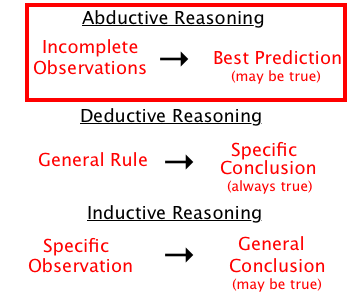
Abductive reasoning, also referred to as abductive approach is set to address weaknesses associated with deductive and inductive approaches. Specifically, deductive reasoning is criticized for the lack of clarity in terms of how to select theory to be tested via formulating hypotheses. Inductive reasoning, on other hand, criticized because “no amount of empirical data will necessarily enable theory-building”[1]. Abductive reasoning, as a third alternative, overcomes these weaknesses via adopting a pragmatist perspective. Feature Deductive Approach Inductive Approach Abductive Approach Starting point Existing theory Observations Unexpected observation or puzzle Purpose Test theory Develop theory Explain surprising phenomena Direction of reasoning General → specific Specific → general Interaction between theory and data Research methods Often quantitative Often qualitative Mixed methods often used Outcome Confirmation or rejection of theory Generation of theory Development of best possible explanation Comparison of research approaches The figure below illustrates the main differences between abductive, deductive and inductive reasoning: At the same time, it has to be clarified that abductive reasoning is similar to deductive and inductive approaches in a way that it is applied to make logical inferences and construct theories. In abductive approach, the research process starts with ‘surprising facts’ or ‘puzzles’ and the research process is devoted their explanation[2]. ‘Surprising facts’ or ‘puzzles’ may emerge when a researchers encounters with an empirical phenomena that cannot be explained by the existing range of theories. When following an abductive approach, researcher seeks to choose the ‘best’ explanation among many alternative in order to explain ‘surprising facts’ or ‘puzzles’ identified at the start of the research process. In the course of explaining ‘surprising facts’ or ‘puzzles’, the researcher can combine both, numerical and cognitive reasoning. Despite its increasing popularity in business studies, application of abductive reasoning in practice is challenging and you are advised to stick with traditional…
This portal offers reports containing the application of strategic analytical tools SWOT, PESTEL, Porter’s Five Forces Analysis, Value-Chain Analysis and McKinsey 7S Framework. Also our company reports include the analysis of business strategy, leadership practices, organizational structure, marketing strategy and company’s corporate social responsibility (CSR) programs and initiatives. An effective combination of academic qualifications and practical experience in the industry possessed by authors writing for this portal increases the relevance and quality of our company reports. You can access reports here. We produce new reports regularly. Please let us know about the companies you are interested in and tell us which companies we should analyse in our new reports here.