
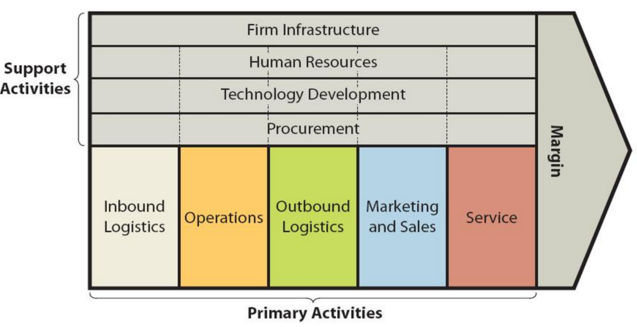
Value chain analysis is an analytical tool used to identify the ways in which businesses create value for customers. The essence of value chain analysis is illustrated in Figure 1 below: Figure 1. PepsiCo Value chain analysis Primary Activities Inbound logistics PepsiCo portfolio comprises 22 brands including Pepsi-Cola, Tropicana, Gatorade, Mountain Dew and Diet Pepsi and each brand belonging to PepsiCo generated at least one billion USD in retail sales in 2015.[1] Inbound logistics practices of each brand within PepsiCo portfolio reflect the nature and quantity of raw materials used, the proximity between the location of suppliers and manufacturing plant and other set of factors. The economies of scale can be specified as the main source of value for PepsiCo derived from inbound logistics primary activity. PepsiCo also benefits from locating its production sites within close geographical proximity to the main sources of raw materials in order to save on transportation costs. Technology is another driver of innovation that provides advantage to PepsiCo’s supply chain. One of the innovations that PepsiCo is exploring is 3D printing. For example, RUFFLES® Deep Ridged used 3-D printing technology to create optimal potato chip prototypes.[2] Operations PepsiCo operations are divided into the following the following six operational segments: Frito-Lay North America (FLNA). This segment engages in manufacturing, marketing, distributing and selling branded snack foods. Quaker Foods North America (QFNA). This segment is assigned with producing, marketing, distributing and selling cereals, rice, pasta and other branded products. Latin America segment produces markets, distributes and sells a several snack food brands for Latin American market. These brands include Doritos, Cheetos, Marias Gamesa, Ruffles, Emperador, Saladitas,Sabritas, Lay’s, Rosquinhas Mabel and Tostitos. Asia, Middle East & North America (AMENA). AMENA segment makes, markets, distributes and sells a number of leading snack food brands including Lay’s, Kurkure, Chipsy, Doritos, Cheetos and…
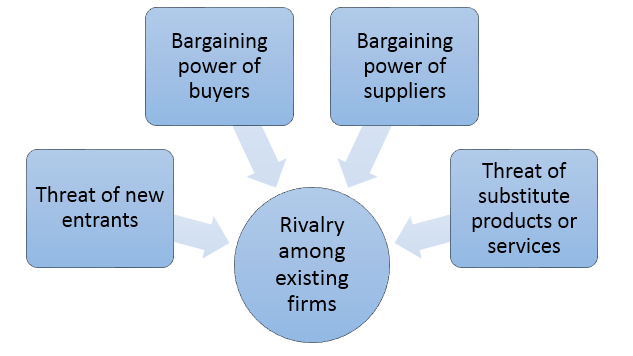
Porter’s Five Forces analytical framework developed by Michael Porter (1979)[1] focus upon five separate forces that shape the overall intensity of competition in the industry. These forces are represented in Figure 1 below: Figure 1. PepsiCo Porter’s Five Forces Bargaining power of PepsiCo suppliers is insignificant. The main ingredients used by PepsiCo to produce its beverages, food and snacks include apple, orange and pineapple juice and other juice concentrates, aspartame, corn, corn sweeteners, flavorings, flour, grapefruit and other fruits, oats, oranges, potatoes, raw milk, rice, seasonings, sucralose, sugar, vegetable and essential oils, and wheat [2] PepsiCo purchases from a large number of suppliers and the bargaining power of each individual supplier is low due to the lack of uniqueness of products supplied. Furthermore, high level of importance for each supplier to have business with PepsiCo and PepsiCo’s ability to switch suppliers can be specified as important factors that reduce PepsiCo supplier bargaining power. Rivalry among existing firms is highly intensive. Beverage, food and snack manufacturing industry is highly competitive. The major brands competing with PepsiCo include but are not limited to The Coca Cole Company, DPSG, Kellogg Company, The Kraft Heinz Company, Mondelez International Inc., Monster Beverage Corporation, Nestlé S.A., Red Bull GmbH and Snyder’s-Lance, Inc. The Coca Cola Company is PepsiCo’s primary competitor and the US market share of these two brands amount to 20 per cent and 24 per cent respectively.[3] On the global scale, on the other hand, Coca-Cola has a leadership position with a market share of about 48.6 per cent compared to PepsiCo’s market share of 20.5 per cent (see Figure 2 below). Figure 2. Market share of carbonated beverages worldwide as of 2015[4] Threat of substitute products for PepsiCo is significant. The range substitutes for PepsiCo’s beverage products include tea, coffee, tap water and a…
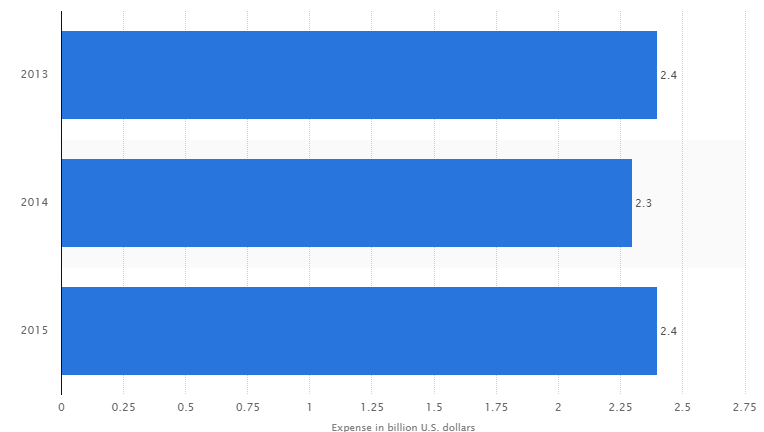
PepsiCo marketing strategy integrates a set of elements of the PepsiCo marketing communication mix as discussed further below. In 2015, PepsiCo increased its spending on advertising and marketing as a percentage of sales by 40 basis points.[1] PepsiCo marketing strategy benefits from the application of creativity and strategic collaborations. For example, in 2015 Lay’s collaborated with renowned artist Malika Favre to develop iconic illustrations for special edition packaging, promotions and activations as part of the brand’s global summer campaign.[2] PepsiCo marketing strategy also relies on celebrity endorsement to a considerable extent. The list of celebrities involved in spreading PepsiCo’s marketing message include but not limited to Usher and Serena Williams, as well as Vine and Snapchat sensation Jerome Jarre.[3] Advertising PepsiCo uses print and media advertising extensively as a traditional channel to transmit the marketing message to the target customer segment. PepsiCo print and media advertising occasionally contains comparative campaigns aimed at damaging the brand image of its main competitor – The Coca Cola Company. For example, “One ad shows a happy Pepsi drinker mocking a Coke buyer by telling him, “you’ve still got the polar bear.”[4], thus mocking Coca Cola’s the Christmas Polar Bear campaign. As it is illustrated in Figure 3 below, although the amount of PepsiCo’s advertising budget did not change significantly during the last three years, the pattern of distribution of this budget has changed. Specifically, taking into account the increasing integration of social media into personal lives of billions of customers around the globe, the company is increasingly investing its advertising dollar for social media advertisements. PepsiCo’s advertising budget As a result, PepsiCo has been able to launch a series of successful viral marketing campaigns with an evident positive implications on the brand image. For example, Pepsi Max Test Drive Prank viral video launched in…
PepsiCo 7Ps of marketing comprises seven elements of the marketing mix. These are product, place, price, promotion, process, people and physical evidence. Product. PepsiCo sells a wide range of beverages, foods and snacks under 22 different brands that include Pepsi-Cola, Lay’s, Mountain Dew, Gatorade, Tropicana, Diet Pepsi, 7UP, Doritos and other internationally famous names[1]. Although, PepsiCo senior management led by Chairman and CEO Indra Nooyi does stress the direction of the strategy towards healthy products, the majority of products within PepsiCo portfolio are beverages high in sugar and food and snacks high in salt. PepsiCo products are attractively packaged with colorful designs and they are readily available in many supermarkets and grocery stores around the globe. PepsiCo product portfolio also includes brand-related accessories, drink gears and a limited range of other products related to specific brands. However, it is important to note that the sales of these accessories account for only a small fraction of the total revenues. Place. PepsiCo products are sold in more than 200 countries and territories around the world.[2] Consumers can purchase PepsiCo products from supermarkets, mini-markets and grocery stores of various formats, restaurants and fast food restaurant chains. The company increasingly focuses on fast-food chains in order to achieve a greater level of market penetration. In 2015 alone, more than 5,000 Subway locations were added to its customer portfolio across Canada, the UK, the Netherlands and India.[3] PepsiCo does not use online sales channels to sell its food, snacks and beverages. However, PepsiCo food, snacks and beverages can be purchased online from the websites of major supermarket chains along with other products. The use of online sales channels by PepsiCo is limited to brand-related accessories, drink gears and a limited range of other products related to specific brands. Price. PepsiCo pricing strategy is market-orientated and…
PepsiCo Inc. is a US-based global food, snack and beverage company that was incorporated in Delaware in 1919 and reincorporated in North Carolina in 1986. Today, PepsiCo brand portfolio includes a range of globally famous brand names such as Pepsi, Lays, Lipton, Doritos, Tropicana, Walkers, Miranda, Cheetos and others. In total, PepsiCo portfolio comprises 22 brands and each of these brands have generated at least one billion USD in retail sales in 2015. Products belonging to PepsiCo portfolio are consumed about one billion times each day in more than 200 countries and territories. PepsiCo’s mission statement is formulated as “to provide consumers around the world with delicious, affordable, convenient and complementary foods and beverages from wholesome breakfasts to healthy and fun daytime snacks and beverages to evening treats” The company employs 263,000 people globally, including approximately 110,000 people within the United States.In 2015, PepsiCo achieved 5 per cent organic revenue growth with a cash flow of more than USD 8.1 billion. About 53 per cent of net revenues were generated from food business, whereas net revenues generated from the beverage businesses amounted to 47 per cent. PepsiCo has major impact in the US economy. The company has been acknowledged as the Number One contributor to retail sales growth in the U.S. in 2015, generating more growth than the next 15 largest food and beverage manufacturers combined. PepsiCo Report contains the application of the major analytical strategic frameworks in business studies such as SWOT, PESTEL, Porter’s Five Forces, Value Chain analysis and McKinsey 7S Model on PepsiCo. Moreover, the report contains analyses of PepsiCo’s business strategy, leadership and organizational structure and its marketing strategy. The report also discusses the issues of corporate social responsibility. 1. Introduction 2. Business Strategy 3. Leadership and Organizational Structure 4. SWOT Analysis 4.1 Strengths 4.2 Weaknesses…
PepsiCo leadership of six divisions have nearly 140 years of combined PepsiCo experience across multiple categories, markets and functions[1]. PepsiCo Board of Directors comprises 15 members with Indra K. Nooyi serving as Chairman of the Board and Chief Executive Officer. The name of Indra Nooyi is on every list of top female leaders around the globe and she is widely acknowledged as a charismatic and effective corporate leader. PepsiCo leadership can be assessed as strong and dynamic and this has been reflected on strong financial performance of the company over the years. Despite an evident effectiveness of PepsiCo leadership, a lack of clarity on CEO succession plan can be specified as a noteworthy issue. Specifically, a number of reputable members of senior management team and rising starts have been leaving PepsiCo recently. These include the departure of Enderson Guimaraes executive vice president for Global Categories and Operations, the Pepsi President John Compton, former nutrition head Debra Crew and former president Zein Abdalla. It has been noted that “when questioned about the string of high-level departures, PepsiCo has consistently pointed to its status as a well-known supplier of executives to other companies, a talent factory of sorts”.[2] Nevertheless, this tendency may cause CEO-succession-related problems in long-term perspectives. PepsiCo organizational structure can be described as divisional and it integrates the following divisions: Frito-Lay North America (FLNA). Quaker Foods North America (QFNA). Latin America Asia, Middle East & North America (AMENA). Europe & Sub-Saharian Africa (ESSA). North America Beverages (NAB). Each division is led by a divisional CEO, who report to PepsiCo CEO and Chairman Indra K. Nooyi. Besides divisional CEOs, PepsiCo leadership team comprises the following positions: Executive Vice President, Communications President, North America Nutrition Senior Vice President, Chief HR officer for Human Capital Management Services and Operations Senior Vice President and…
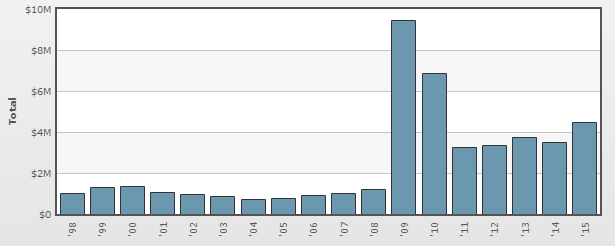
Changes in external environment might affect organizational performance in direct and indirect manners; therefore they need to be taken into account in strategic planning. PepsiCo PESTEL analysis can be highlighted as the most appropriate strategic analytical tool for specifying and categorizing external factors impacting businesses. Political Factors Government stability in the USA and other countries selling PepsiCo products is a major political factor for the company. PepsiCo is also impacted by bureaucracy, trade unions, corruption, home market lobbying, the freedom of press and a range of other political factors either directly or indirectly. PepsiCo actively attempts to influence political factors to benefit its business via its lobbying initiatives. As it is illustrated in figure below, the amount of money PepsiCo spends annually for lobbying has increased more than six-fold during the last ten years to reach USD 4.47 million in 2015. PepsiCo uses a set of lobbying firms such as Russell Group, FTI Government Affairs, Duberstein Group and Covington and Burling[1] to secure its interests via political channels. PepsiCo’s annual lobbying budget[2] Economic Factors Economic factors impacting PepsiCo include rise of inflation and unemployment in the USA. Rising prices of raw materials have to be mentioned as another significant economic factor. Additionally, changes in income levels of current and perspective PepsiCo consumers can be highlighted as a substantial economic factor that impacts the business. Strong USD against other major world currencies is one of the most significant economic factors directly impacting the amount of profit reported by PepsiCo. For example, in quarter 1, 2016, PepsiCo’s total sales declined by 3 per cent to USD 11.86 billion, the sixth straight quarter of decline partially caused by a strong dollar.[3]… PepsiCo Inc. Report contains the full discussion of PepsiCo PESTEL analysis. The report also illustrates the application of the major analytical strategic frameworks…

SWOT analysis is one of the most popular strategic analytical tools that used for strategic decision making. The acronym stands for strengths, weaknesses, opportunities, and threats associated with a particular business. PepsiCo SWOT analysis is presented on table below: Strengths 1. Large, yet focused brand portfolio in food, snack and beverage industry. 2. Strong leadership from CEO Indra Nooyi 3. High level of customer loyalty for most of the brands within product portfolio 4. Extensive experiences in mergers and acquisitions 5. Integrated supply-chain and distribution practices across PepsiCo brands Weaknesses 1. Overdependence on domestic market in the USA 2. High level of dependence on large supermarkets such as Wal-Mart 3. “Aquafina” tap water scandal and product recall cases 4. PepsiCo brand perceived as ‘unhealthy’ 5. No presence outside of food, snack and beverage industry Opportunities 1. Improving health implications of products 2. Business diversification into other industries 3. Increasing presence in emerging economies 4. Increasing the effectiveness of CSR strategy 5. Focusing on research and development Threats 1. Intensification of competition 2. Rapid decline in the sales of carbonated drinks 3. New product recalls due to quality scandals 4. High amounts of sugar or salt in products being criticized by government and non-government health organizations PepsiCo SWOT analysis Strengths 1. PepsiCo portfolio is large and it comprises 22 brands in food, snack and beverage industry.[1] Despite the large number of companies it contains, PepsiCo product portfolio can be described as highly focused because of the uniformity of product positioning across the whole portfolio. According to marketing messages, the consumption of all products within PepsiCo portfolio is associated with being active and dynamic and enjoying life to the full extent. Such a uniformity in product positioning provides significant advantages to PepsiCo in terms of promoting its products in an efficient manner despite…

PepsiCo mission statement has been worded by CEO Indra Nooyi as ‘Performance with Purpose’ and this principle is closely integrated with the strategic direction chosen for the company. The most prominent aspects of PepsiCo business strategy are based on the following six principles: First, achieving growth through mergers and acquisitions (M&A). M&A can offer the advantages of gaining access to competencies and infrastructure, reducing direct costs and overheads and achieving organic growth. Recently, PepsiCo has completed as a set of important acquisitions such as acquisition of juice and diary businesses Lebedyansky and Wimm-Bill-Dann in Russia, Lucky snacks and Mabel cookies in Brazil, and Dilexis cookies in Argentina. M&A can be specified as one of the cornerstones of PepsiCo business strategy. As a result of an aggressive pursuit of this strategy, today PepsiCo portfolio comprises 22 brands and each of these brands have generated at least one billion USD in retail sales in 2015.[1] Second, forming strategic alliances in the global scale. Specifically, strategic partnerships have been formed with Tingyi in China in order to claim a share in growing beverage market in China. Moreover, formation of a joint-venture with Tata in India to enhance drinking water manufacturing capabilities, and initiation of strategic partnership with Almarai in Saudi Arabia can be mentioned to illustrate PepsiCo’s adoption of strategic alliances as an integral part of the corporate strategy. Important strategic alliances are formed by PepsiCo at home markets as well. Specifically, by forming a strategic alliance with Starbucks – a global coffee house chain, PepsiCo has been able to claim its share from increasing energy drink market segment. Third, focusing on emerging markets. An aggressive pursuit of this strategy has had positive impact on the bottom line. The year of 2015 witnessed a double-digit growth in the sales of snacks in China and…
PepsiCo Inc. is a US-based global food, snack and beverage company that was incorporated in Delaware in 1919 and reincorporated in North Carolina in 1986. Today, PepsiCo brand portfolio includes a range of globally famous brand names such as Pepsi, Lays, Lipton, Doritos, Tropicana, Walkers, Miranda, Cheetos and others. In total, PepsiCo portfolio comprises 22 brands and each of these brands have generated at least one billion USD in retail sales in 2015. Products belonging to PepsiCo portfolio are consumed about one billion times each day in more than 200 countries and territories (Annual Report, 2015). PepsiCo’s mission statement is formulated as “to provide consumers around the world with delicious, affordable, convenient and complementary foods and beverages from wholesome breakfasts to healthy and fun daytime snacks and beverages to evening treats” The company employs 263,000 people globally, including approximately 110,000 people within the United States. In 2015, PepsiCo achieved 5 per cent organic revenue growth with a cash flow of more than USD 8.1 billion. About 53 per cent of net revenues were generated from food business, whereas net revenues generated from the beverage businesses amounted to 47 per cent (Annual Report, 2015). PepsiCo has major impact in the US economy. The company has been acknowledged as the Number One contributor to retail sales growth in the U.S. in 2015, generating more growth than the next 15 largest food and beverage manufacturers combined. PepsiCo Report contains the application of the major analytical strategic frameworks in business studies such as SWOT, PESTEL, Porter’s Five Forces, Value Chain analysis and McKinsey 7S Model on PepsiCo. Moreover, the report contains analyses of PepsiCo’s business strategy, leadership and organizational structure and its marketing strategy. The report also discusses the issues of corporate social responsibility. 1. Introduction 2. Business Strategy 3. Leadership and Organizational Structure…